Review cycles
Performance review process: a step-by-step annual cycle for HR teams
How to run the whole performance review process across a year: seven steps from goal setting to pay and development, an editable month-by-month calendar, a RACI for HR, managers and employees, the points where cycles usually break and a checklist to download.
By the CLEAR Talent team17 min read
Key takeaways
- The performance review process is a year-long cycle: goals, check-ins, a mid-year review, self-evaluation, manager review, calibration, then communication, pay and development.
- Move the dates to fit your year but keep the order: inputs before drafts, drafts before calibration, calibration before anyone hears a rating.
- Give every step one accountable owner. HR runs the process, managers own the ratings and a senior leader signs off the final set.
- If ratings feed pay, agree the rule before calibration and hold the pay conversation after the review conversation.
Most HR teams can describe their performance review as a form and a meeting. Fewer can describe the process around it: when goals are set, what happens at mid-year, who writes what before the year-end conversation, when ratings are calibrated and how they reach pay. Those gaps, rather than the form itself, are where review cycles usually come apart.
This guide sets out the performance review process as one annual cycle. It covers the seven steps in order, an editable month-by-month calendar for a January to December year, a RACI showing what HR, managers, employees and senior leaders each own, the points where cycles usually break and a checklist you can download. Each section links to the guide that covers its step in depth.
What the performance review process covers
The performance review process is the sequence of steps an organisation follows to agree expectations with each employee, track progress against them through the year, assess the result and act on it. The year-end meeting is one step in that sequence. Most of what decides whether that meeting is fair happens in the months before it.
Before you draw up a calendar, decide what the cycle has to produce. Most produce some mix of four things: a record of results against goals, an assessment of how the work was done, a decision on pay or progression, and a development plan. Each needs its own evidence and its own owner. When one forty-minute meeting is expected to deliver all four, the development plan is usually the one that gets dropped.
Then choose the cadence. A common pattern, and the one this guide uses, is one formal year-end review, a lighter mid-year review, quarterly goal check-ins and monthly 1-on-1s in between. If you run two equal reviews a year, or a quarterly cycle, the steps stay the same; only the spacing changes.
Guide: what is performance management? The full process and cycle
The performance review process in seven steps
The order matters more than the dates. Each step produces something the next one depends on, so a step that runs late delays everything after it.
Set goals and expectations
Each employee agrees three to five goals with their manager at the start of the year, each linked to a team or company priority, and both confirm the competencies the role will be assessed against. Aim to finish in January: goals agreed in March leave a quarter of the year unmeasured.
Check in through the year
Monthly 1-on-1s and quarterly goal check-ins keep goals current and build the evidence the review will need. When priorities move, the goal is changed in writing, so nobody is assessed in December against work that was cancelled in May.
Hold a mid-year review
A shorter, lower-stakes conversation halfway through the year about progress, what needs to change and how development is going. It is the last comfortable point to raise a concern, so that nothing at year end comes as a surprise.
Gather the self-evaluation and feedback
Before managers draft anything, employees assess themselves against each goal and competency with specific examples, and peer or 360 feedback is collected where the organisation uses it. Input that arrives after the manager’s draft is rarely read properly.
Write the manager review
The manager drafts ratings for goals and competencies on the published scale, citing evidence for each. At this stage a rating is a proposal, not a decision, and it is not shared with the employee.
Calibrate and sign off
Managers compare their draft ratings against one standard, outliers first, with HR facilitating. Every changed rating is recorded with its reason, and an approving leader signs off the final set so it does not move once conversations begin.
Communicate, decide pay and plan development
Managers hold the review conversation and share the written review. Where ratings feed pay, decisions follow a rule agreed in advance, and every employee leaves the cycle with next year’s goals and two or three development actions.
Free review form templates: self-assessment, 360 feedback, manager and annual review
A month-by-month performance review calendar
This calendar assumes a performance year that runs from January to December, with final ratings locked before the December break and review conversations in January. Download it as a CSV, change the months and owners to fit your organisation, and publish it before the year starts so every manager works to the same dates.
Editable timeline
Annual performance review calendar, January to December
| Month | What happens | Who leads | What exists at the end |
|---|---|---|---|
| Q1: set direction | |||
| January | Last year’s review conversations; this year’s goals agreed | Managers and employees | Written reviews shared; three to five goals per person |
| February | Pay decisions, where ratings feed pay; development plans agreed | HR and senior leaders; managers | Pay outcomes recorded with reasons; a plan per person |
| March | First quarterly goal check-in | Managers and employees | Goals confirmed, revised or closed in writing |
| Q2: check progress | |||
| April | Check that 1-on-1s are happening; feedback refresher for managers | HR | A list of anyone without a regular 1-on-1 |
| May | Mid-year set-up: template, dates and manager briefing | HR | A published mid-year timeline |
| June | Second quarterly check-in; mid-year reflections open | Employees, then managers | A short written reflection per person |
| Q3: reset and keep the record | |||
| July | Mid-year conversations; goals reset | Managers | Revised goals and updated development actions |
| August | No new stages; 1-on-1s and journal notes continue | Managers | Evidence recorded as it happens |
| September | Third quarterly check-in; year-end design drafted | Managers; HR | Goal status at three quarters; a draft scale, template and timeline |
| Q4: review, calibrate and decide | |||
| October | Year-end design approved; managers briefed; employees told how ratings are used | HR, approved by senior leaders | A timeline with one owner per stage |
| November | Self-evaluations and 360 feedback close, then manager drafts | Employees, peers, then managers | Draft ratings with the evidence behind them |
| December | Calibration and sign-off; review conversations prepared | Managers, HR facilitating; approving leader | Final ratings locked before the break |
Built for a January to December performance year. If yours runs from April to March, move every row three months later; the order stays the same.
January and February belong to two cycles at once: they close last year’s review and open this year’s goals. Keep them in that order. Goals agreed before anyone has discussed the review outcome tend to carry last year’s problems forward instead of learning from them.
November carries the most risk of slippage. Self-evaluations, peer feedback and manager drafts all compete for the same few weeks, so give each its own closing date, in that order, and resist extending the first two. A late input pushes the drafts into December and squeezes calibration up against the holidays.
Guide: the year-end performance review checklist, week by week
Who does what: a RACI for HR, managers and employees
A RACI matrix names four roles for every step: who does the work (responsible), the single role that owns the outcome and signs it off (accountable), who gives input before it is done (consulted) and who is told afterwards (informed). Publish it with the calendar, so that nobody discovers in November that they owned a step.
RACI matrix
Performance review RACI for HR, managers, employees and senior leaders
| Step | HR | Managers | Employees | Senior leaders |
|---|---|---|---|---|
| Plan | ||||
| Set company priorities for the year | C | I | I | R/A |
| Design the cycle: scale, template and dates | R | C | I | A |
| Agree individual goals | I | A | R | — |
| Monitor | ||||
| Hold 1-on-1s and quarterly goal check-ins | I | R/A | R | — |
| Mid-year reflection and conversation | C | R/A | R | — |
| Review | ||||
| Self-evaluation | I | I | R/A | — |
| 360 or peer feedback, where used | C | A | R | — |
| Manager review and draft rating | C | R/A | C | — |
| Calibration | R | R | — | A |
| Sign-off of final ratings | R | I | — | A |
| Act on the outcome | ||||
| Review conversation and written review | I | R/A | C | — |
| Pay and promotion decisions | R | C | I | A |
| Development plan and next year’s goals | C | A | R | — |
| Review the process before the next cycle | R | C | C | A |
R = responsible, A = accountable, C = consulted, I = informed, — = not involved. Rename the roles to fit your organisation, but keep one A in every row.
Two rows settle most of the arguments. HR is responsible for calibration but not accountable for the ratings: HR prepares the evidence and runs the meeting, while managers own their ratings and a senior leader signs off the final set. Once HR starts deciding ratings, managers stop explaining them to their teams.
Employees, for their part, are accountable for their own self-evaluation and do most of the work on their goals and development plan, with the manager approving both. That is a fair expectation only if they were told at the start of the year how each will be used.
Goal setting and the check-ins that keep goals current
Goals are the yardstick for the whole year, so they deserve its first few weeks. Agree three to five per person, each linked to a team or company priority and weighted so the most important one counts most. Ask employees to draft their own and managers to approve or adjust them: a goal the employee wrote is one they can explain.
Put the check-ins in the calendar before the year begins. The monthly 1-on-1 is where progress, blockers and feedback are discussed while they can still change something. The quarterly check-in is where the goal itself is confirmed, revised or closed. Record every change in writing, and assess people against the revised goal rather than the January version.
Adjust goals for periods of leave and reduced hours too, so that nobody is assessed on time they were not at work. That is easy to agree at the March or June check-in and much harder to settle in December.
See 1-on-1s, goal check-ins and the performance journal in CLEAR Talent
The mid-year review: a reset, not a rehearsal
The mid-year review exists to change the second half of the year. Keep it shorter than the year-end review, and consider leaving it unrated: a mid-year rating tends to anchor the year-end one, and the conversation drifts into negotiating the number rather than the next six months.
Three questions cover it. What has been delivered against each goal, and does each goal still make sense? What needs to change, in the goals, the support or the way the work is done? And how is the development plan going? Ask the employee for a short written reflection first, so the conversation starts from their view of the first six months.
If performance is falling short, this is the point to say so plainly, with examples and agreed support. A concern first raised at year end has had no chance to be put right, and it is much harder to defend later.
Guide: quarterly performance review template, agenda and check-in questions
Self-evaluation and 360 feedback: gather the inputs first
The self-evaluation is the employee’s account of the year against the same goals and competencies the manager will assess. Open it at least two weeks before manager drafts are due, ask for specific examples rather than adjectives, and say in advance how it will be used: whether the manager reads it before drafting, and whether the calibration group sees it.
If you use 360 or peer feedback, run it in the same window. Ask each group of raters only about what they can observe, set a minimum number of responses before any group’s results are shown, and close it on the same date as the self-evaluation. Feedback that arrives after the manager has drafted a rating is either ignored or forces a rewrite.
Both inputs widen the evidence; neither replaces the manager’s judgement. A self-evaluation that disagrees with the manager is useful in its own right, because it shows where the review conversation needs to spend its time.
The manager review and the rating scale
The manager review turns a year of evidence into a rating, and it can only be as consistent as the scale behind it. Publish the scale before the cycle opens, with every level defined in words and an example of performance at that level. Until somebody writes down what ‘meets expectations’ means, each manager supplies their own definition.
Ask managers to rate goals and competencies separately, combine them by a written rule, and cite evidence from across the whole period for each rating. If there is nothing on record from the first half of the year, that gap is worth knowing before calibration rather than after it.
Keep drafts private until calibration is finished. Once an employee has heard a rating, changing it costs the manager credibility, and the calibration meeting turns into a discussion about how to explain a change rather than whether the rating fits the evidence.
Guide: performance rating scales explained, with sample definitions for each level
Calibration and sign-off
Calibration is the step that makes ratings comparable across managers, and it has to sit between the manager’s draft and the final rating. Managers present their proposed ratings with the evidence behind them, the group starts with the highest and lowest ratings and the largest changes since last year, and every changed rating is recorded with its reason. HR prepares the pack and facilitates; the decision stays with the managers and the approving leader.
A rating distribution is a useful diagnostic in that room. If one team’s ratings sit well above every other team’s, ask why. Used as a quota, the same distribution turns calibration into an allocation exercise and teaches managers to open with inflated ratings so they have something to concede.
Close with sign-off. Name who approves the final set and by when, and treat any change after that as a documented exception. The review conversations that follow need a final decision behind them, not a provisional one.
Communicating outcomes and linking ratings to pay
How outcomes are communicated, and when pay enters the conversation, largely decides whether people trust next year’s cycle.
Plan communication in three waves. Before the year-end review opens, tell employees how the cycle runs, what each rating level means and what ratings will be used for. After sign-off, brief managers on the final ratings, any changes made in calibration and how to explain them. Then managers hold each review conversation and share the written review, followed by written confirmation of any pay outcome where your policy requires it.
If ratings feed pay, agree the rule that links them before calibration starts: which ratings make someone eligible for an increase or bonus, how much outcomes can vary within a rating and who approves exceptions. Settling the rule first keeps the calibration discussion on evidence rather than on the budget.
Hold the pay conversation a week or two after the review conversation where you can; a conversation that opens with a number rarely reaches development. Record the reason for every pay outcome. Directive (EU) 2023/970 on pay transparency expects the criteria used for pay progression to be objective and gender-neutral, and where ratings feed pay, the review criteria become part of them. Check how your country has transposed it.
Finish with development. Agree two or three development actions, each with an owner and a date, alongside next year’s goals, and build both on what the review found.
Guide: the EU Pay Transparency Directive and performance reviews
Where the performance review process usually breaks
Most review cycles fail at a handover between steps rather than inside one. These are the points to check before the year starts.
- Goals set too late
- Goals agreed in March or April leave the first quarter unmeasured, and the year-end review ends up assessing work nobody planned. Finish goal setting in January, even if some goals are provisional and revisited at the first check-in.
- A mid-year review that quietly disappears
- When the mid-year review is cancelled for a busy quarter, the year-end review becomes the first real conversation since January. Hold a short mid-year review rather than none.
- Inputs that close after the drafts
- Self-evaluations and 360 feedback that are still open when manager drafts are due get skimmed or ignored. Close the inputs first, then open the drafts.
- Ratings shared before calibration
- A manager who has already told someone their rating will defend it in calibration rather than test it. Keep drafts private until the final set is signed off.
- The budget deciding the rating
- When the pay budget is known and no rule links ratings to pay, ratings tend to drift towards whatever the budget allows. Agree the rule first and calibrate against the evidence.
- Steps nobody owns
- A deadline that belongs to everyone is chased by no one. Publish the RACI alongside the calendar, with one accountable role for every step.
- Joiners, leavers and long absences
- People who joined mid-year, changed role or spent months on leave need adjusted goals and review periods. Decide the rule before the cycle opens rather than case by case in December.
- A cycle that stops at the rating
- If the process produces ratings but no goals, development actions or follow-up, employees conclude that it is administration. Close every review with next year’s goals and two or three development actions.
Performance review process checklist
Work through it before the year starts and again before the year-end review opens. Download it to track owners and dates in your own spreadsheet.
Checklist
Performance review process checklist
| Task | Owner | Done by |
|---|---|---|
| Before the year starts | ||
| Purpose agreed: what ratings will and will not decide | Senior leaders | Before January |
| Rating scale published, with every level defined in words | HR | Before January |
| Calendar published, with a date for every stage | HR | Before January |
| RACI published, with one accountable role per step | HR | Before January |
| Rule agreed for joiners, leavers and long leave | HR | Before January |
| Through the year | ||
| Monthly 1-on-1s held for every employee | Managers | Monthly |
| Quarterly goal check-ins held and changes recorded | Managers and employees | March, June, September |
| Goals adjusted for leave and role changes | Managers | At each check-in |
| Mid-year reflections and conversations completed | Employees and managers | June–July |
| Year-end review | ||
| Managers briefed; employees told how ratings are used | HR | October |
| Self-evaluations and 360 feedback closed before drafts are due | Employees and peers | November |
| Draft ratings cite evidence from the whole year | Managers | November |
| Calibration held, every change recorded with its reason | Managers, HR facilitating | December |
| Final ratings signed off and locked | Approving leader | December |
| Closing the cycle | ||
| Review conversation held and written review shared | Managers | January |
| Three to five weighted goals agreed for the new year | Managers and employees | January |
| Two or three development actions agreed, with owners and dates | Managers and employees | February |
| Pay decisions made by the agreed rule and recorded | HR and senior leaders | February |
| Process reviewed: completion, rating spread, calibration changes | HR | March |
Dates assume a January to December performance year. Move them if yours differs, but keep the order.
Template: a performance management policy that puts these rules in writing
Where CLEAR Talent fits
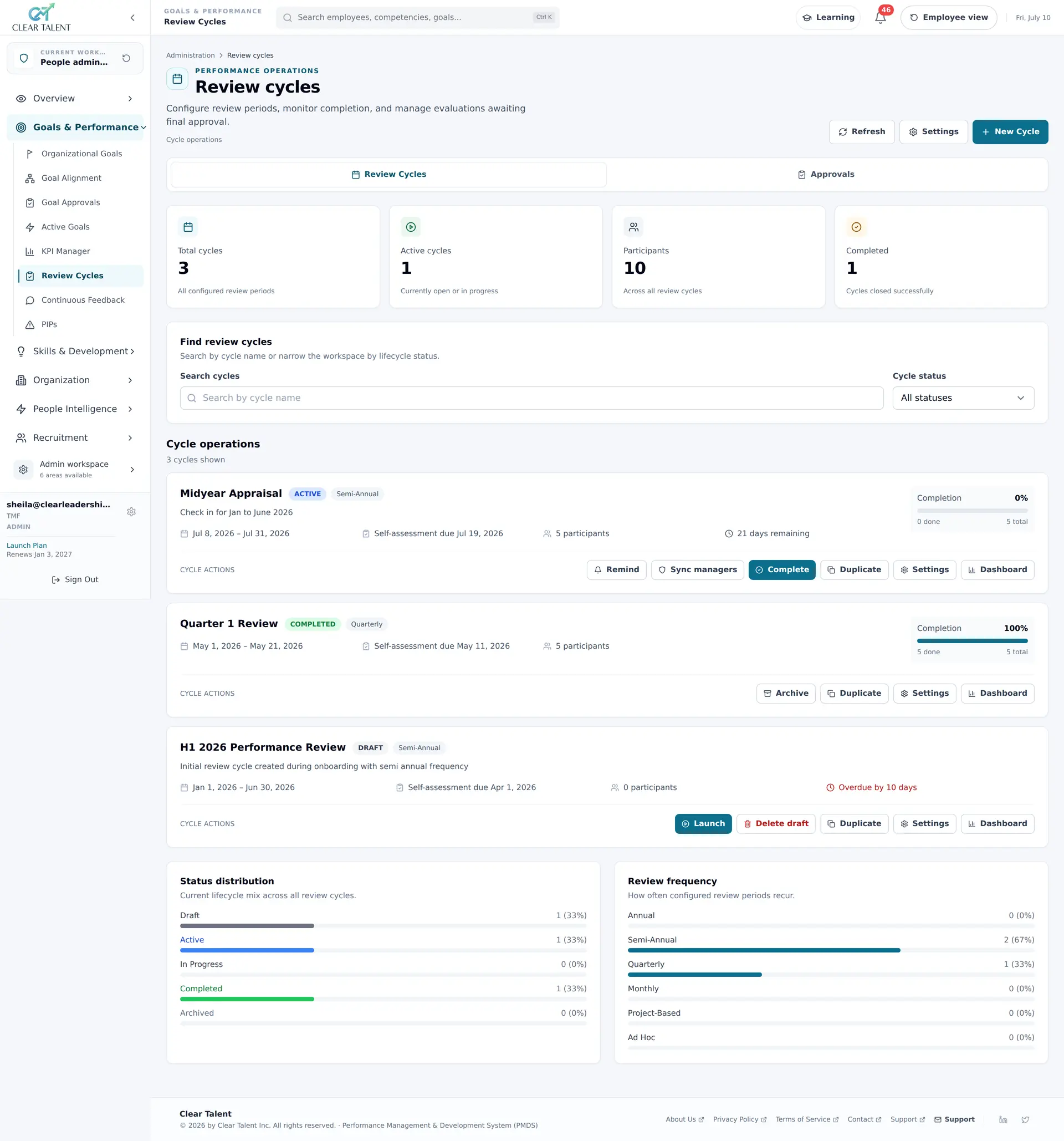
CLEAR Talent runs each review, whether mid-year, year-end or quarterly, as its own cycle with a configurable template. Every stage, from self-assessment through manager review and calibration to the final rating, opens and closes on the dates you set, with automated reminders along the way. Strategic Linked Goals cascade company objectives to individual goals, goals employees draft go to their manager for approval, and goal scores roll up into the review without re-entry.
Between reviews, managers schedule 1-on-1s from their own schedule, which flags anyone without a next session booked; goal check-ins flag goals that are falling behind; and the performance journal records evidence tagged to competencies as it happens. At calibration, heatmaps and outlier flags show where managers have read the scale differently, forced distribution is an optional simulation rather than a rule, and every rating change is written to the audit log. Once a manager releases a review, the employee sees their competency ratings and every narrative section, and reviews export to PDF or Excel.
CLEAR Talent holds performance and development data, not payroll, so pay decisions stay in your own pay process: final ratings export to Excel on every plan for whoever runs the pay review.