Continuous Performance Management, Done Properly
The annual review was designed for the industrial age. Continuous performance management is designed for now — where projects change quarterly, teams reshape monthly, and feedback needs to be in the moment to matter. CLEAR Talent gives you the best of both: always-on coaching with the audit trail and calibration rigour you still need.
- Check-ins on iOS & Android
- Mobile-first
- Year-end consolidation
- Automated
- Feedback flow
- Always-on

Why annual reviews fail
Annual reviews collapse 12 months of performance into a single conversation, usually remembered through recency bias. Feedback is stale. Goals are obsolete.
And managers avoid hard conversations because they happen once a year under high stakes.
The four pillars of continuous PM
Real-time goals
Goals update quarterly (or monthly) with progress check-ins baked into one-on-ones.
Weekly/monthly check-ins
Structured templates keep conversations focused on outcomes, blockers and development.
Always-on feedback
Any employee can give structured feedback to any other at any time, mapped to competencies.
Coaching over rating
Feedback drives behaviour change, not a score.
One quarter between two reviews, step by step
Continuous performance management is easy to describe and hard to picture. This illustrative example follows one manager and a small team through a quarter, and shows what is already on record when the formal review opens.
- 1
Book the one-on-ones
The manager schedules 1-on-1s from their own schedule, which tracks upcoming, completed and cancelled sessions for the period and flags anyone on the team who still needs a next one booked.
- 2
Prepare from the record, not from memory
Before each meeting, the team overview gives a per-person snapshot: a combined summary of their sessions so far and suggested next steps, so the conversation picks up where the last one ended.
- 3
Capture feedback where it happens
Coaching agreed in the meeting is recorded as a development note linked to that 1-on-1, and can be kept private. Good work seen elsewhere gets kudos, tagged to the competency it shows, which can be made public.
- 4
Log what you notice between meetings
Observations, achievements and incidents go into the performance journal as they happen, each tagged to the competencies it evidences, while the detail is still accurate.
- 5
Keep goals current
Check-ins against each goal keep progress up to date, and goals falling behind are flagged from pace and check-in signals while the quarter is still running.
- 6
Open the review with the evidence already there
When the formal review opens, competencies are assessed with the journal to hand, and check-ins, feedback and goal scores consolidate into the rating instead of being rebuilt from memory.
One-on-ones that remember the last one
Most one-on-ones are held and then forgotten, which is why so many feel like the first. In CLEAR Talent they are scheduled, summarised and followed up in the same place as the rest of a person's performance record.
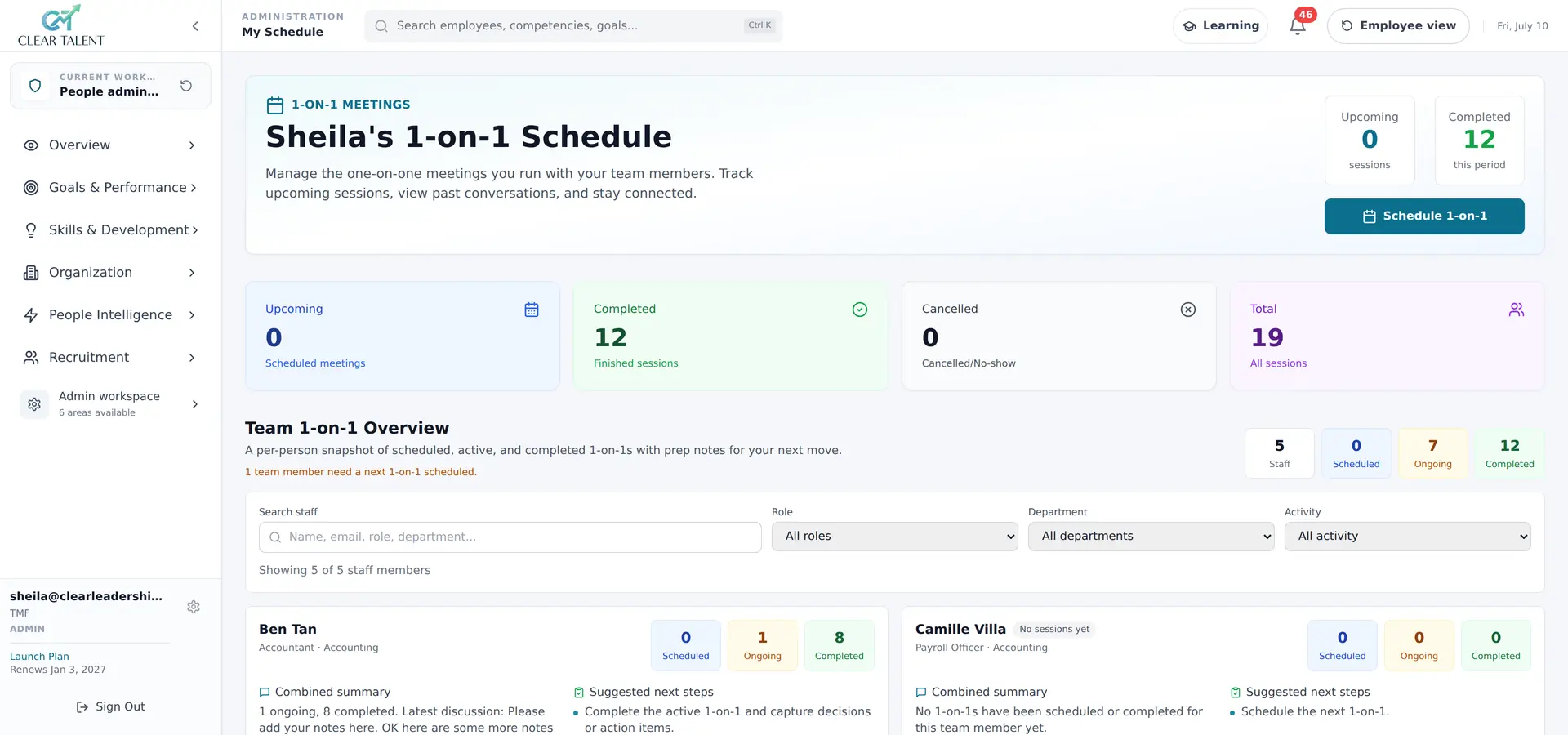
- 1
Sessions this period
Upcoming, completed and cancelled or no-show sessions, with a running total — so a manager can see whether the rhythm they intended is the one actually happening.
- 2
Who needs a next 1-on-1
The team overview calls out anyone without a next session scheduled. That is how the quiet member of a team stops going a quarter without a conversation.
- 3
Search and filter the team
Search by name, email, role or department, and filter by role, department and activity — useful as soon as a manager looks after more than one team.
- 4
Combined summary and suggested next steps
Each person's card carries a summary of their sessions and the next steps suggested for them, so preparation starts from what was agreed last time rather than from a search through old notes.
Feedback and observations that are still there at review time
Continuous feedback covers both coaching and recognition. Development notes carry coaching, including feedback captured from a 1-on-1, and can be kept private. Kudos recognise good work, can be tagged to the competency or value they reflect, and can be made public. Quick templates — kudos, team player, helpful suggestion, above and beyond — give people a starting point instead of a blank box, and received, given, recognition-wall and timeline views keep the history in one place.
Managers also keep a performance journal: a running log of what they observe about each team member, referenced when that person is next assessed. The feedback history and the journal are what make the year-end conversation a review of twelve months rather than of the last fortnight.
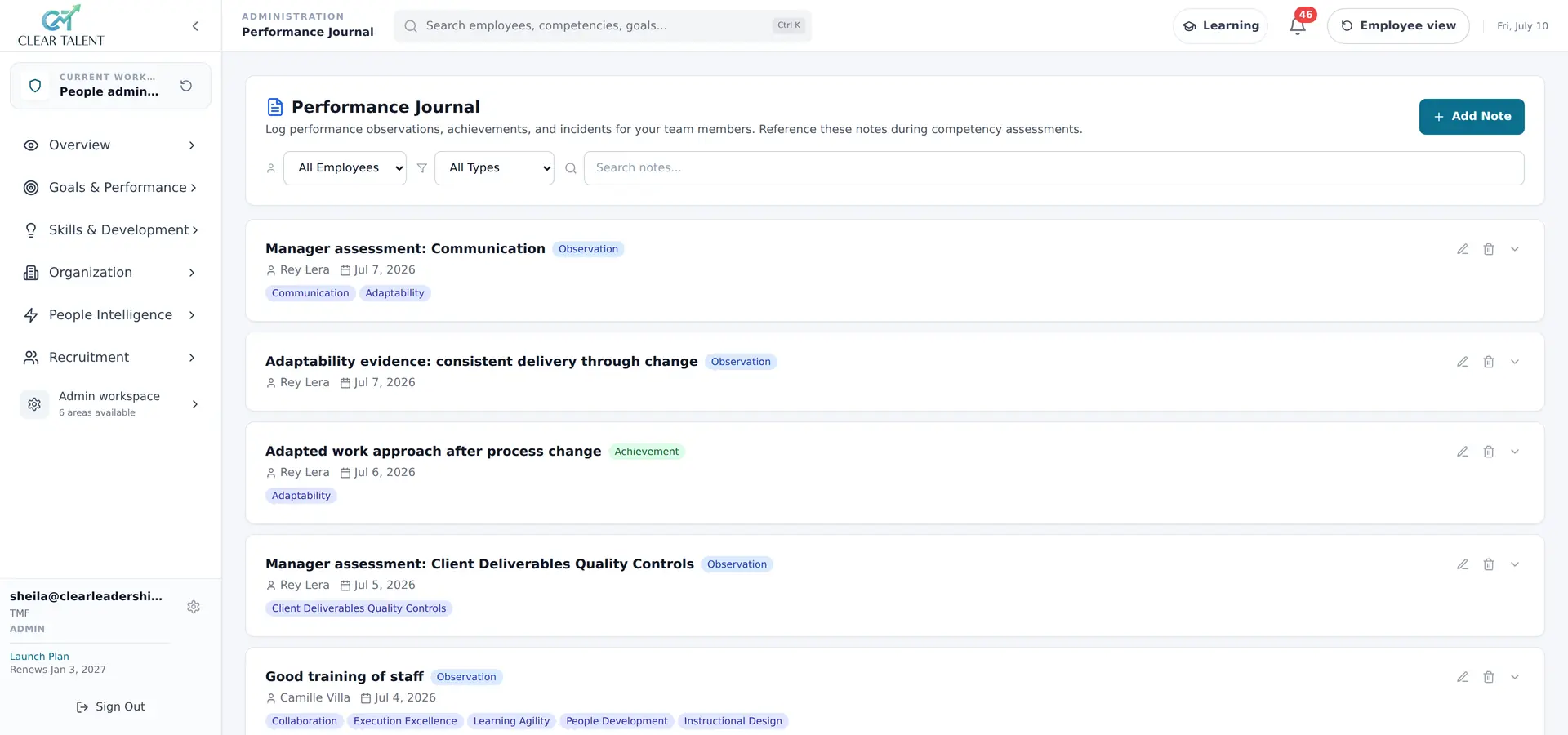
- 1
Add a note as it happens
Record an observation, an achievement or an incident against a team member on the day, not reconstructed at the end of the year.
- 2
Tagged to competencies
Each note can carry the competencies it evidences, so it lines up with the framework the person will actually be assessed against.
- 3
Filter by person, type or text
Narrow the journal to one employee or one type of note, or search it, when it is time to prepare an assessment.
Keep the best of annual — defensibility and calibration
Continuous doesn't mean unstructured. At year-end, all the check-ins, feedback and goal scores consolidate automatically into a defensible, calibrated annual rating for compensation, promotion, and audit.
What leaders see between cycles
Dashboards report goal completion by department, team and manager, flag goals falling behind from pace and check-in signals, and project end-of-cycle scores from current pace — so a drifting quarter is visible while it can still be changed. Ava surfaces attrition and performance risk signals, so leaders know where to look first.
CLEAR Talent does not run engagement or pulse surveys. If measuring sentiment is part of your continuous model, that stays in a dedicated survey tool alongside it.
Built around what managers actually do
Every feature is built around what managers actually do: one-on-ones, check-ins, unblocking. No 90-minute forms. No chase emails.
Related solutions
- 360-degree feedback softwareAnonymised peer, manager and direct-report feedback, structured against the competencies that matter for each role.
- Employee engagement and pulse survey softwareNo survey product: how survey findings become 1-on-1 actions, goals and evidence, with anonymity and GDPR kept in order.
- Employee development and IDP softwareTurn competency gaps into individual development plans that managers track at every check-in.
- Performance management software for retailMobile reviews between shifts, role-based competencies and multi-site reporting for store teams.
Frequently asked questions
Can't find what you're looking for? Talk to a specialist →
Do we have to abandon annual reviews?
How often should check-ins happen?
Will managers actually adopt this?
Is this just "more admin"?
Does CLEAR Talent schedule and track one-on-ones?
Can feedback from a one-on-one stay private?
Does CLEAR Talent include pulse or engagement surveys?
See continuous performance management in action.
Book a live demo with a CLEAR Talent specialist. No generic slide deck—just the platform and a conversation focused on your scenario.