Review cycles
Year-End Performance Review Checklist for HR Teams (2026)
An eight-week countdown from October to January for closing the 2026 review cycle: who does what, how to calibrate and sign off ratings, and how to turn the outcomes into 2027 goals and development plans.
By the CLEAR Talent team10 min read
Key takeaways
- Start in late October. A cycle that opens in December has no room for calibration before the break.
- Give each stage one owner and one deadline: employees own the self-review, managers own the draft rating, HR owns the process and the timeline.
- Calibrate before anything is communicated, then sign off the ratings so they do not move after the conversations start.
- Set 2027 goals from the review outcomes, not alongside them, and turn every agreed gap into a development action with an owner.
The year-end review is the busiest stretch of the HR calendar, and most of what goes wrong with it is decided weeks before the first form opens. Deadlines collide with the holidays, managers write twelve months of feedback from memory in an evening, calibration gets squeezed into the last week before the break, and next year’s goals are set in January by people who have not yet seen the review outcomes.
This checklist works backwards from the point where ratings are final. It sets out an eight-week countdown from late October, splits the work between managers, employees and HR, explains the calibration and sign-off step, and shows how to carry the outcomes into 2027 goals and development plans. It ends with the whole list as a table you can copy or download.
Before the countdown: decide what the review decides
Every year-end cycle answers some combination of four questions: how did this person perform against their goals, how did they demonstrate the competencies their role needs, what should change in pay or progression, and what should they work on next. Decide which of those your 2026 review is expected to answer before you open it. A review asked to settle all four in one forty-minute meeting usually settles none of them well.
If you already hold regular check-ins through the year, the year-end review should summarise that record rather than rebuild it. If you do not, accept that this cycle will lean on memory, plan more time for evidence-gathering, and use it to make the case for a lighter rhythm in 2027.
Guide: annual vs continuous performance reviews, and the hybrid most teams settle on
The eight-week countdown, October to January
Count back from the date ratings must be final, ideally before the December break. Adjust the weeks to your calendar, but keep the order: evidence, then drafts, then calibration, then sign-off, then conversations.
Week 8 (late October): fix the design
Confirm who is in scope, the review period, the rating scale and its definitions, the templates and every stage deadline. Agree with leadership what the ratings will feed and when pay decisions are due.
Week 7: brief managers
Walk managers through the timeline, the scale and what good evidence looks like. Ask them to gather goal results, check-in notes and feedback for each report now, while there is time to fill gaps.
Week 6 (early November): open self-reviews and feedback requests
Employees start their self-reviews and nominate peers where 360° input is part of the cycle. Give at least two weeks; a self-review written in one sitting reads like one.
Week 5: chase the gaps, not the people
Check completion by team. Where a manager is behind, find out whether the problem is time, access or uncertainty about the standard, and fix that rather than sending another reminder.
Week 4: self-reviews and 360° feedback close
Close the inputs on the published date. Late input that arrives after managers have drafted their ratings gets ignored or causes rework.
Week 3 (late November): manager drafts due
Managers draft goal and competency ratings with the evidence behind each one. HR reviews the distribution by manager and team and circulates it to the calibration group.
Week 2 (early December): calibrate
Run calibration by population, outliers first. Record every changed rating with its reason, and send managers back with anything that needs more evidence.
Week 1: sign off and lock
Final ratings are approved and signed off. From here they change only through a documented exception, so the conversations in January rest on a decision that will not shift underneath them.
January: conversations, then 2027 goals
Managers hold review conversations in the first weeks back, then agree 2027 goals and development actions from what the review found.
Who does what: managers, employees and HR
Most cycles stall at a handover nobody owned. Write the split down and publish it with the timeline.
- Employees
- Complete the self-review against each goal and competency with specific examples, nominate peers for feedback where the cycle includes it, give the feedback they are asked for on time, and come to the January conversation with a view on what they want to develop next.
- Managers
- Gather the year’s evidence, draft ratings that cite it, attend calibration ready to explain each rating, hold the review conversation, and agree 2027 goals and development actions with each report. Managers own the rating and the conversation, including any change made in calibration.
- HR
- Design the cycle, publish the scale and timeline, brief managers, track completion, prepare and facilitate calibration, keep the record of changes, and check that every review ends with goals and a development plan. HR runs the process; it does not make the rating decisions.
- Senior leaders
- Confirm company priorities for 2027 before January, so teams have parent objectives to set goals against, and attend calibration for the populations they lead.
If a step has two owners, it has none. Every line of the timeline should name one role.
Calibration and rating sign-off
Calibration is the step that turns individual manager judgements into ratings that can be compared across teams. It has to sit between the manager’s draft and the final rating, while the decision is still live. Calibration held after ratings have been shared with employees changes nothing except trust in the process.
Prepare the group with the scale definitions, the draft distribution by manager and team, and the evidence behind each rating. In the meeting, start with the highest and lowest ratings and anyone who has moved more than one band since last year. Ask what the person did and what the outcome was. If the ratings feed pay decisions, the record of who changed what and why matters more each year, not less.
Then sign the ratings off. Agree who approves the final set, by when, and what counts as an exception afterwards. A rating that can still change after the conversation has started invites a second round of negotiation and undermines the manager who delivered it.
Turning review outcomes into 2027 goals
The review tells you what worked, what did not and what changed. Goal-setting is where that knowledge is either used or lost.
Start from the company objectives
Leadership confirms the 2027 organisation objectives first. Department and team goals describe each group’s own contribution to one of them, and individual goals link to a team or organisation goal.
Carry forward what the review found
A goal missed for reasons inside the person’s control becomes a development focus. A goal missed because priorities changed is closed, not copied into next year. A goal exceeded may mean the next one should be more ambitious.
Keep the number of goals small and weighted
Three to five goals per person, each with a weight that states its priority, gives a clearer signal than a long list of equally weighted ones.
Write outcomes, not tasks
Each goal or key result should describe a result someone can influence and measure, with a date. If it reads like a project plan, it is a task list.
Schedule the first check-in now
Put the first quarterly goal check-in in the calendar when the goals are agreed, so the 2027 goals are reviewed while they can still change.
See OKR and goal-setting software that links every goal to a parent objective
From rating to development plan
A rating describes the past year. The development plan is what makes the review worth the employee’s time. Take the two or three competencies where the gap between current and required level matters most for the role, and agree one action for each: a stretch assignment, supervised practice, a course or a mentor, with an owner and a date.
Keep development separate from the pay conversation where you can. People listen to feedback about what to work on more readily when they are not also waiting to hear about a salary increase. Many teams hold the development discussion a week or two after the rating conversation for exactly that reason.
Then keep it alive. A development action reviewed in each one-to-one gets done. One written in January and reopened next December rarely does.
See continuous performance management: 1-on-1s, check-ins and a performance journal
The year-end review checklist
The whole cycle on one page. Copy it into your own plan or download it as a CSV.
Checklist
Year-end performance review checklist, 2026 cycle
| Task | Owner | When |
|---|---|---|
| Set up | ||
| Confirm scope, review period, rating scale and templates | HR | Week 8 |
| Agree what ratings feed and the pay decision date | HR and senior leaders | Week 8 |
| Publish the timeline with one owner per stage | HR | Week 8 |
| Brief managers on the scale and on good evidence | HR | Week 7 |
| Gather evidence | ||
| Collect goal results, check-in notes and feedback per report | Managers | Weeks 7–4 |
| Complete the self-review with specific examples | Employees | Weeks 6–4 |
| Request and give 360° feedback | Employees and peers | Weeks 6–4 |
| Track completion by team and remove blockers | HR | Week 5 |
| Rate, calibrate and sign off | ||
| Draft goal and competency ratings with evidence | Managers | Week 3 |
| Circulate the draft distribution by manager and team | HR | Week 3 |
| Calibrate outliers first and record every change | Managers, HR facilitating | Week 2 |
| Approve and sign off final ratings | Approving leader | Week 1 |
| Close and plan | ||
| Hold the review conversation and share the final review | Managers | January |
| Confirm 2027 organisation objectives | Senior leaders | Before January |
| Agree three to five weighted 2027 goals linked to a parent | Managers and employees | January |
| Agree two or three development actions with owners and dates | Managers and employees | January |
| Book the first quarterly check-in | Managers | January |
Week numbers count down to the date ratings must be final. Move the dates, not the order.
Four year-end mistakes to avoid
- Opening the cycle in December
- There is then no time to calibrate before the break, and either calibration is skipped or the ratings sit unsigned over the holidays.
- Rating the last quarter and calling it the year
- Ask managers to cite evidence from across the period. If there is none for the first half, that is worth knowing too.
- Setting next year’s goals before the review
- Goals agreed in November without the review outcomes repeat this year’s misses and ignore what the review revealed.
- Ending at the rating
- A review that produces a rating but no goals and no development action has done the administrative half of the job.
Where CLEAR Talent fits
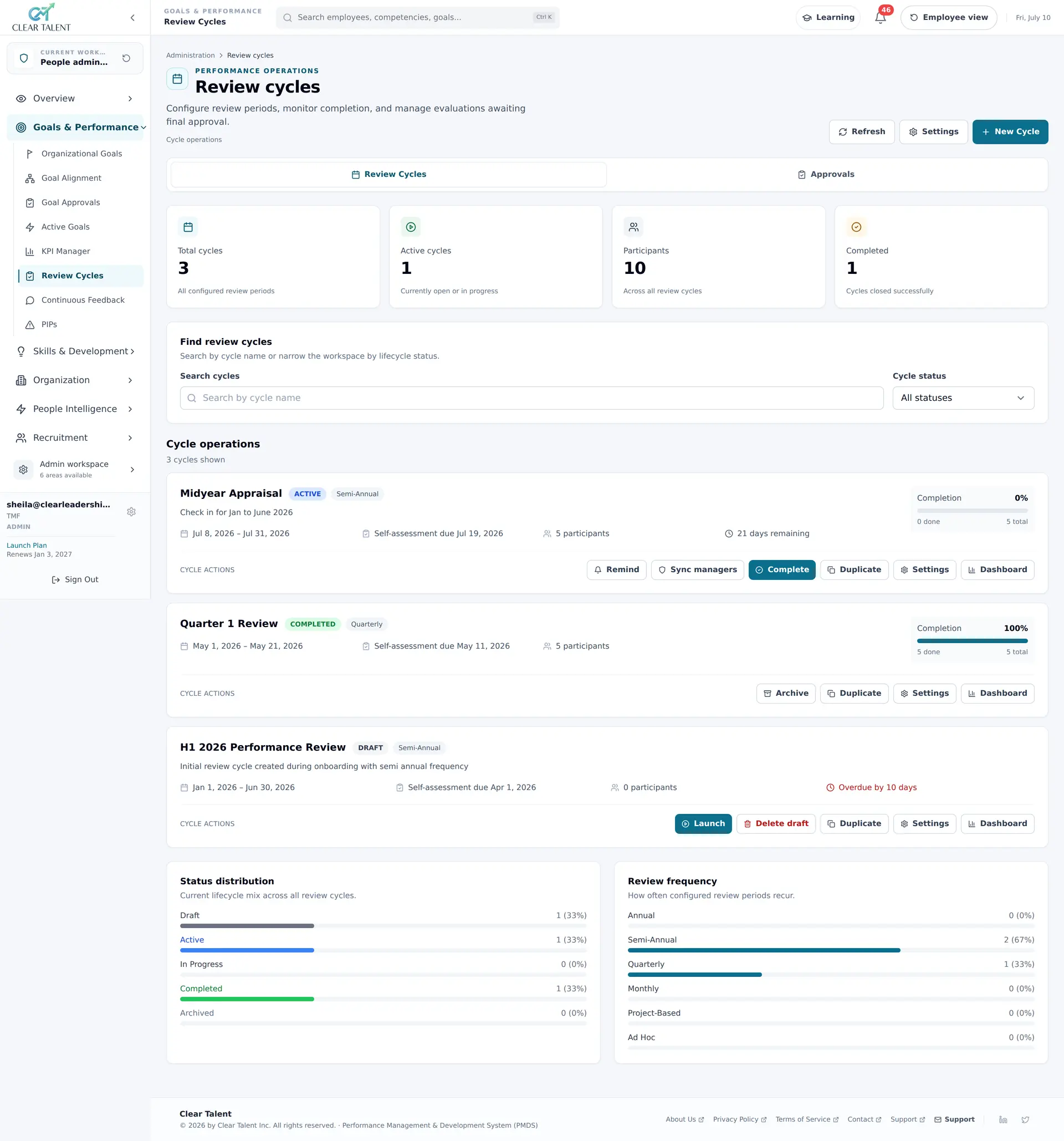
CLEAR Talent runs mid-year and end-of-year reviews as configurable cycles, from self-review through 360° feedback, manager review and calibration to a final rating and a signed-off report, with automated reminders at each stage. Goal scores roll up into the review without re-entry, competency ratings carry the evidence behind them, and calibration views use heatmaps and outlier flags to show inconsistent ratings across managers before anything is final. Every change is logged, and PDF and Excel exports produce the pack and the record.
For 2027, Strategic Linked Goals will not accept an individual goal without a parent, so every goal traces back to a company objective, and goals employees draft go to their manager for approval. Each competency assessment drafts an individual development plan from the competencies most important for the next role, ranked by gap, and 1-on-1s, goal check-ins and the performance journal keep the evidence building through the year.
See employee performance review software: self-review to calibration to sign-off