Manager enablement
How to train managers to run performance reviews: a workshop agenda and follow-up plan
A practical guide to training managers to run performance reviews: what good looks like, a 90-minute workshop agenda, the rater errors to practise against, role-play scenarios, a readiness checklist and a 30/60/90-day follow-up cadence.
By the CLEAR Talent team12 min read
Key takeaways
- Train for judgement and conversation, not for the software. Managers need practice rating against a standard and practice saying difficult things out loud.
- One 90-minute workshop held just before the cycle opens beats a long course months earlier, because managers use the skills while they are fresh.
- Rater errors are best taught with a shared sample case: managers rate it separately, compare, and see their own leniency or halo in the spread.
- The follow-up matters more than the workshop. Check the first reviews written, coach on real examples and debrief after calibration.
Most organisations put real effort into the review process — the form, the rating scale, the timeline — and then hand it to managers with an email and a link. The quality of the review that reaches the employee depends almost entirely on the person running it, and many managers have never been shown how. They learnt by being reviewed, which is not the same thing.
This guide sets out manager training for performance reviews that fits into one 90-minute workshop and a few weeks of follow-up. It covers what a well-run review looks like, a timed workshop agenda, the rater errors worth practising against, role-play scenarios for the hard conversations, a readiness checklist each manager completes before the cycle opens, and a 30/60/90-day cadence so the training survives contact with a busy quarter.
Why performance review training for managers is worth the time
When employees describe a bad review, they rarely complain about the form. They describe a manager who rated them on the last few weeks, could not give an example, delivered criticism with no warning, or spent the meeting reading out a document. Each of those is a skill gap, and each is fixable with practice.
Untrained managers also make the rest of the process harder. Ratings drift apart between teams, so calibration turns into an argument about whose standard is right. Written comments are vague or about personality, which is a problem if the employee later asks to see them. And the conversations people dread get postponed, so underperformance surfaces at year end rather than when it could still be fixed.
Training does not need to be long to change this. It needs to be specific to your process, timed close to the cycle, and followed up on the reviews managers actually write.
What a well-trained manager does differently
Before designing the session, agree what you are training towards. These five behaviours are a useful target, and they double as the criteria for the follow-up review later in this guide.
- Rates against the written standard
- Reads the rating definitions before writing, rates goals and each competency separately, and can say what would have moved a rating one level up or down.
- Cites evidence from the whole period
- Draws on one-to-one notes, goal updates and feedback from across the year, not only the last month, and names specific pieces of work.
- Writes comments the employee could read without surprise
- Describes behaviour and outcomes rather than personality, and raises nothing in writing that was never raised in conversation.
- Runs a two-way conversation
- Opens with the employee’s own view, listens more than it talks, and leaves the meeting with agreed goals and one or two development actions.
- Gives feedback between reviews
- Raises issues and recognises good work as it happens, so the formal review confirms what the employee already knows.
A 90-minute manager training workshop agenda
This agenda suits six to twelve managers in a room or on a video call with breakout rooms. Run it in the two or three weeks before the review cycle opens, and send the rating definitions and one sample case in advance.
Agenda
90-minute workshop: running performance reviews
| Segment | Time | What happens | What managers leave with |
|---|---|---|---|
| Set the standard | |||
| Purpose and the process | 0:00–0:10 | Why reviews matter here, what they feed (pay, development, promotion) and the dates for this cycle. | A clear picture of the timeline and their own deadlines. |
| Rating a sample case | 0:10–0:25 | Each manager rates the same hypothetical employee against your rating definitions, alone. Reveal the spread and discuss the outliers. | A shared reading of what each rating level means in practice. |
| Practise the judgement | |||
| Rater errors | 0:25–0:40 | Walk through the errors that showed up in the sample case — recency, halo, leniency, central tendency — and the check for each. | A short list of questions to ask before submitting any rating. |
| Writing evidence-based comments | 0:40–0:50 | Rewrite three vague comments (“great attitude”, “needs to step up”, “not a team player”) into specific, observable ones. | A pattern for comments: the work, the behaviour, the effect. |
| Practise the conversation | |||
| Role-plays in threes | 0:50–1:15 | Manager, employee and observer rotate through two scenarios from the list below. The observer uses a short checklist and gives feedback after each round. | Having said the difficult sentence out loud at least once. |
| Close | |||
| Calibration and what happens next | 1:15–1:25 | How calibration works, what evidence to bring, and how changed ratings are recorded and explained. | Knowing their ratings will be compared, and how to prepare. |
| Commitments | 1:25–1:30 | Each manager writes down one thing they will do differently this cycle and shares it with a peer. | A personal commitment that the 30-day check-in follows up. |
If you only have 60 minutes, keep the sample case and the role-plays and send the rest as reading. Those two segments are the ones managers cannot get from a document.
The rater errors to train against
Naming biases in a slide rarely changes ratings. Showing managers their own errors on a shared case does. These are the ones a sample case reliably surfaces, with the habit that counters each.
- Recency
- Rating the last quarter rather than the year. Counter it by asking for one piece of evidence from each part of the period before a rating is final.
- Halo and horns
- Letting one strength or one incident colour every competency. Counter it by rating each competency on its own, against its own definition, before forming an overall view.
- Leniency and severity
- Applying a softer or harsher standard than colleagues. The sample-case spread makes this visible immediately; in the live cycle, managers compare their own spread with comparable teams.
- Central tendency
- Putting everyone in the middle because the evidence is thin. Counter it by requiring a specific example for a middle rating, exactly as for any other.
- Similarity and contrast
- Rating people who work like you more generously, or rating someone down because they sit beside the strongest person on the team. Counter both by rating against the written standard, not against people.
Run the sample case before you explain any of the errors. Managers learn more from seeing their own rating sit two levels from a colleague’s than from any definition.
Guide: how to reduce bias in performance reviews, with eight bias types and data checks
How to train managers to give feedback
Feedback is the skill managers say they find hardest, and it is the one that most rewards practice. Teach a simple structure, then spend the time rehearsing it.
Prepare the specifics
Before the conversation, write down the situation, the behaviour you observed and its impact. If you cannot name all three, you are not ready to give the feedback yet.
Ask before you tell
Open by asking how the employee thinks the piece of work went. People often name the issue themselves, and the conversation becomes problem-solving rather than judgement.
Say it plainly
State the behaviour and its impact in one or two sentences, without softening it into vagueness or wrapping it between two compliments.
Listen to the response
There may be context you did not have. Acknowledge it, and separate what changes your view from what does not.
Agree a next step and write it down
End with one concrete action and when you will look at it again. Record a short note the same day, so the feedback is still there when the review is written.
Positive feedback deserves the same specificity. “Good job” teaches nothing; naming what worked and why it mattered tells the person what to repeat.
Role-play scenarios for the workshop
Each scenario gives the person playing the employee a brief the manager does not see. The observer watches for the points listed. All the scenarios are hypothetical; adapt the detail to roles in your organisation.
- The strong performer who expects a promotion
- The employee’s results are good, but the next level needs skills they have not yet shown. Observer watches for: recognising the results specifically, being clear about the gap without promising an outcome, and agreeing a development step.
- The rating the employee disagrees with
- The employee arrives having rated themselves a level higher. Observer watches for: asking for their evidence first, explaining the rating against the definition rather than defending it, and saying what would change it.
- The underperformance nobody has raised
- Quality has slipped for several months and this is the first formal conversation about it. Observer watches for: the manager acknowledging the issue should have been raised sooner, specific examples, and a clear, supportive next step.
- The emotional reaction
- The employee becomes upset partway through and mentions pressure outside work. Observer watches for: pausing the agenda, not probing personal detail, offering a break or a follow-up meeting, and pointing to available support.
- The quiet contributor
- A reliable team member gives one-word answers. Observer watches for: open questions, comfortable silence, and whether the employee did most of the talking by the end.
Keep the observer checklist short — three or four points — and have the observer speak first after each round, then the person playing the employee, then the manager.
A manager readiness checklist
Ask each manager to work through this before the review cycle opens. It is printed in full so you can copy it into your own cycle briefing.
Checklist
Before the review cycle opens
Know the process
- I know the dates for self-assessment, my reviews, calibration and the review conversations.
- I have read the rating definitions and the competency descriptions for my team’s roles.
- I know which outcomes this cycle feeds, such as pay, bonus or promotion, and what I can and cannot say about them.
Gather the evidence
- I have my one-to-one notes, goal updates and feedback for each person from the whole period.
- I have at least one specific example for each goal and competency I will rate.
- I have noted context outside each person’s control, such as leave, a role change or a vacancy.
Prepare the conversations
- Nothing I plan to write will be new to the employee; anything that would be is raised before the review.
- I have booked an hour for each conversation, with time to prepare beforehand.
- I know who to contact in HR if a conversation raises wellbeing, conduct or legal questions.
- I have a draft of one or two development actions for each person to discuss, not impose.
A manager who cannot tick the evidence items for someone has found the most useful thing the checklist can show: where the record needs to be filled in before the rating, not after.
Preparing managers for calibration
Calibration is where untrained rating habits become visible, so it belongs in the training rather than as a surprise afterwards. Tell managers before the cycle that their ratings will be compared with those of colleagues managing similar roles, and that they will be asked for evidence behind the outliers — the very high and the very low ratings first.
Two habits make the meeting faster and fairer. Managers bring one or two concrete examples for each rating they expect to be questioned on, and they accept that a changed rating is recorded with its reason, which they will then explain to the employee. A manager who knows both in advance writes better reviews in the first place.
A 30/60/90-day follow-up cadence
One workshop fades within weeks unless someone follows it up on real work. Count the days from the workshop; the cadence is HR’s or the senior manager’s to run, not the trainee’s.
Day 30: review the first written reviews
Read a sample of each manager’s draft reviews before they are submitted. Check the five behaviours from earlier in this guide — evidence from the whole period, comments about behaviour rather than personality — and give each manager one or two points of written feedback. Follow up on the commitment they wrote down at the workshop.
Day 60: debrief after calibration and the conversations
Hold a 30-minute group session once calibration and most review conversations are done. Ask which conversations were hardest, which ratings moved in calibration and why, and what managers would prepare differently. Share the anonymised patterns, such as which teams’ ratings moved most.
Day 90: check the habits between reviews
Look at whether managers are still holding regular one-to-ones, recording feedback and updating goals now the cycle is over. This is the habit that decides how good the next review is, so coach managers who have let it lapse.
New managers should join the next workshop before their first review cycle, and a short refresher before each cycle — the sample case alone takes 15 minutes — keeps experienced managers calibrated with each other.
Where CLEAR Talent fits
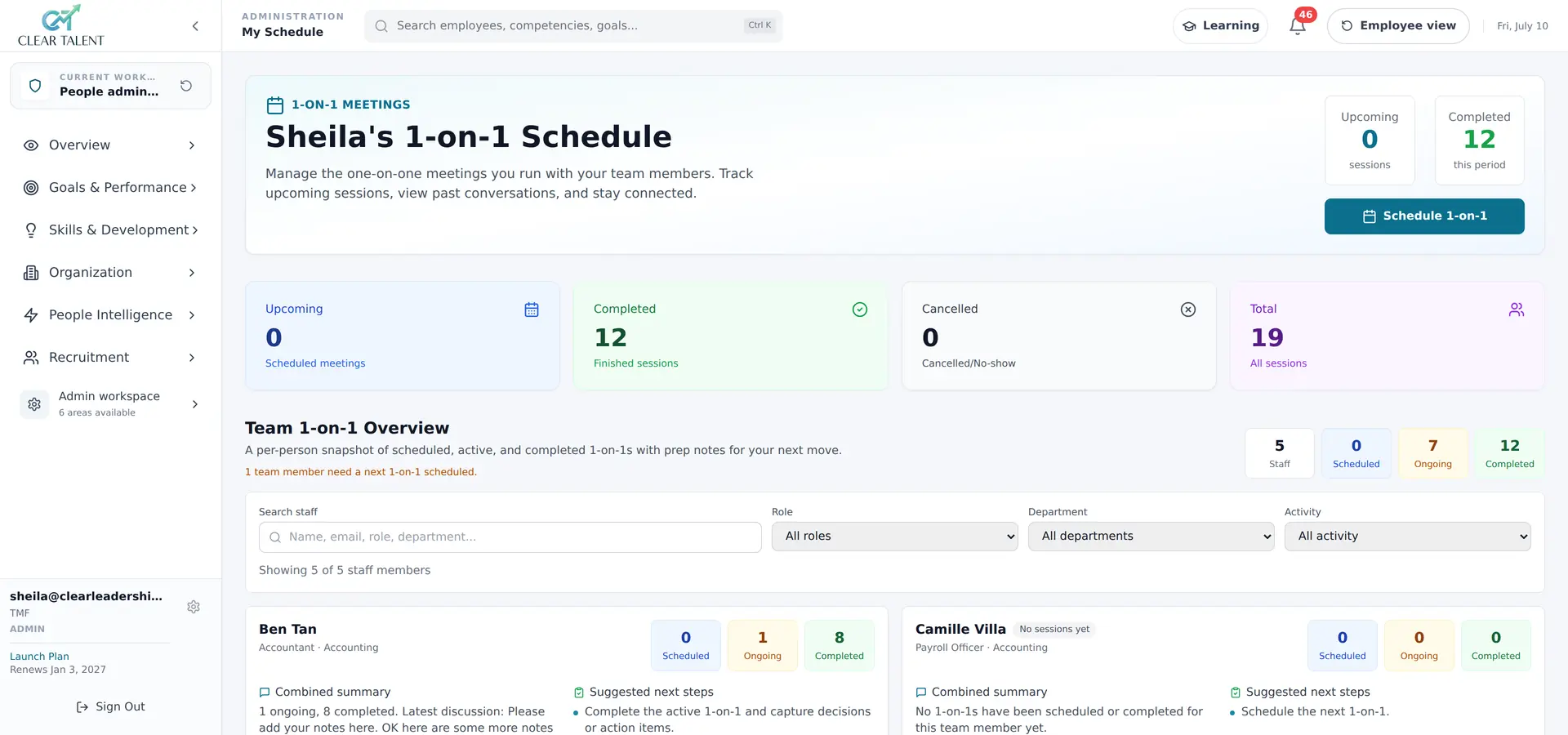
Software does not train managers, and CLEAR Talent does not run the workshop for you. What it does is support the habits the training asks for. Managers schedule 1-on-1s from a view that tracks upcoming, completed and cancelled sessions, feedback captured in a 1-on-1 is kept as a development note, kudos can be tagged to a competency or value, and observations go into a performance journal as they happen — so the evidence the readiness checklist asks for is already there when the review opens. Every review stage has automated reminders, which keeps the dates from the workshop in front of managers.
At review time, Ava, the platform’s AI assistant, drafts a first review narrative from the goal scores, competency ratings, 360° feedback and check-in notes already recorded, and flags rating patterns that may indicate gender, recency or leniency bias before submission. Ava never makes the final rating, and every output is labelled, editable and logged. Calibration views use heatmaps and outlier flags to show inconsistent ratings across managers, and every change is logged with who, what and when, which gives the day-60 debrief real patterns to discuss.