Fairness & compliance
The EU Pay Transparency Directive and performance reviews: what HR should do now
The Directive expects pay and pay progression to rest on objective, gender-neutral criteria. Where ratings drive raises, bonuses and promotion, your performance records become part of that evidence.
By the CLEAR Talent team8 min readLast reviewed
Key takeaways
- The Directive asks employers to explain pay and progression with objective, gender-neutral criteria, and performance ratings are often part of that explanation.
- Ireland has confirmed it will miss the 7 June 2026 deadline and is phasing implementation. The preparation work does not need to wait for the final text.
- Written criteria, anchored rating scales and calibration records are what turn a rating from an opinion into evidence.
- Run each review cycle as something you may one day need to explain to an employee, a representative or an adjudicator.
The EU Pay Transparency Directive is usually discussed as a reporting exercise: publish the gender pay gap, answer employee requests for pay information, stop asking candidates about their salary history. All of that is true. Underneath it sits a quieter requirement that reaches straight into the performance review cycle.
Directive (EU) 2023/970 expects pay structures and pay progression to rest on objective, gender-neutral criteria that employers can explain. In most organisations, performance ratings feed merit increases, bonuses and promotion. If those ratings cannot be explained, they become the weakest link in any justification of a pay difference. This article sets out what changed, where Ireland stands and how to get your performance criteria ready. It is general information, not legal advice.
What the Directive changes, and where Ireland stands
The Directive was adopted in May 2023 and gave member states until 7 June 2026 to bring it into national law. It builds on the long-standing principle of equal pay for the same work or work of equal value, and adds the transparency needed to enforce it. The obligations most relevant to HR teams are these.
- Pay-setting and progression criteria
- Employers must make available to workers the criteria used to determine pay, pay levels and pay progression, and those criteria must be objective and gender-neutral. Member states may exempt employers with fewer than 50 workers from the pay-progression part.
- A right to pay information
- Workers can request their own pay level and the average pay levels, broken down by sex, for people doing the same work or work of equal value.
- Gender pay gap reporting
- Employers with 250 or more workers report annually and those with 150 to 249 every three years, with first reports due by 7 June 2027. Employers with 100 to 149 workers follow from June 2031.
- Joint pay assessments
- Where reporting shows a gap of at least 5% in a category of workers that the employer cannot justify with objective, gender-neutral criteria and has not remedied within six months, a joint pay assessment with worker representatives follows.
- The burden of proof
- In an equal pay claim, once a worker establishes facts suggesting discrimination, it is for the employer to show there was none.
Ireland has confirmed it will not transpose the Directive by the June 2026 deadline and has signalled a phased implementation, as McCann FitzGerald, William Fry and the Law Society of Ireland have reported. Irish employers with 50 or more employees already publish gender pay gap reports under the Gender Pay Gap Information Act 2021, so the reporting mechanics are familiar. The newer obligations around pay criteria, information rights and joint assessments are where most of the preparation lies. Timelines are still moving, so check the current position with the sources at the end of this article before relying on any date.
Where performance data touches pay
The Directive defines pay broadly: basic salary plus any other consideration in cash or in kind, including variable components. Performance data usually reaches that pay by three routes.
- Merit increases
- A rating that maps to a salary-increase range is a pay-setting criterion in all but name. If women and men in the same role land in different bands, the rating is the first thing you will be asked to explain.
- Bonus and variable pay
- Bonus multipliers linked to ratings or goal scores are pay. A formula is only as objective as the judgements fed into it.
- Promotion and progression
- Moves up a grade or pay band usually rest on readiness judgements, competency assessments and a manager’s recommendation. These are the decisions most exposed to informal criteria such as visibility, availability or “fit”.
If a rating moves money, the criteria behind it are pay criteria.
None of this makes performance-related pay a problem. It means the chain from criterion to rating to pay outcome needs to be written down, applied consistently and explainable to someone who was not in the room.
An 8-point readiness checklist for performance criteria
Use this to test the review cycle you already run. Each point is something you should be able to show, not just describe.
Define role-based competencies
Each role or role family has a written set of competencies and expected levels. People doing the same work, or work of equal value, are assessed against the same set whatever their team or manager.
Anchor every rating level
Replace labels such as “good” and “excellent” with observable behaviours and outcomes at each level, so two managers reading the scale picture the same performance.
Check the criteria for gender bias
Look for descriptors that are easily applied unevenly, such as “assertive”, “always available” or “visible to leadership”, and for criteria that quietly penalise part-time work, flexible working or periods of leave. Rate what was delivered in the time actually worked.
Require evidence with ratings
Each rating arrives with the goals, examples and feedback behind it. A rating without evidence is hard to defend and harder to explain to the employee.
Calibrate before ratings are final
Managers compare how they have applied the scale across comparable roles before ratings are communicated and before they feed pay.
Record every change and its reason
Keep an audit trail of who changed a rating, when and why, including changes agreed in calibration. A reason reconstructed months later is not the same thing.
Write down the link from rating to pay
Document how ratings translate into increase ranges, bonus multipliers and promotion eligibility, and who can override the outcome. This is the text workers may ask to see.
Train managers, then monitor outcomes
Brief managers on the criteria, the scale anchors and common rating biases before each cycle. Afterwards, compare rating and pay outcomes by sex within comparable roles, within your data protection obligations, and investigate differences you cannot explain.
Where a point is weak, fix the process first. Software can record a process; it cannot make an unclear criterion objective.
How competency frameworks and calibration reduce pay-gap risk
A competency framework does two jobs here. It gives every role a stated standard, which is the “objective criteria” half of the requirement. And because the same competencies apply across teams, it makes comparisons between people doing work of equal value possible in the first place. Without one, each manager’s idea of good performance becomes the criterion.
Calibration supplies the consistency. A scale can be well written and still applied unevenly: one manager rates generously, another harshly, and people whose work is less visible are rated down. Calibration puts those judgements side by side before they are final and asks the question the Directive will eventually ask: can this rating be explained by the evidence?
Together they produce the record you need if a worker asks why their pay differs from a colleague’s, or if a gap has to be justified in a joint assessment: the criteria, the evidence, how the scale was applied and why any rating changed. They do not guarantee that a pay structure is free of bias. They make bias easier to find, and they show what you did about it.
Where CLEAR Talent fits
CLEAR Talent is performance management software, not a payroll or reward system, and it does not produce the Directive’s pay reports. What it can do is keep the performance side of the chain documented.
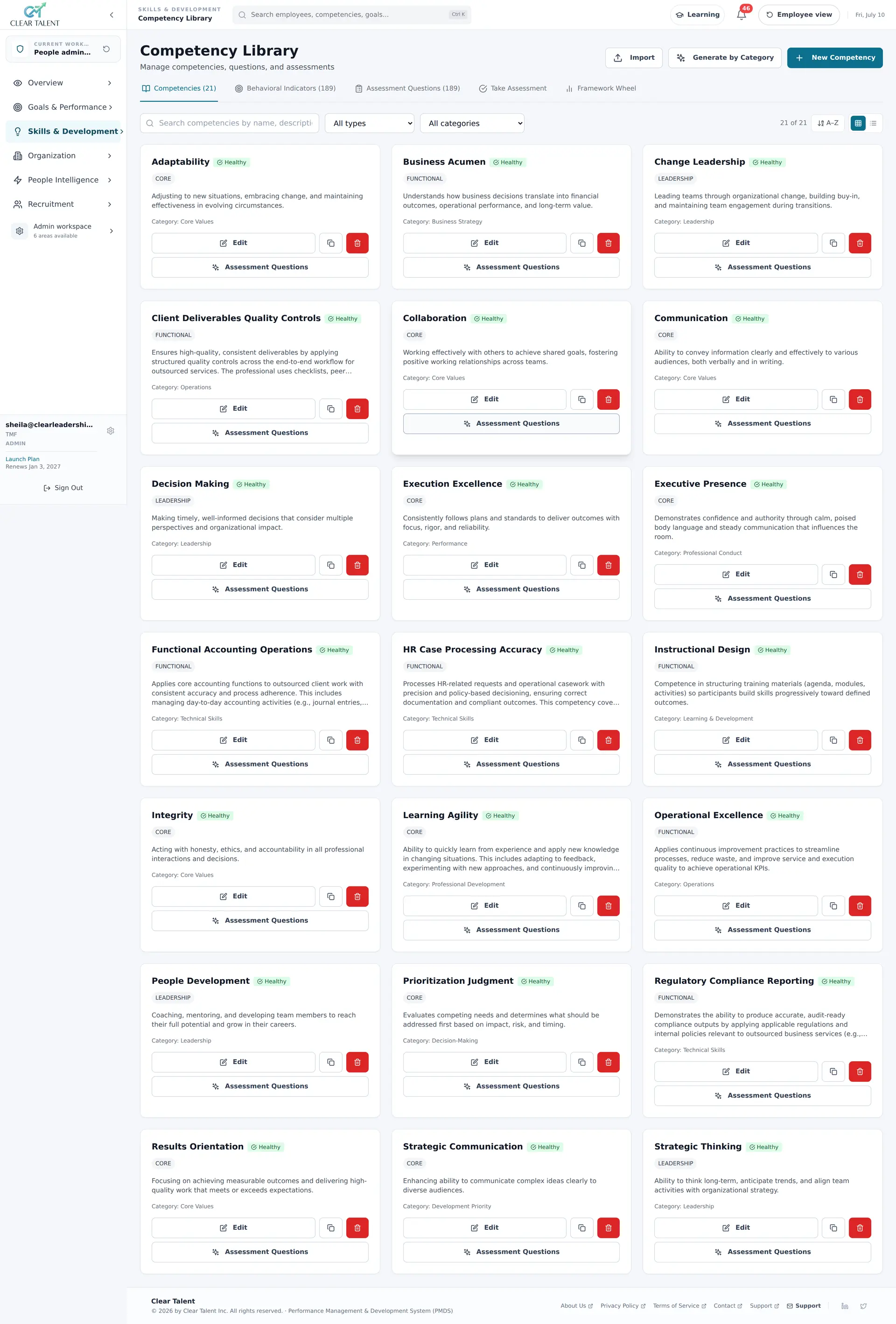
Competencies are defined once in a central library, with behavioural anchors and proficiency levels, and mapped to roles with their required levels. Ratings can be configured to require evidence. Calibration views use heatmaps and outlier flags to show where ratings are inconsistent across managers before anything is final, and Ava, the AI assistant, flags rating patterns that may indicate gender, recency or leniency bias before a manager submits. Every change is logged with who, what and when, and PDF and Excel exports give you the record afterwards.