Goals & alignment
How to cascade company goals without micromanaging
A cascade should give people line of sight, not a longer to-do list. How to structure levels, weighting and cadence so goals still mean something in month three.
By the CLEAR Talent team6 min read
Key takeaways
- A cascade communicates contribution. If it is producing task lists, it has become project management under another name.
- Three levels is usually enough — organisation, team, individual. Every extra layer weakens the link back to strategy.
- Translate goals downwards; do not copy them. A department that inherits the parent objective verbatim has added nothing.
- Weighting is the priority signal people actually read. Equal weights say that nothing matters more than anything else.
Most goal cascades fail in the same quiet way. Objectives are set at the top, broken downwards through a series of meetings, and a few months later nobody below director level can say what the organisation is actually trying to achieve this year.
The instinct when that happens is to add structure: more levels, more goals, tighter tracking. It usually makes things worse. A cascade works when it gives people line of sight to something they can influence, and it stops working the moment it becomes a distribution mechanism for tasks.
A cascade is line of sight, not a chain of command
The purpose of cascading is to let someone answer one question without guessing: how does what I am doing this quarter connect to what the organisation is trying to achieve this year? That is the whole test. If a person can trace their goal upwards two steps and recognise the destination, the cascade is doing its job.
It is not a mechanism for pushing work downwards. A company objective is an outcome; the work required to reach it is a plan, and plans belong wherever the team already runs delivery. Conflating the two produces goal lists that read like backlogs and expire before the quarter does.
Decide how many levels you actually need
Most organisations need three: an organisation level, a team or department level, and an individual level. Larger structures sometimes justify a fourth for functions or business units. Past that, each additional layer weakens the connection more than it clarifies anything, because every translation step introduces another act of interpretation.
A practical check: pick an individual goal at random and walk it up the tree. If reaching a recognisable organisation objective takes more than three steps, or if one of those steps is a restatement rather than a translation, you have more levels than the structure needs.
Translate goals downwards, do not copy them
The most common cascade error is duplication — the organisation objective reappearing word for word at every level with a smaller number attached. It looks like alignment and communicates nothing, because it never tells a team what they are expected to do differently.
A translation asks a specific question at each level: given this outcome, what is the distinct contribution this group can make? A single organisation-level retention objective might translate into a resolution-quality goal in support, an onboarding-completion goal in product, and a billing-accuracy goal in finance. None of those restates the parent, and all of them roll up to it.
If a team’s goal could be pasted into another team’s list without editing, it is not a translated goal.
Weighting is the priority signal people actually read
Once somebody holds more than two goals, weighting stops being an administrative field and becomes the clearest statement of priority they will get all year. Equal weights across everything communicate that nothing matters more than anything else, which is almost never what leadership means.
Keep the list short enough to be memorable — if a person cannot recite their goals without opening a system, there are too many. Then weight deliberately, and make sure the scoring bands mean the same thing across teams. Otherwise the weights are being applied to numbers that were never comparable in the first place.
Cadence: annual outcomes, quarterly goals
Mixed cadence is usually right. Organisation-level objectives are annual because that is the horizon on which they genuinely change. Team and individual goals are better set quarterly, because a goal written twelve months out is either vague enough to survive the year or specific enough to be wrong by March.
Pair the cadence with a check-in rhythm — monthly is a reasonable default — and treat mid-cycle change as normal. Priorities move. What damages trust is not changing a goal; it is quietly rewriting one at year-end so the score reads better than the year did.
The line between alignment and micromanagement
The distinction is easy to state and easy to lose: cascade the what and the why, and leave the how to the person doing the work. A goal that specifies method — which tool, which process, which sequence — is a task with a due date, and it should be managed as one.
The same applies to measurement. Measuring outcomes tells you whether the contribution landed. Measuring activity tells you whether somebody was busy, and it reliably produces the behaviour it measures rather than the result you wanted.
Where cascades break
- Orphaned goals
- Goals with no parent are invisible to the cascade and usually represent work nobody at the top knows is happening. Either link them or ask why they exist.
- Goals that are really tasks
- “Deliver the migration by June” is a deliverable. “Reduce migration-related incidents to a level customers do not notice” is a goal. The first has a single moment of truth; the second can be steered all quarter.
- Goals nobody can influence
- Assigning an organisation-wide revenue figure to an individual contributor with no line of influence over it produces neither motivation nor useful measurement.
- The cascade lands after the quarter starts
- A goal agreed in week six of a thirteen-week quarter is a retrospective description of work already under way.
- Set and forget
- Cascades that are never revisited between the setting meeting and the review meeting degrade into documentation. The check-in is the mechanism; the cascade diagram is just the map.
How this works in CLEAR Talent
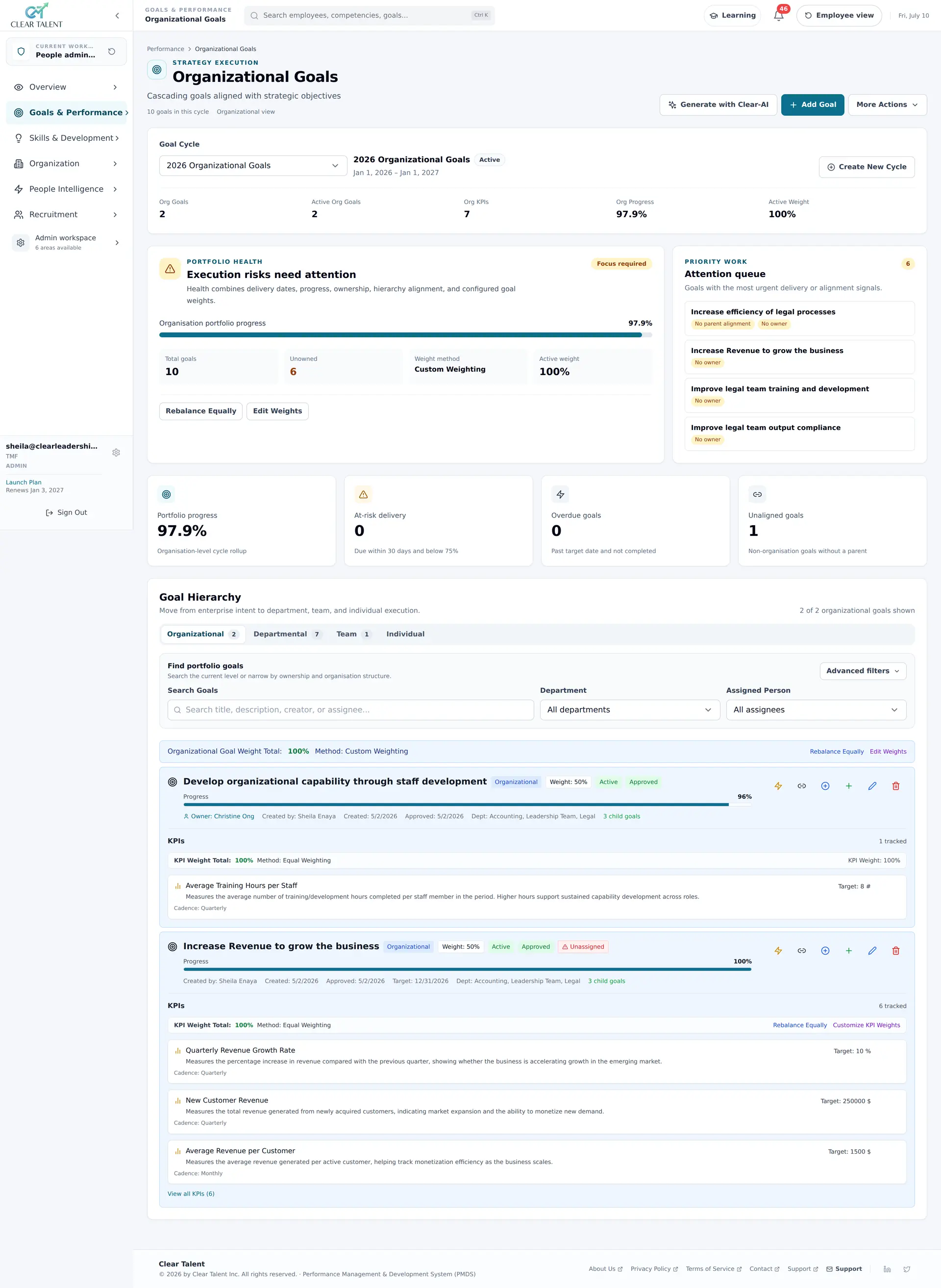
CLEAR Talent handles this through Strategic Linked Goals, which makes the linkage structural rather than a convention people are asked to remember.
- Linkage is enforced
- An individual goal cannot be created without a parent, so orphaned goals cannot quietly accumulate. A visual cascade map shows every goal and the objective it rolls up to.
- Weighting is configurable per level
- Equal, manager-weighted or custom percentages, so the weighting model can match how your organisation actually prioritises rather than a tool default.
- KPIs come from a library
- A central KPI library with reusable, role-aware templates and performance bands keeps scoring consistent between teams, and evidence can be linked to each score.
- Progress is visible while it still matters
- Completion rates by department, team and individual, at-risk flags based on pace and check-in signals, and end-of-cycle score projections — so a drifting goal becomes a conversation in month two instead of a surprise at review.
- Goals feed the review
- Goal scores roll up into the performance review automatically, so the cycle closes with the same data it opened with rather than a fresh round of recollection.
The platform is deliberately methodology-agnostic — OKRs with key results, SMART goals, weighted KPIs, or a mix — because the structure that matters is the linkage, not the vocabulary.
Ava can draft goals, KPIs and weightings for a role and hand them back for editing, which removes the blank page without removing the decision. What no tool will do is decide what your organisation should prioritise this year. That part is still the job.