HR policy template
Performance management policy template: a free sample for HR teams
A free, editable performance management policy for HR teams: what each section should cover, clauses to copy from roles to appeals and GDPR retention, an Ireland and EU note and a checklist.
By the CLEAR Talent team10 min read
Key takeaways
- A policy sets the rules and owners; procedures and forms carry the detail.
- Define the review cycle and every rating level before the cycle opens.
- Give underperformance and appeals their own routes, consistent with your disciplinary procedure.
- Set a retention period, name an owner and review the policy every year.
Most organisations have a review form. Fewer have the document that says when it is used, what each rating means, what happens when someone disagrees and how long the record is kept: the performance management policy. It is one of the first things read when a review or decision is questioned.
This template covers the ten sections a policy should include, with clause wording to copy. Replace the text in square brackets, keep what matches how you work and delete the rest; the checklist offers the whole policy as a text file. It is general guidance, not legal advice.
Purpose and scope: what the policy is for and who it covers
Open with why the policy exists, in words employees will recognise: clear expectations, regular and fair feedback, and decisions based on evidence. Keep it short and stable, and put stage dates, form questions and system instructions in a procedure the policy points to. Then state who is covered, including probation and fixed-term staff.
Sample clause
1. Purpose and scope
1.1 This policy sets out how [Organisation] agrees expectations with employees, reviews their performance, gives feedback and supports their development. Its aim is that performance decisions are fair, consistent and based on evidence.
1.2 It applies to all employees, including part-time and fixed-term employees, once they have completed probation. Employees on probation are covered by the [Probation Policy]. [Contractors and agency workers are not covered.]
Guide: what is performance management? The process and cycle
Roles and responsibilities: employee, manager and HR
Give each role duties it can actually carry out. A manager cannot promise a pay outcome but can hold regular one-to-ones; HR owns the process, not every conversation in it.
Sample clause
2. Roles and responsibilities
2.1 Employees are responsible for understanding their objectives, preparing a self-assessment for each review, taking part in regular one-to-ones and raising any concern about their objectives, support or rating promptly.
2.2 Managers are responsible for agreeing objectives, holding one-to-ones at least [monthly], recording evidence during the year, completing reviews on time, taking part in calibration and applying this policy consistently.
2.3 HR is responsible for maintaining this policy, publishing the review calendar, training managers, facilitating calibration, advising on underperformance and appeals, and keeping records in line with section 9.
Review cycle and rating scale
State the cadence and its formal points: annual, mid-year, quarterly or a mix. Then define the rating scale in words. A number without a definition is read differently by different managers; the policy gives ‘meets expectations’ one meaning across the organisation.
Say what the rating draws on and whether it feeds pay or promotion, so people know what it will be used for before they receive one.
Sample clause
3. Review cycle and rating scale
3.1 The performance year runs from [1 January] to [31 December], with a mid-year review in [July] and a year-end review in [January], following the dates in the [Performance Review Procedure].
3.2 Each year-end review includes a self-assessment, the manager’s assessment against objectives and [competencies], and a meeting to discuss both. The employee may comment before sign-off.
3.3 Overall performance is rated on a [four]-point scale: 1, below expectations; 2, partly meets expectations; 3, meets expectations; 4, exceeds expectations. Each level is defined in [Appendix A]. Ratings [are / are not] used in pay decisions under the [Reward Policy].
Goal-setting: how objectives are agreed and changed
Set three rules on goals: when they are set, roughly how many, and how they change. Without the third, an objective agreed in January can still be judged in December after the work it described was cancelled.
Sample clause
4. Setting and changing objectives
4.1 Each employee agrees [three to five] objectives with their manager within [four] weeks of the start of the year or of joining or changing role. Objectives are specific, measurable and linked to team priorities.
4.2 Objectives are reviewed at one-to-ones. Where priorities change, the manager and employee agree revised objectives in writing, and the employee is assessed against the revised version.
4.3 Objectives are adjusted for periods of leave and reduced hours, so that employees are assessed only on the time they were at work.
Ongoing feedback and documentation
A year-end review should contain nothing the employee hears for the first time. Make that a rule: set a minimum one-to-one rhythm, ask managers to record dated evidence when it happens, and raise concerns when they arise rather than saving them for the review.
Sample clause
5. Ongoing feedback and records
5.1 Managers hold a one-to-one with each employee at least [monthly] to discuss progress, priorities, feedback and support.
5.2 Managers record significant achievements and concerns when they occur, with the date and the evidence, in [the performance system]. Notes are factual, relevant to work and written on the basis that the employee may read them.
5.3 Concerns about performance are raised with the employee when they arise. No concern is raised for the first time at a formal review.
Guide: how to keep a performance journal that holds up at review time
Calibration: checking that ratings are consistent
If ratings affect pay, promotion or talent decisions, say how they are checked across managers before they are final. Calibration compares the evidence behind ratings, not the people, and every change needs a recorded reason.
Sample clause
6. Calibration
6.1 Before year-end ratings are confirmed, managers present proposed ratings and their evidence at a calibration meeting facilitated by HR, which checks that the definitions in [Appendix A] have been applied consistently.
6.2 A rating changes at calibration only on the basis of evidence. The reason for any change is recorded, and the manager explains the final rating to the employee.
6.3 Managers do not share proposed ratings with employees until calibration is complete. [Organisation] [does not set / sets] a target distribution of ratings.
Underperformance: from informal support to a formal process
Describe the route from a first conversation to a formal process, and hand over to your capability or disciplinary procedure where formal warnings begin. In Ireland, an adjudicator will measure you against that procedure as well as the Code of Practice in S.I. 146/2000.
Sample clause
7. Managing underperformance
7.1 Where performance falls below the expected standard, the manager raises it promptly and informally, with specific examples, and agrees the support to be given and when progress will be reviewed.
7.2 If performance does not improve, the manager may, with HR, put a performance improvement plan in place, setting out measurable objectives, support, review dates and possible outcomes. The employee receives a copy and may comment on it.
7.3 If the required standard is still not met, the matter is managed under the [Capability / Disciplinary Procedure], which sets out the employee’s rights to know the case, to respond, to be represented and to appeal.
Guide: performance improvement plan (PIP) template, with a written example
Appeals: what an employee can do if they disagree
Separate disagreement with a review from an appeal against a formal outcome. Give employees an informal step first, then a formal route with a time limit, a different decision-maker and a written outcome.
Sample clause
8. Appeals
8.1 An employee who disagrees with their review first discusses it with their manager within [10] working days of receiving it. The employee’s comments are added to the review record.
8.2 If the disagreement is not resolved, the employee may appeal in writing to HR within a further [10] working days, on the grounds that this policy was not followed, relevant evidence was not considered, or the rating was affected by discrimination or unfair treatment.
8.3 The appeal is heard by [a manager not previously involved], and the employee may be accompanied by a colleague or trade union representative. The outcome and reasons are confirmed in writing within [15] working days and are final under this policy.
Guide: fair procedures and appeals when managing underperformance in Ireland
Record retention and GDPR
Reviews, ratings, one-to-one notes and calibration comments are the employee’s personal data, available to them through a subject access request. The GDPR sets no fixed retention period, so set one you can justify and state it in your retention schedule and privacy notice.
Say what is kept, where, who can see it and for how long, and rule out side channels such as personal notebooks or chat messages.
Sample clause
9. Records and data protection
9.1 Performance records, including objectives, reviews, ratings, one-to-one notes, improvement plans and appeal outcomes, are kept in [the performance system]. Access is limited to the employee, their manager, [the manager’s manager] and HR.
9.2 Records are kept for [the duration of employment plus X years], in line with the [Data Retention Schedule], and then securely deleted. Performance information is processed as described in the [Employee Privacy Notice].
9.3 Employees may request a copy of their personal data, including performance records, from [HR / the Data Protection Officer].
Reviewing the policy itself
Review the policy once a year, after the cycle closes, while the problems are fresh. If a works council, union or employee forum must be consulted on changes, say so.
Sample clause
10. Ownership and review
10.1 This policy is owned by [the Head of HR], approved by [the leadership team] and reviewed at least once a year after the year-end cycle, taking account of feedback, calibration results and changes in the law.
10.2 Changes are [consulted on with employee representatives and] communicated before the next cycle begins. Version [1.0], approved [date]; next review due [date].
A short compliance note for Ireland and the EU
General information to check with your adviser, not legal advice.
- Fair procedures
- Where underperformance could lead to dismissal, the Code of Practice in S.I. 146/2000 expects the employee to know the case, respond, be represented and appeal, and the dismissal procedure must be given in writing within 28 days of the contract starting.
- Equal treatment
- The Employment Equality Acts 1998–2015 prohibit discrimination on nine grounds, including gender, family status, age and disability. Part-time and fixed-term employees should not be treated less favourably without objective justification, and leave should not count against anyone.
- Pay transparency
- Where ratings feed pay progression, Directive (EU) 2023/970 expects the criteria to be objective and gender-neutral. Ireland’s transposition is still in progress, so check the current position.
- Worker representatives and AI
- In some EU countries, a performance evaluation system can require works council consultation or consent. If AI helps write or summarise reviews, note that the EU AI Act treats AI used to evaluate workers’ performance as high-risk.
Guide: the EU Pay Transparency Directive and performance reviews
Performance management policy checklist
Work through this before you publish, and again at each annual review.
Checklist
Before you publish the policy
Content
- Purpose, scope and exclusions are stated, including probation.
- Employee, manager and HR responsibilities are listed separately.
- The review calendar and every rating level are defined in words.
- Calibration, underperformance and appeals each have their own clause.
Consistency
- The underperformance clause matches your disciplinary procedure.
- Retention periods match your retention schedule and privacy notice.
- Any link between ratings and pay matches your reward policy.
Launch
- Managers are trained on the rating definitions and the appeal route.
- Employees can find the policy, and changes are explained before the cycle opens.
- An owner, a version number and a review date are recorded.
Template
Performance management policy template
The ten sections above as one plain-text file, ready to paste into your own document and edit.
Where CLEAR Talent fits
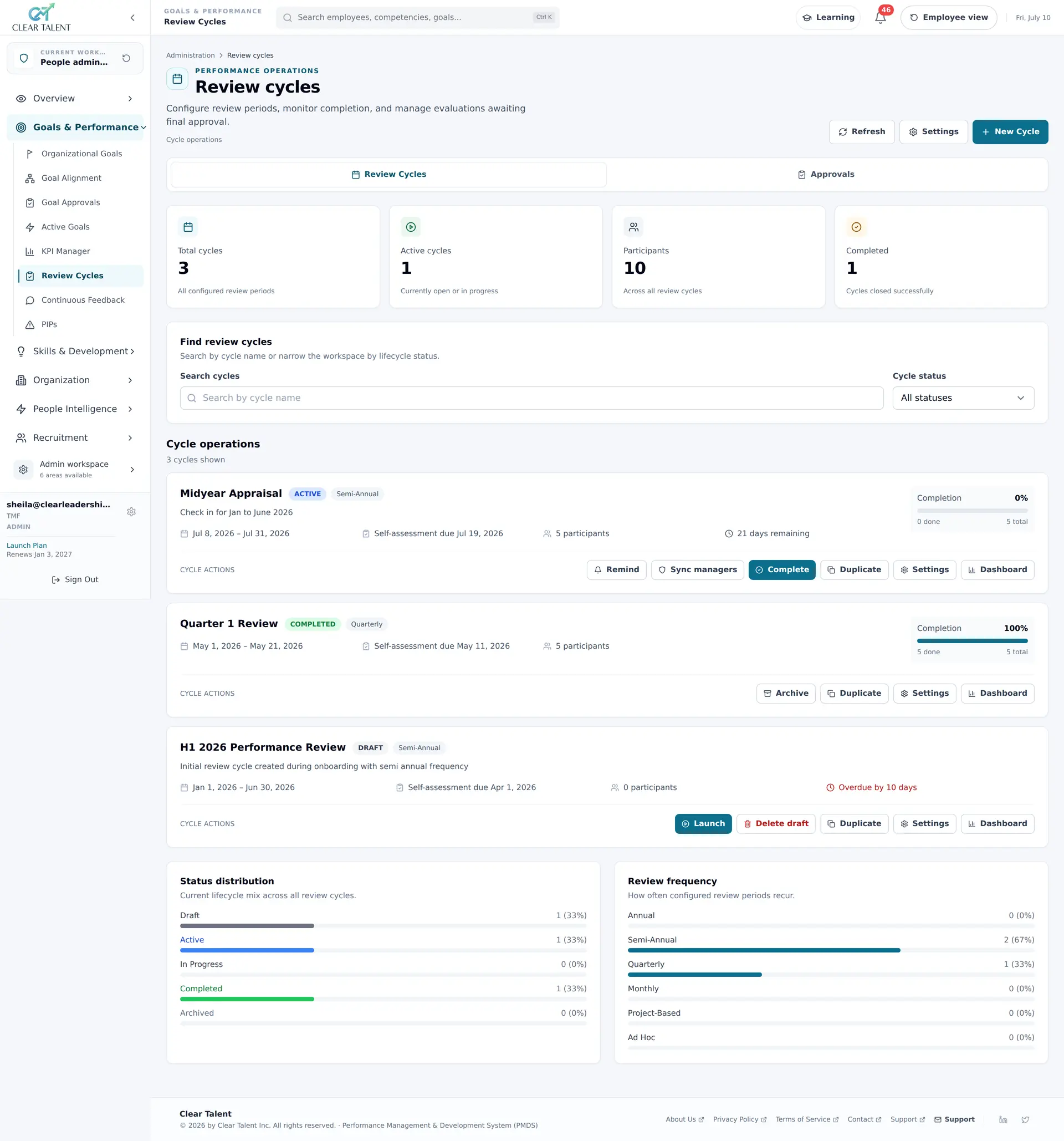
In CLEAR Talent, each review cycle has its own configurable template, rating scales are configurable, and stages open and close on your dates with automated reminders. 1-on-1s, goal check-ins and the performance journal keep a dated record, calibration heatmaps and outlier flags show where managers read the scale differently, and every rating change is written to the audit log.
Access is role-based, reviews export to PDF or Excel, and subject access request exports support the records clause. There is no PIP, disciplinary or appeals workflow; those records stay in your HR case file.