OKR Software That Connects Strategy to Every Role
Strategy dies in the gap between the leadership offsite and Monday morning. CLEAR Talent's Strategic Linked Goals (SLG) framework cascades every company objective down to the individuals who deliver it — visibly, measurably, and in real time.
- Parent-goal linkage
- Enforced
- Goals & KPI portfolios
- Weighted
- Goals, KPIs & weightings
- AI-drafted
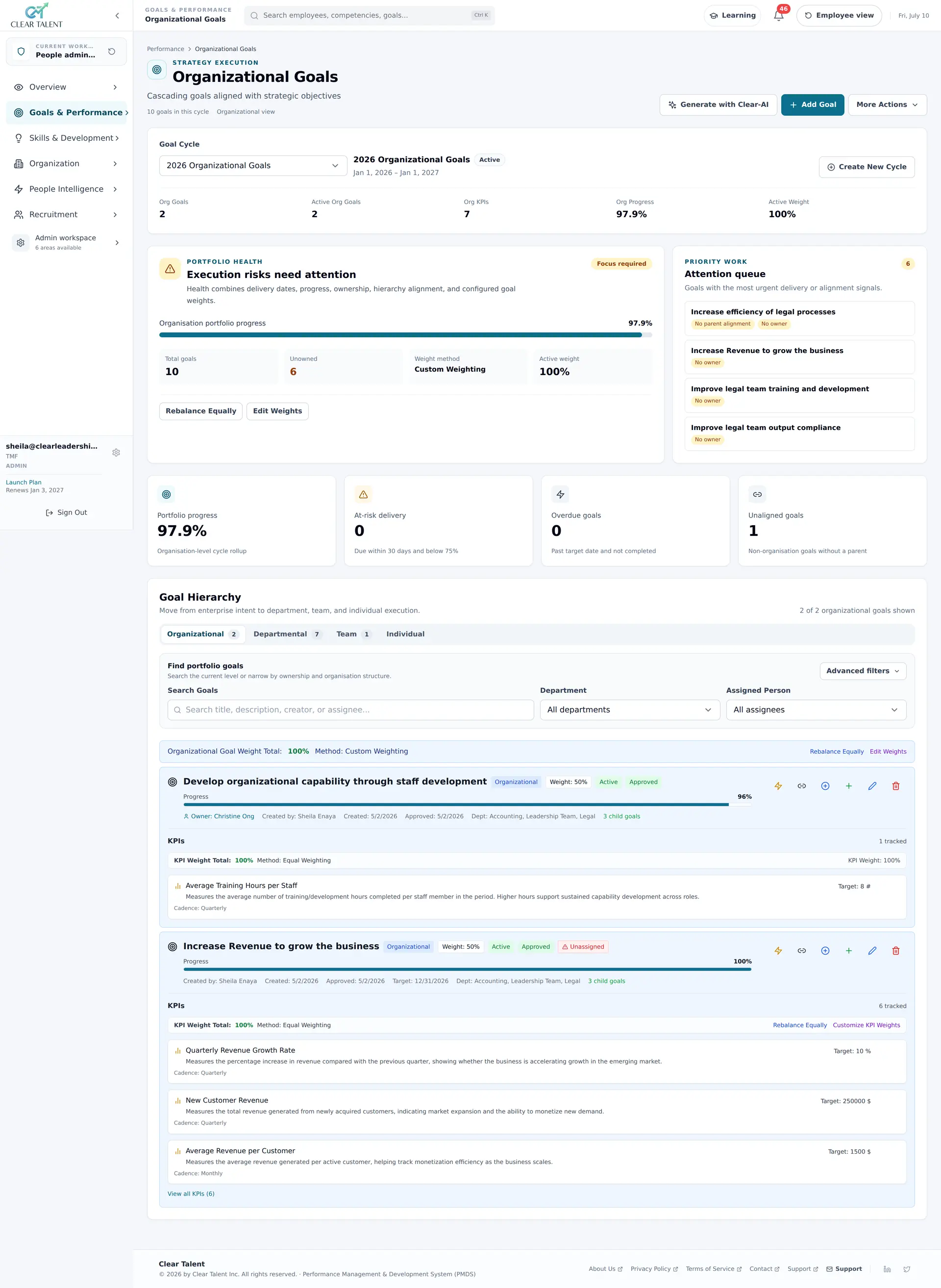
Why goal programmes lose the thread by the second quarter
Most organisations are not short of objectives. They are agreed at the start of the year and translated through a round of planning meetings, and by the second quarter the connection between what leadership asked for and what teams are actually working on has become a matter of opinion.
The framework is rarely the problem. The link between an individual goal and the objective it serves usually lives in a slide deck or a spreadsheet column nobody is obliged to fill in. Goals get written without a parent, weights stay equal because nobody chose otherwise, and progress is reconstructed from memory when the review arrives.
OKR software earns its place by making those links structural: a goal cannot float free of strategy, a priority is stated as a weight rather than implied, and progress is visible while there is still time to act on it.
From boardroom objective to individual goal
CLEAR Talent holds the cascade as one connected structure, not a set of documents that someone has to keep in step by hand.
- 1
Set the organisation objectives
Leadership records the outcomes the organisation is working towards. Most organisations set these annually, because that is the horizon on which company-level objectives genuinely change.
- 2
Translate them for departments and teams
Each department and team sets goals describing its own contribution to a parent objective — a distinct contribution, not the company objective copied down with a smaller number attached.
- 3
Link every individual goal to a parent
Individual goals are written against a team or organisation goal. Strategic Linked Goals will not accept an individual goal without one, so any piece of work can be traced upwards to the objective it serves.
- 4
Approve, track and score
Goals an employee drafts go to their manager, who can approve them, reject them or send them back with requested changes. Approved goals are tracked through check-ins and scored at the end of the cycle.
Linkage that is enforced, not requested
Asking people to link each goal to a parent objective works for as long as someone keeps checking. Strategic Linked Goals makes it a rule instead: an individual goal that is not connected to a parent cannot be created.
That single design decision removes the strategic drift you see in spreadsheet OKRs. Orphaned goals — work nobody at the top knows is happening — cannot quietly accumulate, and a team cannot spend a quarter optimising for something the organisation stopped asking for.
A visual cascade map shows every goal and the objective it rolls up to, so leaders can see which objectives are well supported and which have nothing beneath them yet.
Where the cascade breaks, on one screen
A cascade is only as strong as its weakest links, so the goal alignment view opens on the problems rather than on the full tree. It is where an HR or strategy lead checks, mid-cycle, whether the objectives set at the start of the year are still the ones people are working towards.

- 1
Overall alignment
One alignment score for the goals in view, with how many of them are strongly or moderately aligned, so a leadership team can tell at a glance whether the cycle is holding together.
- 2
Weak alignment and cascade gaps
Goals with weak or missing alignment signals, and goals below organisation level with no parent connection. These are where the cascade breaks — a short list to work through rather than a tree to search.
- 3
Unlinked KPIs
KPIs in the cycle that are not connected to any goal: measures someone is tracking that do not yet count towards an objective.
- 4
Goals without an owner
Active goals with nobody accountable are called out on their own, because direct KPI inputs on those goals are left out of score roll-ups until an owner or assignee is assigned.
- 5
Network, tree or list
The cascade itself can be explored three ways: a network to see relationships, a tree to follow it down from the top, and a list for a focused review.
OKRs, SMART goals and weighted KPIs on one platform
CLEAR Talent is methodology-agnostic. What holds a goal programme together is the linkage between goals, not the vocabulary used to describe them.
OKRs with key results
An objective and the measurable key results that show it was achieved, typically on a quarterly rhythm for teams and individuals.
SMART goals
Specific, measurable goals with success criteria and a target date. Ava can suggest SMART goals for a role as a starting point for the employee and manager to edit.
Weighted KPIs
Ongoing measures held together in a KPI portfolio and weighted to reflect what the role is accountable for. Portfolio weights count only active KPIs, so a retired metric no longer holds a share of anyone's score.
A mix of all three
Departments and levels can use different frameworks and cadences on the same platform, and every goal still rolls up to the same organisation objectives.
KPIs that mean the same thing in every team
"Exceeded target" is only a useful phrase if it means the same thing in sales, in support and in finance. A central KPI library is how that consistency survives a dozen different managers.
Reusable, role-aware templates
Define a KPI once and reuse it for every role that carries it, instead of each team rebuilding its own version with slightly different wording.
Performance bands and guardrails
Bands and guardrails are agreed centrally, which keeps scoring consistent between teams rather than letting each one recalibrate its own definition of success.
Cascaded with configurable weightings
KPIs cascade from organisation goals down to teams and individuals with the weightings you set, so a score reflects the measures a role is actually accountable for.
Evidence linked to every score
Evidence can be linked to each KPI result, so when someone asks how a score was reached, the answer is in the record rather than in a mailbox.
Weighting is the priority signal people actually read
Once someone holds more than two goals, the weights on them are the clearest statement of priority they will get all year. Equal weights say that nothing matters more than anything else — which is almost never what leadership means.
Goal weighting in CLEAR Talent is configurable per level: equal, manager-weighted or custom percentages. A person's goal weights for a period cannot total more than 100%, so a new priority has to take its share from an existing one rather than quietly landing on top of it.
One level up, the balance between goals and KPIs on one side and competency assessment on the other is configurable per level as well — so a revenue-generating role and a control function can sit on the same platform without being measured the same way.
Spot a drifting goal in month two, not at review time
Dashboards keep progress in front of the people who can still change the outcome.
Completion by department
Goal completion rates by department, team, manager and individual.
At-risk flags
Goals falling behind are flagged automatically from pace and check-in signals, so the conversation happens while the quarter is still running.
Cascade coverage
Objectives that nothing has been linked to yet are surfaced for leaders — usually the first sign that a priority has not landed.
Score projections
End-of-cycle score projections based on current pace, so an outcome nobody wanted is visible while there is still time to change it.
A new priority lands halfway through the quarter
Goal programmes rarely fail at the planning offsite. They fail when leadership changes its mind six weeks later and nobody updates anything. Here is that moment followed through the platform, as an illustrative example.
- 1
Leadership adds the objective to the live cycle
The new organisation goal goes into the current cycle with its success criteria, a weight, a target date and the departments it applies to. Assignees are limited to admins, managers and people managers in those departments, so it lands with someone who can act on it.
- 2
The roll-up rule is decided up front
Every goal carries a progress roll-up setting that controls how its progress is calculated from child goals, linked KPIs and key results, with an average as the default. Choosing it now avoids an argument at quarter end about why the parent reads the way it does.
- 3
Weights make room instead of piling up
Department and team goals are written against the new objective. Because a person's goal weights for a period cannot total more than 100%, the new priority takes its share from an existing goal. At organisation level the portfolio can be rebalanced equally or weighted by hand.
- 4
The alignment view confirms it landed
A week later, the goal alignment view shows whether the change reached the people doing the work: cascade gaps where a goal has no parent, KPIs not yet linked to any goal, and active goals still without an owner.
Check-ins that keep goals live between cycles
A cascade that is never revisited between the setting meeting and the review meeting turns into documentation. Check-in prompts tied to each goal and structured progress updates replace the ad-hoc "how's it going?" catch-up, so managers coach against the goal and its evidence rather than against what they happen to remember.
Priorities move, and changing a goal mid-cycle is normal. What damages trust is a goal quietly rewritten at year end, so goal status changes are written to the audit log and an adjusted goal stays a visible decision.
Check-ins can be completed on the web or in the iOS and Android apps, in 16 languages, so keeping a goal current is not something only desk-based staff find easy.
Goal scores that carry straight into the performance review
Goal scores roll up into the performance review automatically, so the cycle closes on the same data it opened with. Nobody retypes a quarter of results at year end, and nobody argues about which version of a spreadsheet is current.
Quarterly and annual cycles run side by side. Teams can work to quarterly OKRs while compensation and promotion decisions stay on the annual cycle, with each quarter feeding the annual review. Decide early how much of the annual rating goal scores should carry, because the roll-up applies exactly the weighting you configure.
In the review, goal achievement sits alongside evidence-based competency ratings and structured 360° feedback, combining into one composite rating whose parts stay visible — so a calibration session can question a goal score without disturbing the rest of the rating.
Ava drafts the goals. People decide what matters.
The blank page is the slowest part of goal setting. Ava can draft goals, KPIs and weightings tailored to a role and hand them back for the employee and manager to edit and approve.
What no tool can do is decide what your organisation should prioritise this year. Every Ava output is labelled and editable, and Ava can be switched off per cycle, team or module.
Related solutions
- Competency management softwareA reusable competency library with behavioural anchors, proficiency levels and skills-gap dashboards.
- Employee development and IDP softwareTurn competency gaps into individual development plans that managers track at every check-in.
- Continuous performance management1-on-1s, goal check-ins, feedback and a performance journal that carry into the year-end review.
- Performance management for technology companiesQuarterly OKRs, skills-based career ladders, 360° feedback and calibration for engineering and product teams.
Guides, walkthroughs and more
Frequently asked questions
Can't find what you're looking for? Talk to a specialist →
What is OKR software?
How is OKR software different from tracking goals in a spreadsheet?
Do you support quarterly OKRs and annual goals?
Can employees write their own goals?
How does goal weighting work?
Can I see goal alignment across the whole company?
How do we find goals that have drifted away from strategy?
How is progress on a parent objective calculated?
What happens when a new priority is added in the middle of a quarter?
Can OKRs feed into performance reviews?
Is CLEAR Talent a standalone OKR tool?
See okr & goal setting software in action.
Book a live demo with a CLEAR Talent specialist. No generic slide deck—just the platform and a conversation focused on your scenario.