Review cycles
Quarterly performance review template and agenda (with 10 check-in questions)
When a quarterly review works better than relying on the annual or mid-year review alone, a 45-minute agenda, ten check-in questions on goals, blockers, development and wellbeing, rated and rating-free variants, a copy-paste template and what to write down afterwards.
By the CLEAR Talent team13 min read
Key takeaways
- A quarterly review sits between monthly one-to-ones and the annual review: long enough to see a pattern, short enough to change course before the year is gone.
- Keep it to 45 minutes with a fixed agenda: wellbeing, goals, blockers, development, then next quarter’s goals and actions.
- Default to a rating-free quarterly review. If you rate, rate goal progress, and let calibration at year end decide the overall rating.
- Write a short summary within two working days, let the employee add comments, and record decisions and evidence rather than impressions.
Monthly one-to-ones are good at the next few weeks: this week’s priorities, the problem that came up on Tuesday, the piece of feedback that cannot wait. The annual review is good at the year: a rating, a comparison with peers, a pay or progression decision. What neither does well is the middle distance. Is this person still working on the right goals? Is the development plan agreed in January actually happening? Has anything changed since the last formal conversation that should change the plan?
A quarterly performance review fills that gap. It is a structured 45-minute conversation every three months that looks back at the quarter, resets goals for the next one and keeps development on the agenda. This guide explains when a quarterly cadence beats relying on an annual or mid-year review alone, sets out a 45-minute agenda and ten check-in questions, compares a rating-free and a rated variant, and ends with a copy-paste quarterly check-in template and a list of what to document afterwards.
When a quarterly review beats an annual or mid-year review alone
An annual review asks one meeting to carry goal-setting, development and a pay decision for twelve months of work. Adding a mid-year review halves the gap, but six months is still long enough for goals to go stale and for most of what happened to be forgotten. A quarterly review does not replace either of them. It gives the year four points where goals are checked and reset, so the annual review summarises a record rather than reconstructing one.
Quarterly is not always the right answer. In a small team where the manager sees everyone’s work every day and goals rarely change, monthly one-to-ones and a good annual review may be enough. The quarterly cadence earns its place when one or more of the following is true.
- Priorities move within the year
- Product, sales, project and fast-growing teams often find that a goal set in January no longer matters by April. A quarterly review is where it is closed or rewritten, rather than scored as a miss in December.
- You already run quarterly OKRs
- If objectives and key results are set by quarter, the quarterly review is the natural place to score the last set and agree the next. Running the two separately doubles the meetings and splits the evidence.
- Development plans go quiet between reviews
- If the development actions agreed at the annual review are rarely mentioned again until the next one, a quarterly checkpoint puts them back on the agenda four times a year.
- One-to-ones have become purely operational
- Monthly one-to-ones tend to fill with this week’s work. A quarterly review protects time for the longer view without turning every one-to-one into a formal review.
- Year-end ratings rely on memory
- If managers struggle to remember the first half of the year when they write the annual review, four short quarterly summaries give them dated evidence to draw on.
Guide: annual vs continuous performance reviews, and the hybrid most teams settle on
How to prepare for a quarterly performance review
A 45-minute review only works if neither person spends the first twenty minutes working out what happened. Preparation takes each side about twenty minutes.
Book the next four reviews in one go
Put all four quarterly reviews in the calendar at the start of the year, in the two or three weeks after each quarter closes. A review booked a quarter at a time is the first meeting to slip when work gets busy.
Send the template a week ahead
Share the agenda and the questions with the employee at least a week before, so they can think about goals, blockers and development rather than answering on the spot.
Employee: note progress and one thing to raise
The employee notes the status of each goal with evidence, one thing that went well, one thing that got in the way and one development wish, and shares it two working days before the meeting.
Manager: read the record, not your memory
Review goal status, check-in notes, feedback and journal entries since the last quarterly review. Pick one strength and one development point, each with a specific example.
Check last quarter’s actions
Open the summary of the previous quarterly review and check whether the agreed actions happened, on both sides. If the manager promised support that did not arrive, say so first.
How to run a quarterly performance review in 45 minutes
Keep the order fixed and the timings roughly to plan. Goals get the most time, but the conversation starts with the person, not the spreadsheet, and ends with agreements rather than a summary of the past.
0–5 minutes: open and check in
Ask how the quarter has been and whether the workload is manageable. Listen before moving on: if something significant comes up, the rest of the agenda can wait for another day.
5–20 minutes: review each goal
Take each goal in turn: is it on track, at risk or behind, what is the evidence, and does it still matter? Agree whether each one continues, changes or closes. A goal made irrelevant by a change in priorities is closed, not counted as a miss.
20–28 minutes: blockers and support
Ask what slowed the work down and what the employee needs from the manager or from others. Agree who will do what about each blocker, including the manager.
28–38 minutes: development
Look at the development actions agreed last time and whether they happened. Agree one or two for the next quarter, tied to a skill or competency the role needs, each with an owner and a date.
38–45 minutes: agree the next quarter
Confirm the goals and priorities for the next three months, read back the actions from the meeting, and confirm the date of the next quarterly review.
If the meeting runs out of time, cut the goal review short, not development. Goals have check-ins between reviews; development usually has nowhere else to go.
10 quarterly check-in questions: goals, blockers, development and wellbeing
Ten questions are more than one meeting needs. Pick five or six that fit the person and the quarter, and keep the same core set across a team so the answers are comparable from quarter to quarter.
- 1. Goals: which goal moved furthest this quarter, and what made the difference?
- Starts with progress and asks for the cause, which tells you what to repeat. Listen for evidence rather than effort.
- 2. Goals: which goal is furthest behind, and is it still the right goal?
- Separates goals that need help from goals that no longer matter. The second kind should be closed or rewritten, not carried into the next quarter by default.
- 3. Goals: what would make next quarter a success for you?
- Invites the employee to propose next quarter’s priorities before the manager states them, which usually produces goals the employee owns.
- 4. Blockers: what slowed you down this quarter that was outside your control?
- Surfaces process, tooling and dependency problems that a manager can often fix more easily than the employee can.
- 5. Blockers: what do you need from me that you are not getting?
- A direct question about the manager’s own contribution. Ask it every quarter, and act on at least one answer, or people stop answering it honestly.
- 6. Development: what did you learn this quarter that you want to use more?
- Connects development to real work rather than to a course catalogue, and often points to the next stretch assignment.
- 7. Development: which skill would make the biggest difference to your work next quarter?
- Keeps the development plan current. Tie the answer to a skill or competency the role needs, and agree one practical action for it.
- 8. Development: where do you want to be in a year, and does this quarter’s work move you towards it?
- A short career check that stops the quarterly review being only about delivery. It does not need an answer every quarter, but it needs asking.
- 9. Wellbeing: how sustainable has your workload been, and what would you change?
- Asks about the work rather than about the person’s health. Agree a change if the answer is “not very”, and follow it up next quarter.
- 10. Wellbeing: is there anything outside the work itself that is making the job harder at the moment?
- Gives space to raise something without requiring it. If the answer involves health or personal circumstances, offer support and the right route to HR or occupational health, and keep the details out of the review notes.
Guide: constructive feedback examples for the conversations that follow
Rating-free or rated: choosing the quarterly variant
The same agenda and questions work with or without a rating. What changes is what the review produces and how it feeds the annual review.
Comparison
Rating-free and rated quarterly performance reviews
| Factor | Rating-free | Rated |
|---|---|---|
| How it works | ||
| What it produces | A written summary, a status for each goal and agreed actions. | The same, plus a score for each goal or an overall rating on the published scale. |
| Effect on the conversation | Attention stays on what happened and what comes next. | The rating can dominate; employees often wait for the number before engaging with the rest. |
| Effort for managers | Lower: a summary and actions. | Higher: each rating needs evidence and a consistent reading of the scale. |
| Feeding the annual review | ||
| How it carries forward | Four summaries become the evidence the annual rating is written from. | Quarterly scores roll up into the annual review with the weighting you set in advance. |
| Consistency across managers | Checked once, in the annual calibration. | Needs checking each quarter, or quarterly ratings drift between managers before anyone looks. |
| Best for | Most teams, and any organisation introducing quarterly reviews for the first time. | Teams on quarterly OKRs or KPIs where goal scores are already objective and part of the annual rating. |
A common middle path: rate goal progress each quarter (on track, at risk, behind, or a goal score) and keep the overall performance rating for the calibrated annual review.
Whichever variant you choose, decide it before the first quarter starts and tell employees which one they are in. Changing from rating-free to rated mid-year makes the earlier summaries look like they were something else.
Copy-paste quarterly check-in template
The whole quarterly review on one page: what each person prepares, the prompts for each part of the 45 minutes and what goes in the record. Copy it into your own document or download it as a CSV.
Template
Quarterly performance review template
| Section | Prompt | What to record |
|---|---|---|
| Before the meeting | ||
| Details | Name, role, manager, quarter and date of the conversation; rated or rating-free variant. | Filled in when the review is booked. |
| Employee preparation | Status of each goal with evidence, one thing that went well, one thing that got in the way, one development wish. | Shared with the manager two working days before the meeting. |
| Manager preparation | Goal status, check-in notes and feedback since the last review; one strength and one development point, each with an example. | Preparation only. What is discussed goes in the record. |
| In the meeting (45 minutes) | ||
| Opening and wellbeing (5 min) | How has the quarter been, and how sustainable has the workload been? | Workload concerns and any support agreed. No health details. |
| Goals (15 min) | For each goal: on track, at risk or behind, the evidence, and does it still matter? | Status of each goal, the evidence, and any goal closed, changed or added. |
| Blockers (8 min) | What slowed you down, and what do you need from me or from others? | Each blocker with an owner and a date, including actions for the manager. |
| Development (10 min) | Did last quarter’s development actions happen? Which skill or competency next? | One or two development actions with an owner and a date. |
| Next quarter (7 min) | What are the goals and priorities for the next three months? | Agreed goals and the date of the next quarterly review. |
| After the meeting | ||
| Summary | Manager writes a short summary within two working days; the employee reads it and adds comments. | The summary, the employee’s comments and the date both saw it. |
| Rating (rated variant only) | A status or score for each goal, or a rating on the published scale, each with its evidence. | The rating and the evidence behind it. |
Timings add up to 45 minutes. Shorten any section except development, and keep the order.
What to document after a quarterly review
The quarterly summary is what the annual review will be written from, so it needs to hold decisions and evidence, not a transcript. Five or six short paragraphs is plenty.
Checklist
What to document after every quarterly review
Work through it when you write the summary, within two working days of the meeting.
Record in the summary
- The status of each goal, with the evidence for it
- Any goal closed, changed or added, and the reason
- Blockers raised, and who agreed to do what about each one
- Development actions agreed, each with an owner and a date
- Goals and priorities agreed for the next quarter
- The date of the next quarterly review
- The rating and its evidence, if you use the rated variant
Check before you save
- Every point describes what happened or what was agreed, not a guess about motives or personality
- No health, family or private-life details; support agreed is noted, the reason for it stays with HR
- You would be comfortable with the employee reading every line, because they can ask to
- The employee has seen the summary and had the chance to add comments
Performance notes are personal data about the employee. Keep them where access is controlled and set a retention period rather than keeping them indefinitely.
Four quarterly review mistakes to avoid
- Turning it into a mini annual review
- Long forms, self-assessments against every competency and a full rating each quarter quadruple the annual workload and wear out managers by the second quarter. Keep the quarterly review short and forward-looking.
- Carrying every goal forward by default
- If no goal is ever closed or rewritten, the quarterly review is not doing its job. Ask whether each goal still matters, every time.
- Letting development slip off the agenda
- When time is short, development is the first thing dropped. Protect its ten minutes, and start with whether last quarter’s action happened.
- Skipping the summary
- A good conversation with no record helps this quarter and nothing after it. Without four summaries, the annual review is written from memory again.
Where CLEAR Talent fits
CLEAR Talent runs quarterly and annual cycles side by side. Teams can work to quarterly OKRs while organisation objectives and the compensation cycle stay annual, cadences can be mixed by department or level, and each quarter’s goal scores roll up into the annual review with the weighting you configure. Review cycles, including quarterly ones, each have their own configurable template, with stages that open and close on the dates you set and automated reminders along the way.
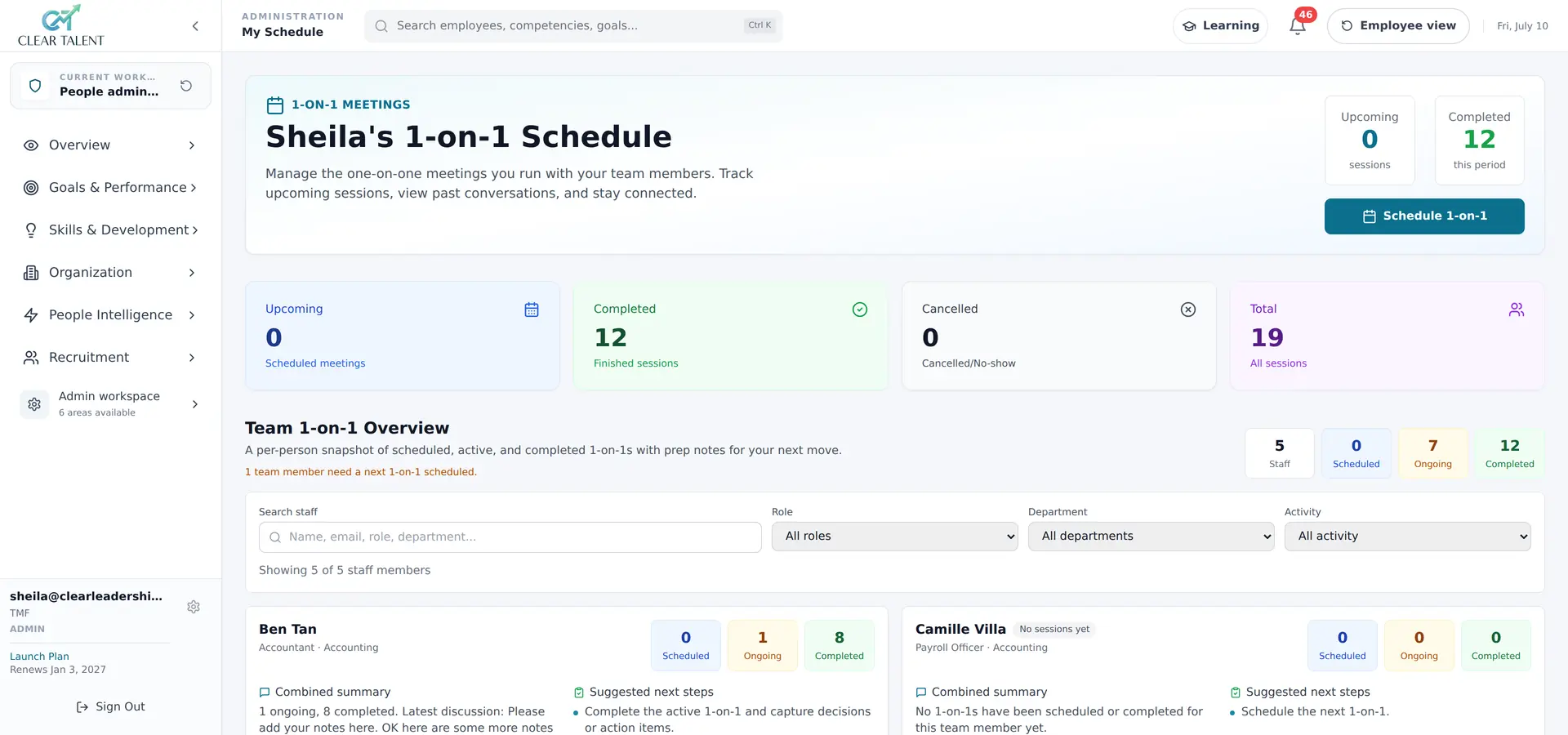
Between reviews, check-ins against each goal keep progress current, and goals falling behind are flagged from pace and check-in signals while the quarter is still running. Managers schedule 1-on-1s, and the team overview calls out anyone without a next session booked. Coaching is recorded as development notes that can be kept private, kudos can be tagged to the competency they show, and the performance journal holds dated observations tagged to competencies. Check-ins work on the iOS and Android apps as well as the web. CLEAR Talent has no survey product, so the wellbeing questions above stay a conversation, not a pulse survey.
See OKR and goal-setting software with quarterly and annual cycles side by side