Review cycles
Performance review self-evaluation: 40 examples and how to write yours
A self-evaluation is your account of the review period, written so your manager can agree, challenge or build on it. How to structure one, 40 example phrases to adapt, and the questions to answer first.
By the CLEAR Talent team16 min read
Key takeaways
- Lead with outcomes, then show how you got there. Adjectives without evidence read as opinion.
- Rate yourself honestly against the standard your rating scale describes — not against colleagues, and not with one eye on negotiation.
- Put a number, a date or a named piece of work on every achievement you can, and do not invent precision you cannot back up.
- In a hard year, say what happened, what you did about it and what you learned, without over-apologising.
- Finish with what you want next: a development goal and the support you need from your manager.
Most people put off their self-evaluation until the evening before it is due, then stare at a blank box labelled “key achievements”. What comes out is usually one of two documents: a modest list that undersells a good year, or a page of adjectives — hard-working, proactive, a real team player — that gives the manager nothing to use.
A good self-evaluation is neither. It is a short, evidenced account of what you delivered, how you went about it and what you want to do next, written so your manager can agree with it, challenge it or build on it. This guide covers how to structure one, then gives you 40 example phrases to adapt — by competency and rating level, for quantifying results, and for a difficult year — and a list of self-review questions to work through before you start. The examples are starting points: replace every bracket with your own specifics and delete anything that is not true of your year.
What a self-evaluation is for
A self-evaluation, or self-assessment, is your account of the review period, written before your manager finalises theirs. In most review cycles it comes first: the self-review, then any peer or multi-rater input, then the manager’s assessment and the review conversation.
It does three jobs. It reminds your manager of work they did not see or have since forgotten — most managers remember the last couple of months far better than the first. It shows how you judge your own performance, which tells your manager where the conversation needs to go. And it puts your priorities for the next period on the record before anyone else sets them for you.
It is not a sales pitch, and it is not a confession. The self-evaluations that land best read like a fair witness statement: specific, balanced and easy to check.
Your manager should be able to verify every claim in your self-evaluation. If they cannot, it will be read as an opinion.
How to write a self-assessment: a five-part structure
Whatever form your organisation uses, the same five parts cover almost every question on it. Draft them in this order, even if the form asks for them in another.
Gather the evidence first
Before you write a word, collect what you already have: your goals and how each one ended, feedback and recognition you received, notes from one-to-ones, finished pieces of work and anything you logged during the period. Writing from evidence is quicker than writing from memory, and it stops the last month standing in for the whole year.
Lead with your main achievements
Pick three to five. For each, say what you did, what changed as a result and how you know. Prioritise outcomes that mattered to your team’s goals over tasks that were merely time-consuming.
Assess yourself against each competency
If your organisation rates competencies such as communication or problem-solving, give your honest rating and one example that justifies it. Use the rating scale’s own descriptions rather than your private sense of what “good” means.
Name what did not go well
One or two areas where you fell short or want to improve, with what you learned and what you will do differently. Choosing these yourself is far better than having them chosen for you.
Set out what you want next
A development goal for the next period, the support you need from your manager, and any change of responsibility or direction you would like to discuss. Most people leave this part out, and it is often the part a manager most wants to read.
Aim for something your manager can read in five to ten minutes. If the form has no word limit, a few short paragraphs per section is usually enough. Length is not evidence.
Self-evaluation examples by competency and rating level
Twenty-four example phrases across eight competencies, each written at one of three levels: exceeds expectations, meets expectations and needs improvement. Use the level that honestly matches your year, then replace the brackets with your own specifics. A phrase with the brackets left vague is exactly the self-assessment you are trying not to write.
Template
Self-evaluation phrases by competency and rating level
Every phrase is written in the first person. Adapt the wording to your role and to the competencies your organisation actually uses.
| Example phrase | Rating level |
|---|---|
| Delivering results | |
| I delivered all [number] of my goals for the period and exceeded the target on [goal] by [amount], which let the team [outcome]. | Exceeds expectations |
| I met my agreed goals for the period. [Goal] was completed on schedule, and [goal] finished within [number] weeks of the original date after the scope changed in [month]. | Meets expectations |
| I completed [number] of my [number] goals. [Goal] slipped because I underestimated [task], and I now break large pieces of work into fortnightly milestones. | Needs improvement |
| Quality of work | |
| I introduced a peer check on [type of work] that the rest of the team has adopted, and rework on [deliverable] fell from [x] to [y] over the period. | Exceeds expectations |
| My work consistently met the agreed standard. Where [reviewer or customer] raised issues, I resolved them within [timescale]. | Meets expectations |
| Several of my [deliverables] needed correcting before release. I now use a checklist before submitting, and I would welcome a mid-period check on whether it is working. | Needs improvement |
| Communication | |
| I wrote the [process or project] guide that [team] now uses as its reference, and ran [number] briefing sessions for colleagues new to [topic]. | Exceeds expectations |
| I kept stakeholders on [project] informed with a weekly update, and flagged the [issue] delay as soon as I knew about it. | Meets expectations |
| I did not always raise problems early enough — on [project] I waited too long to flag [issue]. I now raise risks at the next team meeting rather than trying to solve them alone first. | Needs improvement |
| Collaboration | |
| I led the joint work with [team] on [project], agreed a shared plan within [number] weeks and kept both teams to it through [challenge]. | Exceeds expectations |
| I supported colleagues when workloads peaked, including covering [task] during [period], and followed through on the commitments I made to other teams. | Meets expectations |
| At times I focused on my own deliverables when the team needed help. I have asked [manager] to tell me when capacity is tight so I can offer support earlier. | Needs improvement |
| Problem-solving | |
| I identified the root cause of [recurring problem], proposed a fix that was adopted, and the issue has not recurred since [month]. | Exceeds expectations |
| When [problem] came up, I gathered the relevant information, discussed the options with [person or team] and put a workable solution in place within [timescale]. | Meets expectations |
| I sometimes escalated problems I could have worked through myself. I now try one documented approach before escalating, and note what I tried. | Needs improvement |
| Ownership and initiative | |
| I noticed that [process] was costing the team [time or effort], proposed a change without being asked and put it in place with [manager]’s agreement in [month]. | Exceeds expectations |
| I took full ownership of [area], kept my own work on track without reminders and asked for help when I needed it. | Meets expectations |
| I waited for direction on [area] more than I needed to. For the next period I have agreed with [manager] which decisions I can make without checking first. | Needs improvement |
| Learning and development | |
| I completed [course or qualification], applied it to [piece of work] and shared what I learned with the team through [format]. | Exceeds expectations |
| I made steady progress on my development goal of [skill], mainly through [project or activity], and can now handle [task] with less support. | Meets expectations |
| I made less progress on my development goal of [skill] than I planned, largely because [reason]. I would like to agree protected time for it next period. | Needs improvement |
| Leadership and influence | |
| I mentored [number] newer colleagues through [process or period], and [number] of them now handle [task] independently. | Exceeds expectations |
| I contributed to team decisions, gave my view in [meetings] and supported the final decision once it was made, including where I had argued for another option. | Meets expectations |
| I have not yet led anything beyond my own work. I would like to lead [specific piece of work] next period to build that experience. | Needs improvement |
Examples to adapt, not text to paste. Select the table to copy it into a document, or download it below.
Two notes on choosing a level. First, “meets expectations” is not a weak rating: in most organisations it describes someone doing the job well, and most people land there in most years. Second, a needs-improvement phrase works best when it names a specific gap and a specific change. That is what separates self-awareness from self-criticism.
Quantifying your achievements
Numbers make a self-evaluation easier to believe and easier to remember, and they do not have to be revenue figures. Time saved, volume handled, errors reduced, deadlines met, people trained and requests resolved all count, and so do before-and-after comparisons.
Where the result cannot be measured, make it concrete another way: name the piece of work, the date, the people it affected or the decision it enabled. And do not invent precision. “About a third fewer escalations, based on the team’s tracker” is more credible than a figure to one decimal place that nobody can reproduce.
Template
Eight vague statements, rewritten
The left column is how most first drafts read. The right column makes the same claim specific. Replace the bracketed values with your own figures.
| Vague version | Specific version |
|---|---|
| Rewrites | |
| I worked hard on customer support this year. | I resolved [number] customer tickets this period, and the team’s average first-response time fell from [x] hours to [y] after I rewrote the triage guide. |
| I improved our reporting. | I automated the monthly [report], cutting preparation from [x] days to [y] hours, so it now goes out in the first week of each month instead of mid-month. |
| I helped onboard new starters. | I ran onboarding for [number] new starters, and each of them was handling [task] independently within [number] weeks. |
| I contributed to the product launch. | I owned [workstream] for the [product] launch, delivered it [on time / early], and handled [number] launch-week queries from [team]. |
| I reduced errors. | Errors in [process] fell from [x] a month to [y] after I introduced a pre-submission check in [month]. |
| I managed a lot of projects. | I managed [number] projects this period. [Number] finished on schedule; the one that slipped did so by [number] weeks after an agreed change of scope. |
| I built good relationships with stakeholders. | I set up a fortnightly check-in with [stakeholder team], and their requests now arrive with the information we need instead of taking [number] rounds of follow-up. |
| I saved the company money. | I renegotiated [contract or supplier], reducing the annual cost by [amount] without changing the level of service. |
Every bracket is a placeholder. If you cannot fill one in honestly, rewrite the sentence around what you can show.
If you note it down when it happens, you will not have to reconstruct it at review time.
Self-evaluation tips for a tough year
Missed goals, a project that failed, a restructure, illness or a stretch of personal pressure: most careers include years like this. A self-evaluation cannot change what happened, but it can shape how it is read.
- Name it plainly
- Say what did not go to plan in one or two sentences. Your manager almost certainly knows already, and a self-evaluation that skirts round it reads as either unaware or evasive.
- Separate context from excuse
- Context is legitimate — a reorganisation, a vacancy you covered, a goal that changed mid-year. Say what was within your control and what was not, and do not lean on the second to cover the first.
- Show what you did about it
- What you did once you saw the problem is often the most useful evidence in a difficult year: what you changed, who you asked for help and what you would do differently.
- Still list what went well
- A hard year is rarely only hard. The work you kept going while things were difficult counts, and it belongs in the document.
- Share only what you are comfortable sharing
- If health or personal circumstances affected your year, you decide how much detail to give. It is usually enough to say that circumstances affected part of the period, and to raise anything further privately with your manager or HR.
- Finish with a concrete plan
- Close with what you will do differently and the support you need. A specific plan gives the review conversation somewhere to go other than backwards.
Template
Eight phrases for a difficult review period
Each phrase states what happened, takes appropriate ownership and points forward.
| Example phrase | Use it when |
|---|---|
| Difficult periods | |
| I did not meet my [goal] target. Looking back, I committed to it before [dependency] was confirmed, and I now agree dependencies before accepting a deadline. | You missed a goal and can see why |
| [Goal] was withdrawn in [month] when priorities changed. I redirected that time to [work], which delivered [outcome]. | A goal changed or was cancelled mid-period |
| During the restructure in [period] I covered [responsibilities] alongside my own role. Some of my goals slipped as a result, and I prioritised [work] with [manager]’s agreement. | You absorbed extra work |
| [Project] did not achieve what we set out to do. My part was [area]; what I would change is [specific], and I have already applied that to [current work]. | A project you were part of fell short |
| Personal circumstances affected my work for part of the period. I would like to talk in our review about how that shapes my plans for the next one. | Something outside work affected your year |
| I received feedback in [month] that my [behaviour] was affecting the team. Since then I have [specific change], and I would value your view on whether it has made a difference. | You had difficult feedback to act on |
| I moved into [role] in [month] and am still building confidence in [area]. My priority for the next period is [specific development goal]. | You are new to the role |
| This was not my strongest year. The areas I am most focused on improving are [one] and [two], and the support that would help most is [specific support]. | You want to open an honest conversation |
Adapt these to what actually happened. A phrase that does not match the facts will do more harm than an honest sentence of your own.
Self-review questions to answer before you write
Work through these before you open the form. Your answers become the raw material for every section above, and most review forms ask a version of each.
Checklist
Self-review question list
Answer in rough notes first. Not every question will apply to your role or your year.
Results
- What were my goals for this period, and how did each one end?
- What am I most proud of delivering, and what changed because of it?
- Which piece of work took the most effort, and was the effort worth it?
- What did I deliver that was not on my original list of goals?
How I worked
- Which of my organisation’s competencies or values did I show most clearly, and what is the example?
- What feedback or recognition did I receive, and from whom?
- How did I help colleagues or other teams succeed?
- Where did I take the initiative without being asked?
What did not go well
- Where did I fall short of what I intended, and why?
- What would I do differently if I started the period again?
- What feedback have I received that I have not yet acted on?
Looking ahead
- What do I want to be better at by the end of the next period?
- What would I like to take on or lead next?
- What support do I need from my manager to get there?
- Is there anything about my role, workload or direction I want to raise?
Fifteen questions is plenty. If you have strong answers to half of them, you already have the material for a good self-evaluation.
Common self-evaluation mistakes
- Adjectives instead of evidence
- “Dedicated, proactive and reliable” describes how you would like to be seen. One example of each does far more work.
- Underselling a good year
- Modesty is common and costly. If you delivered something significant, say so plainly and let the evidence carry it — your manager cannot rate what they cannot see.
- Overrating to anchor the conversation
- Rating everything at the top of the scale to leave room for negotiation usually backfires. It suggests weak self-awareness and makes your genuinely strong areas harder to believe.
- Only covering the last few months
- Recency bias affects self-evaluations as much as manager reviews. Look back at your goals and notes from the start of the period before you write.
- Blaming others
- It is fair to explain a dependency that let you down. Naming colleagues as the reason for your own missed goals rarely lands well, and it is hard for a manager to verify.
- Leaving out what you want next
- A self-evaluation with no development goal and no request for support leaves the forward-looking half of the conversation to chance.
For HR teams: collecting structured self-assessments in CLEAR Talent
Most of the advice above is harder to follow when the self-evaluation is a free-text box in a document that arrives the week before the review. Employees write from memory, managers cannot easily compare what they said with what the evidence shows, and the self-rating is quietly overwritten once the manager’s view is in.
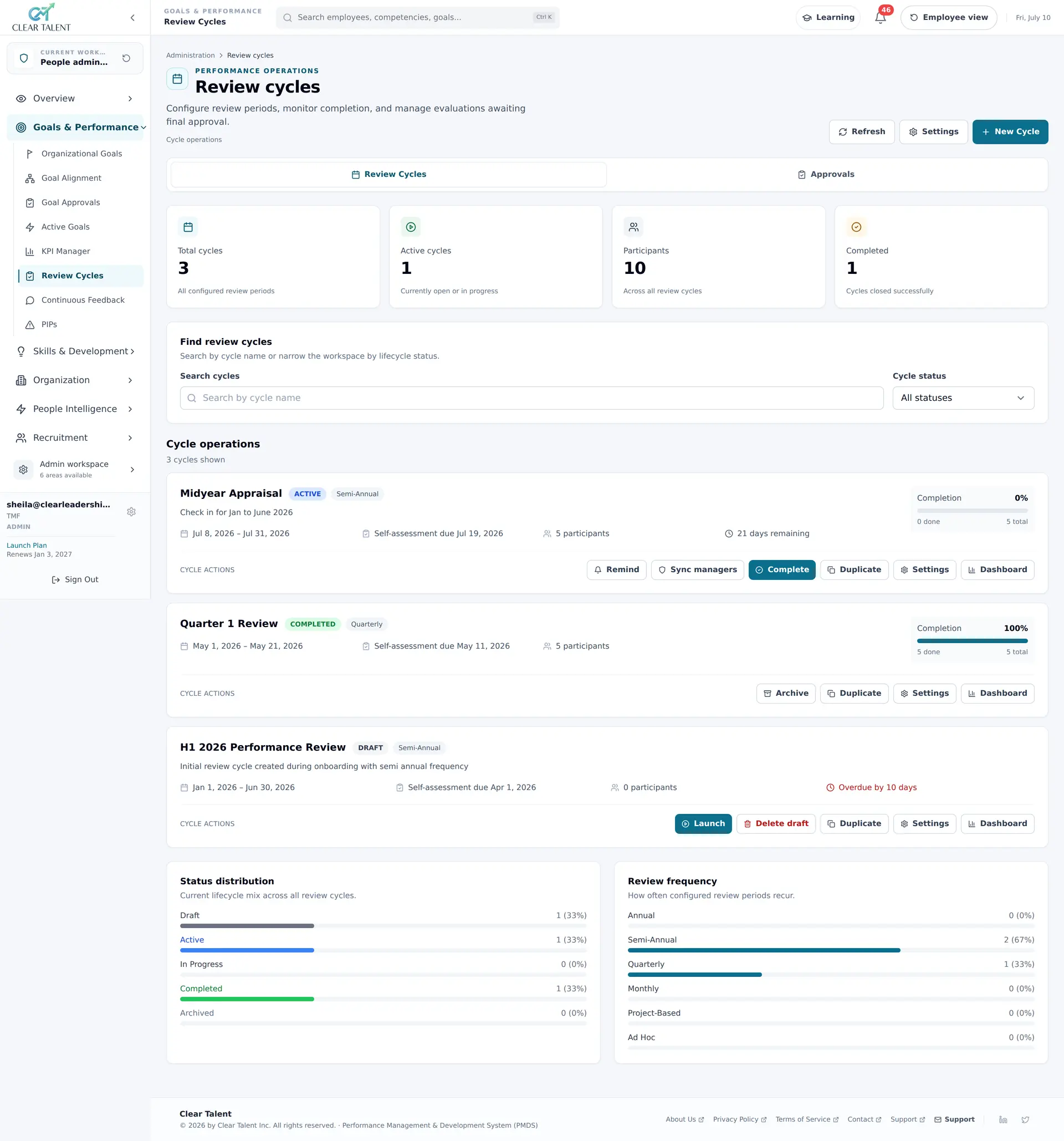
In CLEAR Talent, the self-review is the first stage of a configurable review cycle: self-review, then 360° feedback, the manager review, calibration and a final rating. Each stage opens and closes on the dates you set, with automated reminders for whatever is outstanding. Employees assess themselves against the competencies assigned to their role, and competency ratings can be configured to require written evidence before they are submitted — so a self-rating of “exceeds” arrives with the example behind it.
Self-rating, assessor rating and final rating are held as separate values, each with its own comments, so the gap between how someone sees their performance and how it was assessed stays visible instead of being overwritten. And because goal check-ins, feedback, kudos and 1-on-1 notes are recorded through the period, the review opens with a record of the year rather than a blank page.
A self-assessment is most useful when it is kept alongside the manager’s view, not replaced by it.