Product update
How to keep a performance journal that is still useful at review time
A performance journal only helps if the notes are specific, dated to when things happened and still findable months later. How to keep one — and a fix in the latest CLEAR Talent release.
By the CLEAR Talent team7 min read
Key takeaways
- Write the note while the detail is fresh: what happened, the context and the effect, in a few sentences.
- Date each note to when the event happened, not when you got round to writing it.
- Log achievements as deliberately as problems, and for everyone on the team, not only the people you are worried about.
- Nothing in the journal should surprise the employee at review time. Raise it in a 1-on-1 first.
Most managers agree that a year-end review should cover the whole year. Most year-end reviews still cover the last six weeks, because that is what the manager can remember. A performance journal — a running log of what you observe about each person on your team — is the simplest fix for that, and the one most often abandoned by March.
Journals fail for predictable reasons: notes too vague to be useful later, entries written weeks after the event and dated the day they were typed, and a log that is hard to search when the review finally opens. This guide covers how to avoid all three. It also covers a small fix in the latest CLEAR Talent release that matters to anyone who records notes after the fact: a journal note dated outside the period you are viewing now shows once it is saved.
Why a journal beats memory at review time
Recency bias is not a character flaw; it is how memory works. Events from last week are vivid and detailed, events from last spring are a vague impression, and a rating written in December weights them accordingly. The employee who had a strong first half and a difficult autumn is reviewed on the autumn. The one who coasted until a visible success in November is reviewed on November.
A journal changes what the review is built from. Instead of asking "what do I remember about this person?", the manager starts from a dated list of what actually happened across the period, and the rating conversation becomes a discussion of evidence rather than impressions. It also makes the review faster to write, because the hard part — recalling specifics — has already been done a few minutes at a time.
A review written from memory describes the last few weeks. A review written from a journal describes the period.
What to write in a journal note
A useful note is short and specific. Three or four sentences that someone else could understand without asking you are enough.
- What happened
- The observable behaviour or result, not your interpretation of it. "Rewrote the escalation guide after two missed handovers" is a note; "showed initiative" is a label you can apply later.
- The context
- What made it easy or hard: a deadline, a gap in the team, a change in scope. Context is what stops a single event being over-read six months later.
- The effect
- What changed because of it, for the customer, the team or the work. This is the part that connects a note to a goal or a competency.
- The type
- Whether it is an observation, an achievement or an incident. Keeping the types separate makes it obvious when a log has drifted towards only one of them.
- The competency it evidences
- Tag the note to the competency it speaks to, so that when the person is assessed against their role, the evidence lines up with the framework they are actually measured on.
Date the note to when it happened
Managers rarely write a note on the day. A good week becomes a note on Friday; a difficult client call becomes a note after the follow-up meeting a fortnight later. That is fine, as long as the note carries the date of the event rather than the date it was typed. A journal dated by typing day puts events in the wrong order and, near a period boundary, in the wrong period.
Period boundaries are where this matters most. Something that happened in the last week of one review period is often written up in the first week of the next. Dated correctly, it belongs to the period it describes and is there when that period is assessed. Dated by typing day, it silently moves into the following year’s evidence — or sits outside the period anyone is looking at.
The habit is simple: when you write a note after the fact, set the date first. If you are not sure of the exact day, use the closest date you can stand behind and say so in the note.
What has changed in CLEAR Talent
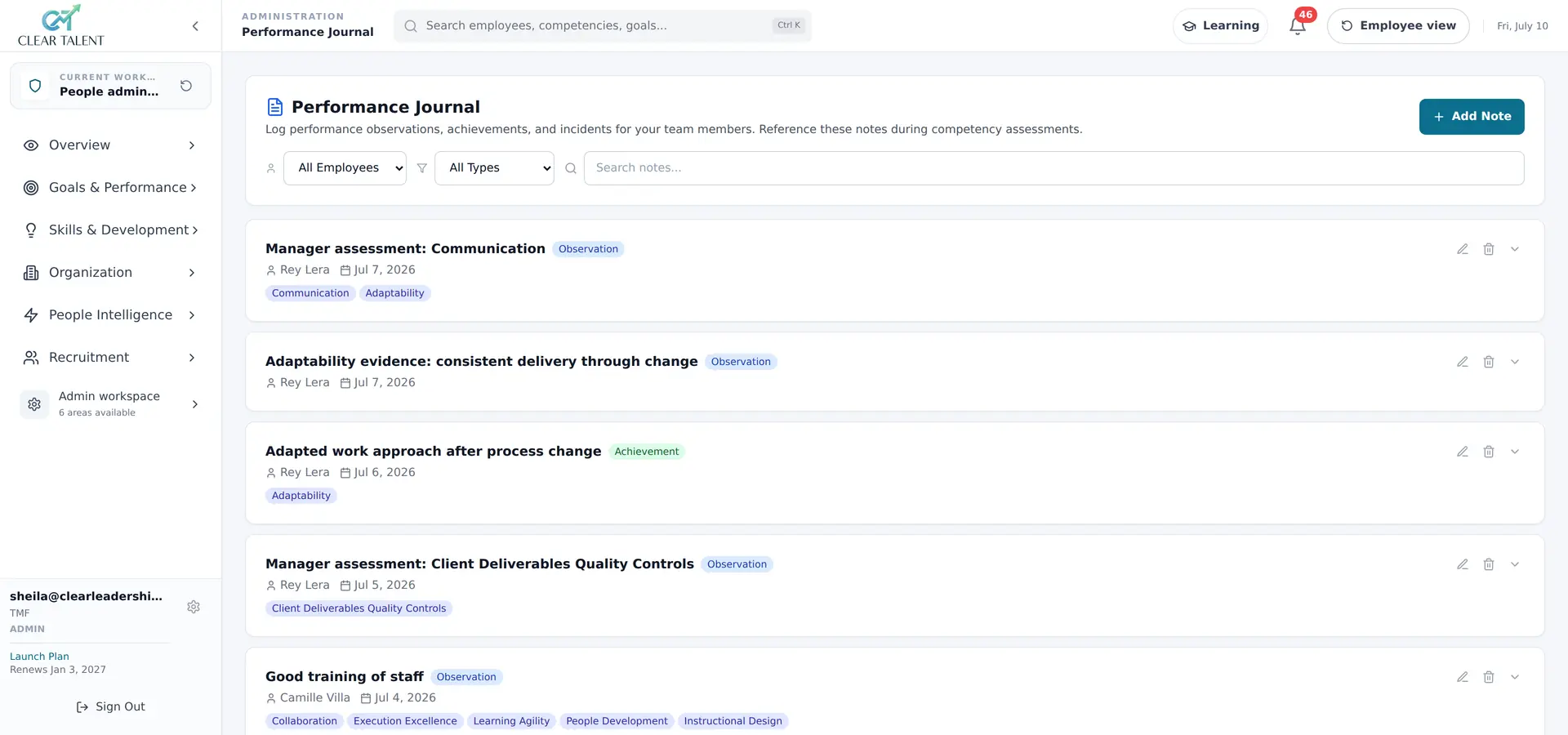
In CLEAR Talent, managers keep the performance journal alongside 1-on-1 development notes and kudos. Observations, achievements and incidents go in as they happen, each can be tagged to the competencies it evidences, and the journal can be narrowed to one employee or one type of note, or searched, when it is time to prepare an assessment.
The latest release fixes how the journal handles notes dated outside the period you have selected. When a manager saves a note whose date falls outside that period — the back-dated note from the end of last period, for example — it now shows after saving. Recording an event against the date it happened is exactly the habit described above, and the journal now reflects it when the note is saved.
It is a small fix, and it changes nothing about how the journal is used. It removes one reason for a manager to doubt that a note went in — which is one fewer reason to date it by typing day instead.
Keeping a journal fair
A journal is a record about a person, and it should be kept as if that person will read it. Write what you saw, not what you suspect. Leave out anything about health, family or private life that has no bearing on the work. If a note would embarrass you read aloud in a 1-on-1, rewrite it.
Balance matters as much as accuracy. A journal that only fills up for the people a manager is worried about becomes a case file, and a review built from it will be harsher for them than for everyone else. Check the log every few weeks: does every team member have entries, and does each person’s log include achievements as well as problems?
Finally, nothing in the journal should be news at review time. If a note records something the employee needs to know — good or bad — raise it in the next 1-on-1. The journal is the memory behind the conversation, not a substitute for having it.
A worked example
This is a hypothetical team, not a CLEAR Talent customer.
A support team lead closes the year’s first review period at the end of June. In the last week of June, one of the team’s analysts spots a recurring fault in the ticket queue and writes a workaround that the whole team adopts. The team lead is busy with the period close and writes the note in the second week of July.
The team lead sets the note’s date to the day in June when it happened, tags it as an achievement against the problem-solving competency, and mentions it to the analyst in their next 1-on-1. When the June assessment is finalised, the workaround is part of the evidence for that period, rather than a note that surfaces a year later in the wrong review.
Using the journal when the review opens
Filter to the person and the period
Start with everything logged about one employee for the period being assessed, in date order.
Group the notes by competency
Read the notes against each competency in the person’s role. Where a competency has no notes at all, treat it as a gap in evidence, not a gap in performance.
Check the balance
Compare achievements with incidents. If the log is lopsided, ask whether that reflects the period or how you kept the log.
Cite, do not summarise
Use specific notes as the examples in your written assessment. A rating backed by two or three dated examples is easier to explain, to the employee and in calibration.
Done this way, the review takes less time to write and is easier to defend — and the employee hears about the whole period, not the last few weeks of it.