Managing performance
Performance improvement plan (PIP) template, with a written example
When to use a performance improvement plan instead of coaching, what the document needs, a 30/60/90-day template you can copy, a written example and how to keep progress on the record.
By the CLEAR Talent team11 min read
Key takeaways
- A PIP is for a specific, evidenced and persistent gap that informal coaching has not closed — never for a problem the employee has not heard about.
- Write objectives someone could verify: what, how much, by when and how it will be checked.
- The support section matters as much as the objectives. A plan without help reads as a formality.
- Check in at least weekly and share a short written summary after each meeting.
- Employment law varies by country and state. Involve HR from the start and consult counsel before a PIP is issued or concluded.
Few documents in people management carry as much weight as a performance improvement plan. For the employee it can feel like the beginning of the end. For the manager it is often the first time months of concern have been written down. And for the organisation it may later be read by someone deciding whether the process was fair.
A good PIP is none of the things people fear. It is a short, specific, time-bound plan that says where someone’s work falls short, what good looks like, what help they will get and when progress will be reviewed — written so that success is genuinely possible. This guide covers when to use one instead of coaching, a 30/60/90-day template you can copy or download, a written example, the documentation cautions to take to HR and counsel, and how to keep progress visible with regular check-ins.
What a performance improvement plan is for
A performance improvement plan (PIP) is a formal, time-bound document for an employee whose work is not meeting the standard of their role. It names the gap with examples, sets a small number of measurable objectives, lists the support the organisation will provide and schedules review points before an end date.
Its honest purpose is improvement. A PIP gives someone a clear target and a fair chance to reach it, and gives the manager a structure for conversations that have often been put off. It frequently sits alongside a capability or disciplinary procedure, which is why it has to be written carefully — but a plan written only to build a paper trail tends to show it, and employees can tell.
If nobody could meet the plan as written, it is not an improvement plan.
When to use a PIP — and when coaching is the better tool
Most performance problems should never reach a PIP. Before you write one, check which situation you are actually in.
- Coach first: the gap is new or has not been raised
- If the employee would be surprised to hear there is a problem, the next step is a direct conversation and informal support, not a formal plan. A PIP should never be the first time someone learns their work is falling short.
- Coach first: the expectation was never clear
- Changed priorities, a new role or a manager who has not set out what good looks like are clarity problems. Write the expectation down, agree it and give it time to work.
- Look further: something outside the work has changed
- A sudden drop in performance can reflect health, caring responsibilities, workload or a team problem. Ask before you assume, and take HR advice if the employee raises a health condition or personal circumstances — the right response may be support or adjustments rather than a plan.
- Consider a PIP: the gap is specific, evidenced and persistent
- You have raised it more than once, documented examples, offered informal support and seen no sustained change. The expectation is reasonable for the role and is applied to others in the same role.
- Use a different process: conduct, not capability
- Misconduct is normally handled through a disciplinary process rather than a performance plan. Mixing the two confuses both, so check with HR which procedure applies.
A useful test: could you show the employee dated examples of the gap and at least one earlier conversation about it? If not, you are probably still in coaching territory.
What every PIP document needs
Checklist
PIP document checklist
Run through this before the plan is shared. Every item should be answerable from the document itself.
The basics
- Employee, manager and HR contact named
- Start date, check-in dates and end date
- The role and the standard it is measured against
The gap
- Two to four specific, dated examples of where work fell short
- The earlier conversations and informal support already provided
- What is going well — the plan is about the gap, not the whole person
The plan
- Two or three objectives, each measurable and time-bound
- How each objective will be checked, and by whom
- The support the organisation commits to: training, coaching, tools or workload changes
- The check-in schedule, with a written summary after each meeting
The outcome
- What happens if the objectives are met, partly met or not met, in the terms your policy uses
- Space for the employee’s comments and how to raise a concern
- Acknowledgement that the employee has received the plan — not necessarily agreement with it
Your organisation’s policy decides the exact fields and wording. Treat this as a prompt for the conversation with HR, not a replacement for it.
A 30/60/90-day performance improvement plan template
Ninety days is a common length because it allows time to change a habit and time to show the change holds. The template splits it into three phases, each ending in a documented review. Replace every bracketed item with the specifics of your case.
Template
30/60/90-day PIP template
Two objectives is usually enough. Add a third only if it is genuinely separate from the first two.
| Element | Days 1–30 | Days 31–60 | Days 61–90 |
|---|---|---|---|
| Expectations | |||
| Focus | Understand the gap; begin the agreed changes | Apply the changes consistently, with less support | Sustain the standard independently |
| Objective 1 | [Specific, measurable first-month target] | [Higher or broader target] | [Full role standard, held for the whole phase] |
| Objective 2 | [Target] | [Target] | [Target] |
| Support | |||
| Manager check-ins | Weekly 1-on-1 | Weekly 1-on-1 | Weekly or fortnightly, as agreed |
| Other support | [Training, shadowing, a named buddy, tools or workload changes] | [Continue, adjust or add support] | [Taper support as agreed] |
| Review | |||
| Checkpoint | Day-30 review; written summary shared | Day-60 review; written summary shared | Day-90 final review and outcome |
| Evidence | [Work samples, figures or observations for each objective] | [Same measures, compared with day 30] | [Same measures across the whole plan] |
The phase lengths are a common pattern, not a requirement — a shorter or longer plan can be appropriate, and your policy may set its own. Select the table to paste it into a document or spreadsheet, or download it below.
Notice that support tapers while expectations rise. By the final phase the question is whether the employee can hold the standard without extra help, because that is what the role will ask of them once the plan ends.
A written PIP example
This is an illustrative example for a fictional employee, not a real case and not a model letter. It shows the level of specificity that makes a plan fair to both sides.
- Role and gap
- Sam is an operations coordinator who prepares weekly client reports. The standard is that reports are sent by 12:00 on Friday and need no factual corrections afterwards. Over the last quarter, five of twelve reports were late and four needed corrections; dated examples are attached. The manager raised this in 1-on-1s in two separate months, and Sam attended a refresher on the reporting tool. Sam’s client communication and work with the finance team are strong and are not part of this plan.
- Objectives
- First, send each weekly report by 12:00 on Friday: at least three of four on time in days 1–30, and every report on time from day 31. Second, reduce corrections: no more than one in days 1–30 and none after day 60. Both are checked from the report log.
- Support
- A 30-minute weekly 1-on-1; the manager reviews Thursday drafts for the first four weeks, then on request; a pre-send checklist agreed together in week one; and, because report preparation clashes with a Friday-morning client call, that call moves to the afternoon for the length of the plan.
- Reviews and outcome
- Written reviews on days 30, 60 and 90, each shared with Sam, who can add comments. If both objectives are met at day 90, the plan closes and Sam returns to the normal 1-on-1 rhythm. If not, next steps follow the organisation’s capability policy, a copy of which Sam has received.
The workload change in the support section is the detail most plans leave out — and often the one that makes improvement possible.
Legal and documentation cautions
This section is general guidance, not legal advice. Employment law differs between countries, states and sectors, and collective agreements or works councils can add requirements of their own. Involve HR from the start, and consult counsel before a PIP is issued and before any decision is taken at the end of one.
- Follow your own policy exactly
- If your capability or performance policy sets out steps, notice, meeting arrangements or an appeal route, the plan must follow them. Departing from your own written process is one of the easiest ways to make a fair decision look unfair.
- Be consistent
- Apply the standard you apply to others in the same role. Before issuing a plan, check whether comparable gaps elsewhere were handled the same way.
- Pause when circumstances change
- If the employee raises a health condition, disability, pregnancy, a grievance or a whistleblowing concern, or has recently returned from leave, stop and take advice before continuing.
- Write facts, not characterisations
- Record what happened, when, and what was agreed. “Report sent at 16:40 on 12 September” holds up; “careless attitude” does not, and the document may be read by people you never expected.
- Keep records contemporaneous
- Summarise each check-in within a day or two, share the summary with the employee and keep their comments with it. A record reconstructed at the end of the plan carries far less weight.
- Keep it confidential
- Limit access to the people who need it, store the plan where your data protection and retention rules say it belongs, and do not discuss it with the wider team.
Running the check-ins
Weekly check-ins are where a PIP succeeds or fails. They stop the plan becoming a 90-day wait for a verdict, and they give the employee a chance to show progress while there is still time to adjust the support.
Keep each one short and structured: progress against each objective with the evidence for it, what helped and what got in the way, any change to support, and what happens before the next meeting. Write it up the same day and share it. When progress is good, say so plainly and put that on the record too — a plan that documents only shortfalls is not a fair record of what happened.
Tracking PIP progress with continuous check-ins in CLEAR Talent
CLEAR Talent does not have a dedicated PIP workflow, and the formal plan, acknowledgements and any outcome letters belong in your HR record-keeping process. What it provides is the continuous record a fair plan depends on — before, during and after the 90 days.
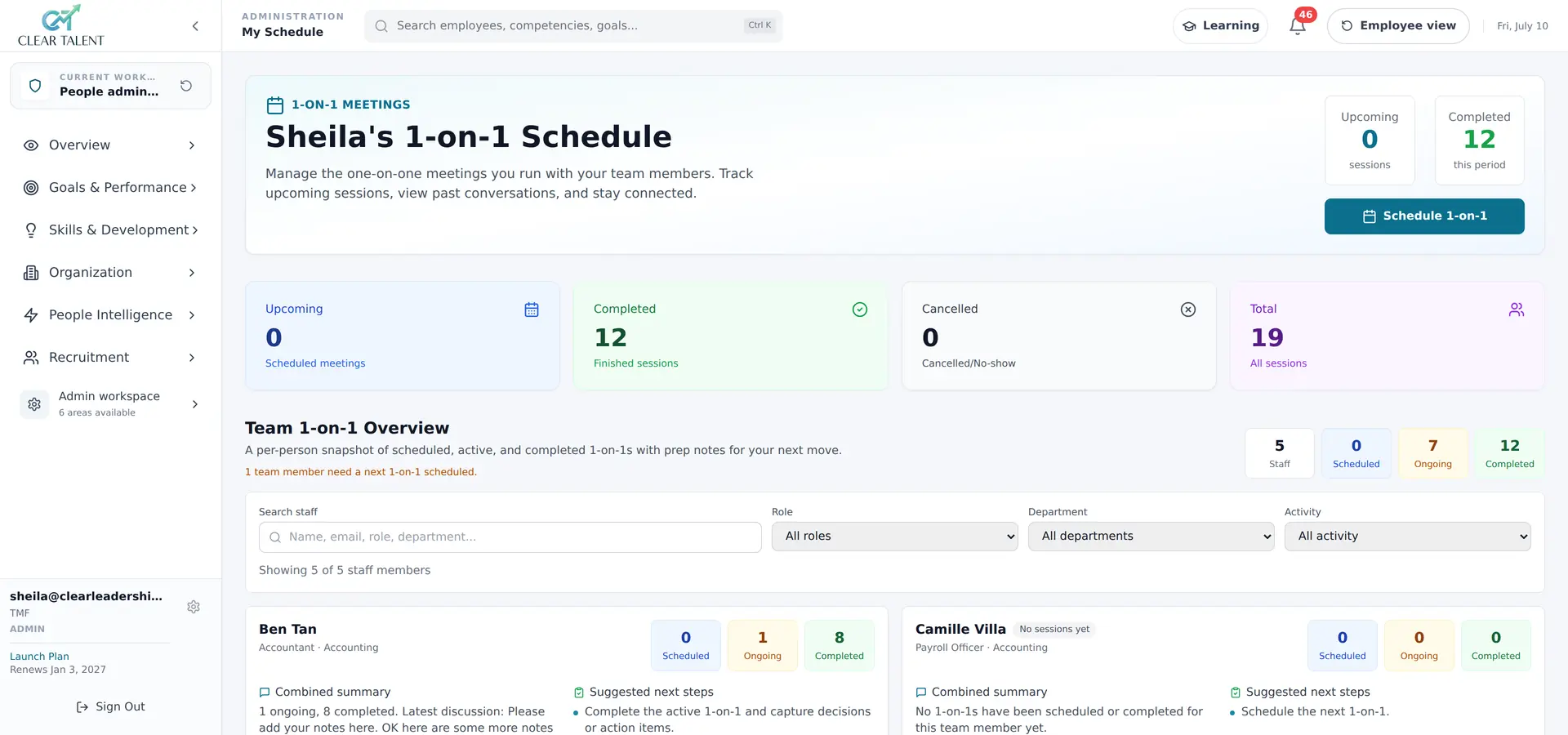
Weekly 1-on-1s are booked from the manager’s own 1-on-1 schedule, which tracks upcoming, completed and cancelled sessions and flags anyone without a next session booked. Coaching agreed in each meeting is recorded as a development note linked to that 1-on-1, and development notes can be kept private. Between meetings, the performance journal holds observations, achievements and incidents as they happen, each tagged to the competencies it evidences — the improvements as well as the shortfalls.
If the plan’s objectives are also set up as goals, check-ins against each goal keep progress current, and goals falling behind are flagged from pace and check-in signals while there is still time to change the support. Changes to goals and ratings are written to an audit trail, so the history is visible if a decision is questioned later.
The same record is most valuable before a PIP is ever needed. A gap that is raised early, coached in regular 1-on-1s and tracked as it goes is far more likely to be resolved at the coaching stage.