Review design
Annual vs continuous performance reviews: which model fits your HR team?
Annual and continuous performance management compared on cadence, admin effort, bias risk, manager time and company size, with a hybrid model, a transition checklist and a self-diagnostic.
By the CLEAR Talent team8 min read
Key takeaways
- Annual reviews are not dead, but an annual review on its own struggles: one meeting a year cannot carry goal-setting, development and pay decisions at once.
- Continuous performance management moves feedback and goal updates into regular check-ins, which costs manager time every month instead of once a year.
- For most HR teams the answer is a hybrid: check-ins that build a record through the year, and an annual review and calibration that turn it into a fair, comparable rating.
- Any model only works if managers hold the conversations. Test that before you change the policy.
Few HR debates run as long as this one. One side says the annual review is a once-a-year ritual nobody trusts; the other says continuous feedback is a pleasant idea that leaves you nothing to base a pay decision on. Both have a point. The useful question is not which model is better in general, but which one your organisation can actually run well.
This guide defines both models, compares them on cadence, admin effort, bias risk, manager time and fit by company size, and sets out the hybrid most teams settle on: quarterly check-ins plus an annual calibration. It ends with a transition checklist and a five-question self-diagnostic to work through with your leadership team.
Annual and continuous performance management, defined
An annual performance review is a once-a-year formal assessment. Goals are set at the start of the year, manager and employee meet at the end to review results and competencies, and the outcome is usually a rating that feeds pay, bonus or promotion. Some organisations add a mid-year review, but the rating still happens once.
Continuous performance management replaces that single event with a rhythm of shorter conversations: one-to-ones every week or month, goal check-ins as work progresses, and feedback given close to the moment it is about. The emphasis shifts from judging the past year to coaching the next few weeks.
The two are often presented as opposites, but they answer different questions. The annual review asks how someone performed against the standard, compared with peers in similar roles. Continuous management asks what they need to do well next. Most organisations need answers to both.
Annual vs continuous performance management compared
How the models differ on the things HR teams have to plan around. The hybrid column is the model described further down.
Comparison
Annual, continuous and hybrid performance management
| Factor | Annual review | Continuous | Hybrid |
|---|---|---|---|
| How it runs | |||
| Cadence | One formal review a year, sometimes with a mid-year check. | Weekly or monthly one-to-ones, goal check-ins and feedback as work happens. | Monthly one-to-ones, a quarterly goal check-in, and one annual review with calibration. |
| Admin effort for HR | Concentrated in one heavy cycle of forms, chasing and sign-off. | Spread across the year: templates, reminders and checking check-ins happen. | A light quarterly rhythm, plus a shorter annual cycle because the evidence is already recorded. |
| Manager time | Little most of the year, then several hours per report in a few weeks. | A steady weekly or monthly commitment per report, all year. | A steady but lighter commitment, and less write-up at year end. |
| Risk and fit | |||
| Bias risk | High recency and first-impression risk, because ratings are written from memory. | Lower recency risk, but no structured check that managers apply the same standard. | A year of notes counters recency; calibration checks consistency before ratings are final. |
| Fit by company size | Workable in small teams where everyone sees everyone’s work; strains as managers multiply. | Suits small, fast-moving teams with confident managers; harder to keep consistent at scale. | Scales from small to large, because calibration supplies the consistency check-ins alone do not. |
These are tendencies, not rules. A well-run annual cycle with good records can beat a continuous model that managers quietly skip.
See continuous performance management: 1-on-1s, goal check-ins and a performance journal
Are annual reviews dead?
Not in the way the headlines suggest. What has fallen out of favour is the annual review as the only performance conversation of the year: one meeting expected to reflect on twelve months, set next year’s goals, plan development and justify a pay decision, usually written from memory the week before.
The parts that still earn their place are the ones continuous management does not supply on its own: a considered look at the whole year, a rating against a shared standard, and a comparison across teams so that similar performance is treated similarly. Where ratings feed pay or promotion, that comparability matters, and under the EU Pay Transparency Directive being able to explain how pay progression decisions were reached matters more, not less.
Teams that drop the annual review entirely often find the judgement has not disappeared, only moved somewhere less visible, such as a pay conversation with no written evidence behind it.
Guide: the EU Pay Transparency Directive and performance reviews
The hybrid model: quarterly check-ins plus an annual calibration
Most HR teams that move away from a pure annual cycle land here. It keeps the evidence-gathering of continuous management and the consistency of an annual review.
Regular one-to-ones
Managers meet each report monthly or fortnightly. The agenda is short — progress, obstacles, feedback and one development action — and a few lines are recorded each time.
A quarterly goal check-in
Once a quarter, review every goal: still relevant, on track, or due to change? Goals are revised here instead of going stale until December.
Notes as things happen
Recognition, coaching points and observations are noted when they occur, tagged to the competency they show, so the detail survives to year end.
An annual review written from the record
The manager rates goal results and competencies against the written standard, citing evidence from across the year rather than the last few weeks.
Calibration before ratings are final
Managers compare draft ratings across comparable roles, starting with the outliers, and record every change with its reason. This is what makes ratings fair enough to inform pay and promotion.
The annual review gets shorter, not longer, because it summarises a year of evidence instead of reconstructing one.
A checklist for moving from annual to continuous or hybrid reviews
Changing cadence is a change-management project more than a policy update. Work through this list before you announce anything.
Checklist
Transition checklist
Decide the design
- Agree what the annual review will still decide — pay, promotion, development priorities — and what moves into check-ins.
- Set the check-in cadence and a minimum, such as one recorded one-to-one per report per month.
- Write a check-in template with no more than four prompts.
- Decide whether you keep ratings, and if so, tighten the rating scale definitions first.
Prepare managers
- Show managers a written example of a good check-in record.
- Explain how check-in notes will be used at year end, so recording them feels worth it.
- Estimate the monthly time per manager and agree it with senior leaders.
Run and review
- Pilot with two or three teams for a quarter before rolling out.
- Track check-in completion by manager and follow up on gaps early.
- Run the first annual calibration from the new records and note what evidence was missing.
- After the first year, ask managers and employees what to keep, change or drop.
If managers are not holding check-ins three months in, the problem is time or skill, not the template. Fix that before adding process.
Which model fits your HR team? A five-question self-diagnostic
Answer each question for your organisation as it is now, not as you would like it to be.
- 1. Do ratings feed pay, bonus or promotion decisions?
- If yes, keep an annual review and calibration in some form. Check-ins alone will not give you comparable, explainable ratings.
- 2. Do managers already hold regular one-to-ones?
- If most do, moving to a continuous or hybrid model is mainly about recording them. If few do, build the habit before changing the policy.
- 3. Do goals change more than once a year?
- If priorities shift every quarter, an annual goal-setting round leaves people working to stale targets. Quarterly goal check-ins are the minimum.
- 4. Do several managers rate people in comparable roles?
- With one or two managers, consistency can be handled informally. With many, you need calibration whatever the cadence.
- 5. Are reviews written mainly from memory?
- If so, recency bias is your biggest risk, and recorded check-ins through the year are the most direct fix.
Yes to questions 1 or 4: keep the annual review and calibration and add check-ins — the hybrid model. Yes to 2 and 3, with little riding on ratings: a continuous model may be enough on its own. Yes to 5, whatever else you answered: start recording check-ins now.
Where CLEAR Talent fits
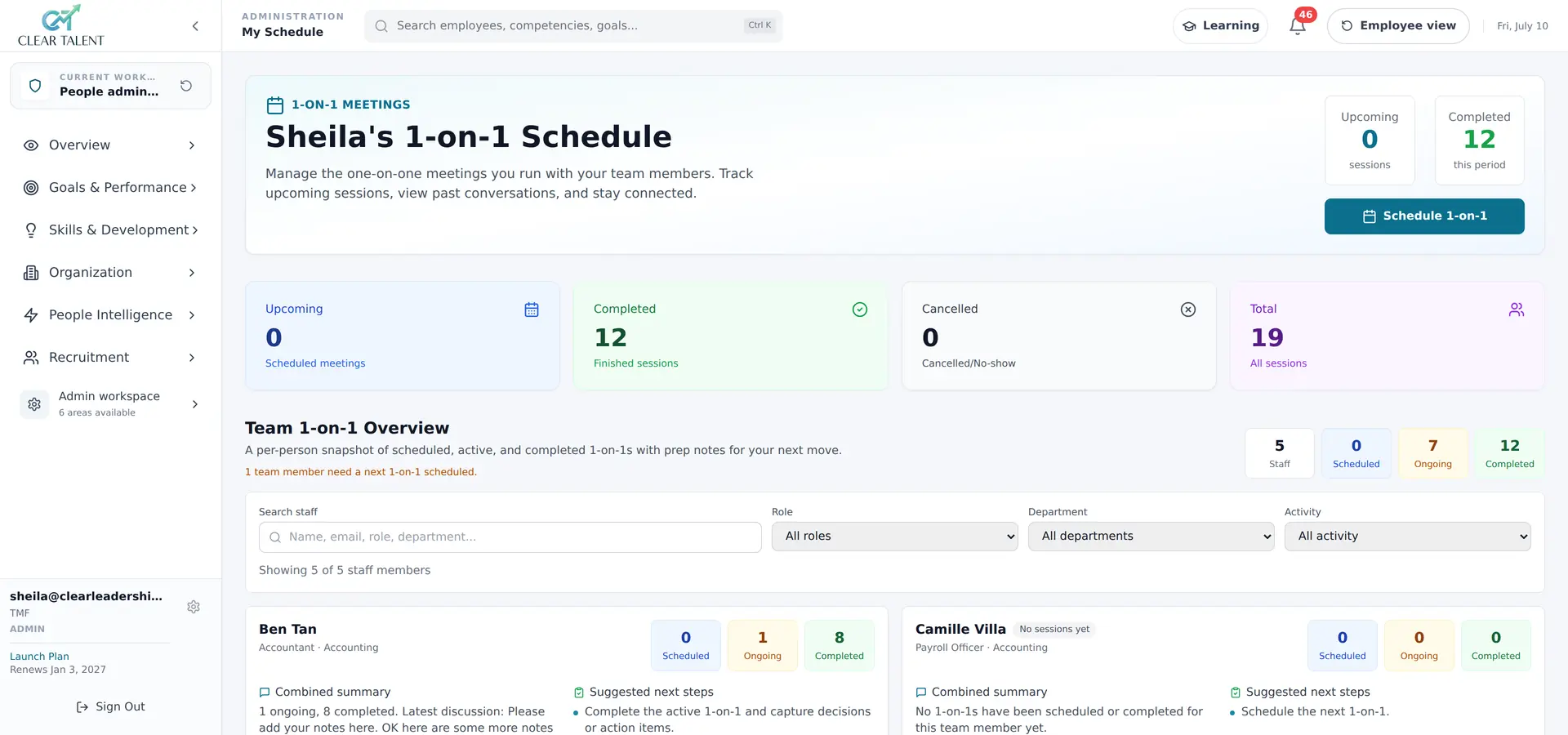
CLEAR Talent is built for the hybrid model. Managers schedule 1-on-1s, record development notes and kudos tagged to competencies, and log observations in a performance journal as they happen. Check-ins against each goal keep progress current, goals falling behind are flagged while the quarter is still running, and check-ins work on iOS and Android.
When the annual review opens, the evidence is already there: check-ins, feedback and goal scores consolidate into the rating instead of being rebuilt from memory. Calibration views use heatmaps and outlier flags to show inconsistent ratings across managers before anything is final, and every change is logged.
See performance management software for goals, check-ins, reviews and calibration