Goals & alignment
How to track employee performance: methods, metrics, tools
A practical workflow for tracking employee performance through the year: five methods that produce evidence rather than activity data, a weekly, monthly and quarterly cadence, what to record and what to leave out under GDPR, and when a spreadsheet stops being enough.
By the CLEAR Talent team12 min readLast reviewed
Key takeaways
- Tracking performance means building a dated record of goals, results and observed behaviour through the period, not monitoring activity.
- Combine several sources: goal check-ins, a feedback log, 360° input, KPI data and 1-on-1 notes. Each one covers gaps in the others.
- A light rhythm kept all year beats a heavy one abandoned by March: a few minutes weekly, a check-in monthly, a goal review quarterly.
- Record only what is relevant to the work, tell people what you record and why, and be cautious about any tool that monitors behaviour automatically.
Most organisations say they track employee performance. In practice, many of them track it once a year: the review form opens, managers reconstruct twelve months from memory and a few emails, and the rating describes the last six weeks. Everything between the reviews went unrecorded, so there is nothing to track.
This guide is about the workflow rather than the metrics. It explains why tracking usually fails, sets out five methods that produce usable evidence, suggests a weekly, monthly and quarterly cadence a busy manager can keep, covers what to record and what to leave out under European data protection rules, and compares running it all in a spreadsheet with using performance software. If you are still choosing what to measure, start with our guide to employee performance KPIs and come back here for how to keep track of them.
Why performance tracking usually fails
The commonest failure is that tracking only happens at review time. A manager asked in December to assess a full year has a vivid memory of October and a vague impression of March. The resulting rating is shaped by recency rather than by the period, and the employee who had a strong spring and a difficult autumn is reviewed on the autumn.
The second failure is the missing evidence trail. Goals were agreed in January but nobody wrote down how they progressed. Feedback was given in corridors and on calls but never recorded. When the rating is challenged, in calibration or by the employee, the manager has an opinion and nothing to show for it. A rating without evidence is hard to explain and harder to defend.
The third failure goes the other way: tracking the wrong things because they are easy to count. Hours online, messages sent and tickets touched are simple to collect and say very little about whether the work was good. They also change behaviour in the wrong direction, because people optimise for the number rather than the outcome.
If the only performance data you have is what a manager remembers in December, you are not tracking performance. You are reconstructing it.
Five methods for tracking employee performance
No single method gives a complete picture. Used together, these five cover results, behaviour and context, and each fills a gap the others leave.
- 1. Goal check-ins
- Agree a small number of goals at the start of the period, then update progress against each one at a regular check-in: where it stands, what is blocking it and whether it still matters. A goal checked monthly can be rescued or rewritten in time. One checked only at year-end can only be scored.
- 2. A continuous feedback log
- Record coaching and recognition as it happens, from managers and colleagues, tied to the behaviour or competency it relates to. A short note written the same week is worth more than a paragraph written months later, and a log that holds praise as well as concerns gives a fairer picture.
- 3. 360° inputs
- Collect structured feedback from peers, direct reports and stakeholders once or twice a year, or after a significant project. Managers see only part of anyone’s work; 360° input covers what they do not see. Keep it anonymous within each rater group, with a minimum number of responses before results are shown.
- 4. KPI dashboards
- For roles with an ongoing measure of healthy work, such as resolution time in support or pipeline coverage in sales, track three to five KPIs against an agreed target band. Use them to prompt a conversation, not to replace one: a number tells you something changed, the manager finds out why.
- 5. Manager 1:1 notes
- Keep a short record of each 1-on-1: what was discussed, what was agreed and what the next step is. Between meetings, log observations, achievements and incidents in a performance journal, dated to when they happened. These notes provide the context that goals and KPIs miss.
Notice what is not on the list: keystroke logging, screenshots, mouse activity or time-at-desk reports. They measure presence rather than performance, they erode trust and, in Europe, they raise serious data protection questions, which are covered below.
See continuous performance management: 1-on-1s, check-ins, feedback and a performance journal
A lightweight tracking cadence: weekly, monthly, quarterly
The right cadence is the one a manager will still be keeping in October. This rhythm takes minutes a week and gives the year-end review a complete record to draw on. Adjust the intervals to your organisation, but keep every layer.
Weekly: log what you notice (five to ten minutes)
Add a dated note for anything worth remembering: a result, a piece of feedback, a problem handled well or badly. Give recognition where it is due while it still means something. Aim for at least one note per person every couple of weeks, so the log covers everyone, not only the people you are worried about.
Monthly: hold a 1-on-1 and a goal check-in
Review progress on each goal with the employee, update its status and agree what happens next. Raise anything from your notes the employee needs to hear, so nothing is saved up for the review. Glance at any KPIs for the role and ask about anything that has moved outside its band.
Quarterly: review goals and look for gaps
Step back from individual check-ins. Are the goals still the right ones, or have priorities moved? Close or rewrite goals that no longer apply. Check your own notes for balance: does every team member have entries, and does each log include achievements as well as concerns? Where a competency has no evidence at all, plan how you will see it.
Twice a year: gather wider input
Run 360° feedback ahead of the mid-year or year-end review, or after a major project, so the review draws on more than one perspective.
At review time: summarise, do not rebuild
Start the review from the record: goal results, check-in notes, feedback, 360° input and journal entries. Cite specific, dated examples. The review becomes a summary of the period rather than an exercise in recall.
See OKR and goal-setting software with check-ins and at-risk flags
What to record, and what not to
Performance records are personal data about the employee. In the EU, Ireland and the UK, that brings data protection obligations with it, and the simplest test of any record is whether you would be comfortable showing it to the person it describes.
Under the GDPR, the principles that matter most here are transparency, purpose limitation and data minimisation: tell employees what is recorded about their performance and why, use it for that purpose, and keep no more than you need. Employees can request a copy of the personal data you hold about them, which includes performance notes, so write every note on the assumption that its subject will read it. Set a retention period for performance records rather than keeping them indefinitely.
Be particularly cautious about automated monitoring. Data protection authorities generally treat systematic monitoring of employees as high-risk processing that calls for a data protection impact assessment, and consent is rarely a reliable legal basis in employment because of the imbalance of power. Several EU countries add their own rules: in Germany, for example, the works council has a right of co-determination before technical systems capable of monitoring behaviour or performance are introduced, and France and the Netherlands have consultation requirements of their own. If you operate across borders, involve your DPO and, where relevant, employee representatives before choosing any tracking tool.
- Record: results against agreed goals
- Progress, outcomes and the reasons behind them, including changes of scope or priority that were outside the person’s control.
- Record: observed behaviour and its effect
- What you saw, the context and what changed because of it, written as fact rather than interpretation. “Rewrote the handover guide after two missed escalations” rather than “shows initiative”.
- Record: feedback given and actions agreed
- What was said in the 1-on-1, what support was offered and what the employee committed to, with dates.
- Leave out: health, family and private life
- Unless it has a direct and necessary bearing on the work and is handled through the proper channel. Health information in particular is special category data and belongs with HR or occupational health, not in a manager’s notes.
- Leave out: speculation and labels
- Guesses about motives, attitude labels and comments about personality. They are unfair, they are hard to justify, and they are disclosable to the employee on request.
- Leave out: activity data collected for its own sake
- Logs of keystrokes, screens, browsing or time online do not tell you whether the work was good, and collecting them is difficult to justify as proportionate.
Track the work, not the worker. Goals, results and observed behaviour make a better record than any amount of activity data, and they are far easier to justify.
Tools: tracking in a spreadsheet vs performance software
Plenty of teams start tracking performance in a spreadsheet, and for a small team with a disciplined manager it can work. The question is when it stops working, and the answer is usually when more than one manager, more than one review cycle or more than one source of evidence is involved.
Comparison
Spreadsheet vs performance software for tracking employee performance
| Need | Spreadsheet | Performance software |
|---|---|---|
| Getting started | ||
| Cost and setup | No new tool; a manager can start today. | A subscription and a configuration step, usually starting with one team or cycle. |
| Flexibility | Any layout you like, which also means every manager invents their own. | A shared structure for goals, check-ins and reviews, configured once for everyone. |
| Keeping the record | ||
| Goal check-ins | Manual updates; easy to skip, and nothing prompts anyone when they lapse. | Check-ins against each goal, with reminders and progress visible to manager and employee. |
| Feedback and notes | Usually in a separate document, inbox or notebook, and hard to find later. | Feedback, 1-on-1 notes and journal entries held against the person and the period. |
| 360° input | Separate survey tool and manual collation; anonymity depends on whoever collates it. | Rater nomination, anonymised results and minimum-response thresholds built in. |
| Review time and governance | ||
| Building the review | Copy and paste from several files into the review form. | Goal scores, feedback and notes are already in the record the review is built from. |
| Access control | Whoever has the file sees everything in it, and copies multiply. | Role-based access, so managers see their own team and HR sees what it needs. |
| Audit and data requests | Little or no history of who changed what; answering an access request means searching every copy. | Change logs and exports, so a record can be traced and produced when someone asks for it. |
A general comparison, not a review of any specific spreadsheet template or vendor. Check what any tool you consider actually provides.
If you stay with a spreadsheet, keep one file per team with restricted access, a tab per person, dated entries and a column for the goal or competency each entry relates to. If you are outgrowing it, look for software that holds goals, check-ins, feedback and notes in one record that the review is built from, rather than another place to type.
See performance management software that keeps goals, feedback and reviews in one record
A worked example: one quarter of tracking
This is a hypothetical team, not a CLEAR Talent customer.
A customer support team lead manages six people. At the start of the quarter, each agent agrees three goals, including one tied to the team’s objective of reducing repeat contacts. The team lead also tracks two KPIs per agent: first-contact resolution and customer satisfaction, each against an agreed band.
Every Friday the team lead spends ten minutes adding notes: an agent who rewrote a confusing help article, another who handled an escalation calmly, a third whose handovers were missing details twice in one week. Each note is dated to the day it happened. The missed handovers come up in that agent’s next 1-on-1, with an agreed fix and a date to check it.
At the monthly check-ins, one agent’s goal is clearly behind because a product change has altered the work, so the goal is rewritten rather than left to fail. At the end of the quarter, the team lead reviews the notes and finds that one quieter agent has almost no entries, so plans to observe their work more closely. When the mid-year review opens, every rating can point to dated examples and goal progress across the period.
Where CLEAR Talent fits
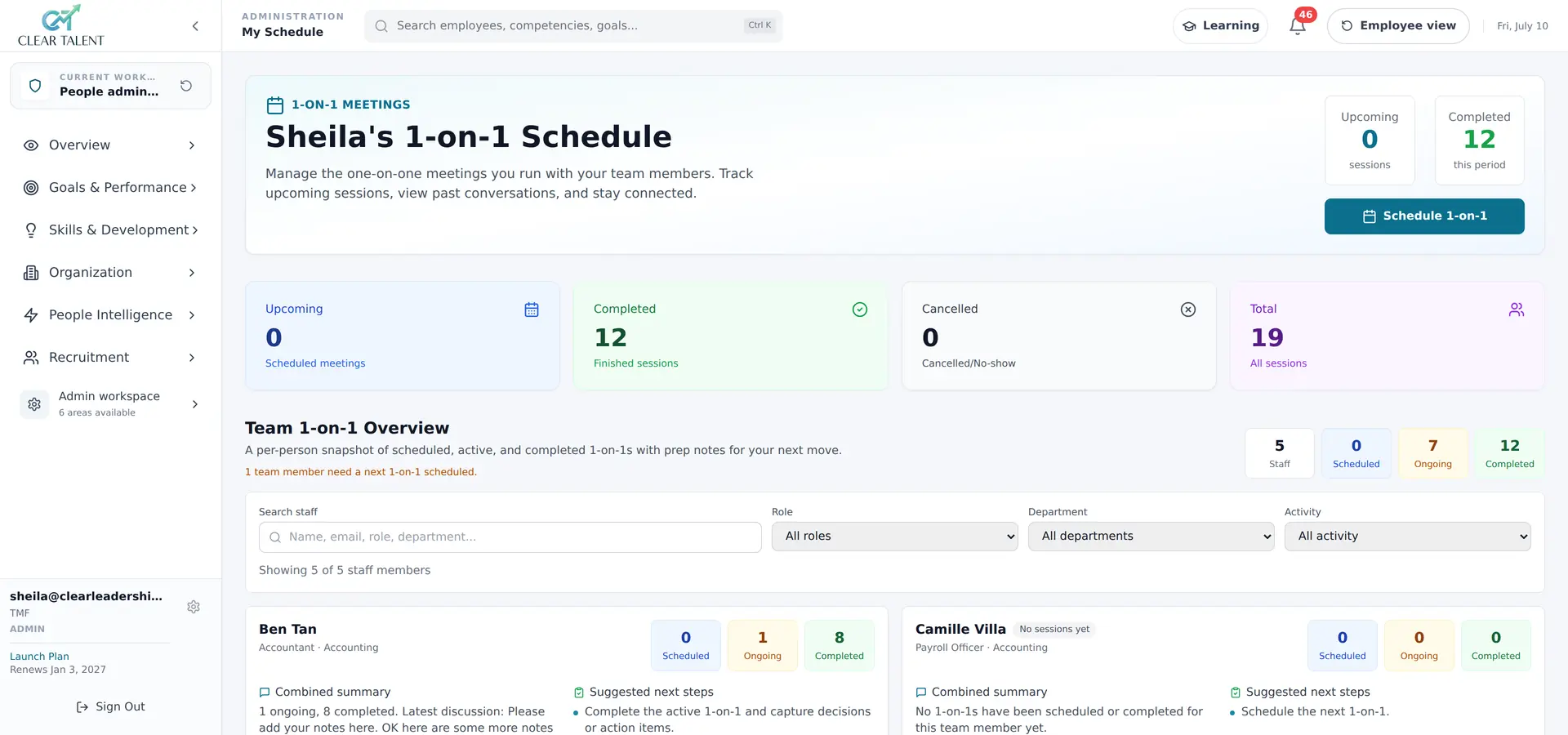
CLEAR Talent keeps the tracking record in one place. Goals cascade from company objectives through Strategic Linked Goals and are tracked through check-ins, with goals falling behind flagged from pace and check-in signals while the quarter is still running. Managers schedule 1-on-1s, and the team overview calls out anyone without a next session booked. Coaching goes into development notes, which can be kept private; kudos can be tagged to the competency or value the work showed; and the performance journal holds observations, achievements and incidents tagged to competencies. Check-ins work on the iOS and Android apps as well as the web.
When the review opens, goal scores, check-ins, feedback and 360° input consolidate into it rather than being rebuilt from memory. The record is made of what people write and rate, not activity data, and the platform provides role-based access, audit logs of sign-ins, exports and rating changes, and subject access request exports. Compliance still depends on how you configure and use it, so involve your DPO in the evaluation.
Book a demo to see how goals, check-ins and notes build the review record