Remote & hybrid
How to manage performance in remote and hybrid teams: a practical framework
A practical framework for remote and hybrid teams: measuring outcomes rather than activity, a 1:1 and check-in cadence, async feedback habits, proximity bias checks, a tooling checklist and goal templates.
By the CLEAR Talent team11 min read
Key takeaways
- Managing performance of remote employees starts with what you measure: agreed outcomes, not visible activity.
- A fixed rhythm of one-to-ones and goal check-ins replaces the informal contact an office used to supply. Protect it from rescheduling.
- Async feedback only counts if it is written down where the review will find it, not scattered across chat threads.
- In hybrid teams, check ratings by work pattern as well as by manager before calibration, so presence is not doing the rating.
Most performance management was designed for people who share a building. The manager sees who is at their desk, overhears how a client call went and catches the quiet word after a meeting. Take the building away and those signals go with it. What is left is either anxious monitoring of activity — green dots, response times, hours online — or a review written from whatever the manager happened to notice on video calls.
Neither works. This guide sets out a framework for remote performance management that does not depend on being seen: measure outcomes rather than activity, hold a predictable rhythm of one-to-ones and check-ins, make feedback work asynchronously, and check hybrid team performance reviews for proximity bias before ratings are final. It ends with a tooling checklist and goal templates you can adapt for remote roles.
What changes when the team is not in the room
The fundamentals do not change. People still need clear goals, regular feedback, a fair assessment and a development plan. What changes is how the manager knows what is happening. In an office, much of that knowledge arrives passively. In a remote team it only arrives if someone writes it down, raises it in a meeting or ships something visible.
That has two consequences. First, a manager who relies on ambient awareness will rate remote staff on less evidence than office-based colleagues, and less evidence means more room for bias. Second, the temptation to compensate with activity tracking grows, because activity is the one thing that is easy to see from a distance. The framework below replaces both with structure: agreed outcomes, a predictable conversation rhythm and a written record.
Measure outcomes, not activity
Activity measures tell you someone was busy. Outcome measures tell you whether the work landed. Remote teams need the second kind, and the difference is clearest side by side.
Comparison
Activity-based and outcome-based measures for the same work
| Role | Activity-based measure | Outcome-based measure |
|---|---|---|
| Customer-facing | ||
| Support specialist | Hours logged in the ticketing tool; tickets touched per day. | Tickets resolved within the agreed response time; repeat contacts on the same issue. |
| Account manager | Calls made; emails sent. | Renewals closed on time; agreed account plans delivered by quarter end. |
| Delivery | ||
| Software engineer | Commits per week; time shown as online. | Agreed features shipped to the quality bar; incidents resolved within the target time. |
| Project coordinator | Meetings attended; status updates posted. | Milestones hit on the agreed date; risks raised before they became delays. |
Some activity measures are useful diagnostics in a one-to-one. They become a problem when they are what the rating rests on.
Outcome-based goals do not mean ignoring how someone works. Collaboration, communication and reliability still matter, and remote work makes some of them more important. Assess them as competencies, with observed examples, rather than inferring them from how often a status light is green.
Guide: employee performance metrics and KPI examples by function
A one-to-one and check-in cadence for remote teams
An office supplies a steady stream of informal contact. A remote team has to schedule it. This rhythm is a workable baseline; adjust the frequency to the role, not to how busy the manager feels this week.
Weekly or fortnightly one-to-ones
Thirty minutes on video, owned by the employee’s agenda: progress, blockers, feedback both ways and one development action. Weekly suits new starters and fast-moving work; fortnightly suits settled, experienced people. Record a few lines each time.
A written weekly update
Three short prompts the employee answers in writing — what moved, what is blocked, what is next — so the one-to-one can spend its time on the blockers rather than on a status report.
A monthly or quarterly goal check-in
Review each goal against its measure: on track, at risk or due to change. Priorities shift faster in distributed teams, and a goal agreed in January should not quietly go stale.
A quarterly development conversation
A longer conversation about skills, career direction and what support is needed. Remote employees often miss the informal mentoring of an office, so make this one deliberate.
A formal review written from the record
Once or twice a year, rate goal results and competencies against the written standard, citing evidence from the whole period. Calibrate before ratings are final.
Across time zones, rotate the inconvenient meeting slot rather than leaving it permanently with the person furthest from head office, and let the written update carry the weeks when a live meeting is impossible. A cancelled one-to-one should be rebooked within the week, not skipped.
See continuous performance management: 1-on-1s, goal check-ins and a performance journal
Async feedback practices that actually reach the review
Remote teams give plenty of feedback — in chat threads, document comments and call recordings. The problem is that almost none of it is findable six months later. These habits keep asynchronous feedback useful.
- Write it down the same day
- Feedback given on a call is gone by the end of the week. A two-line note — the situation, the behaviour and its impact — is enough to keep it, and enough to cite at review time.
- Keep it where the review will look
- Chat threads scroll away and are owned by nobody. Record feedback against the person, ideally tagged to the goal or competency it relates to, in the system the review will be written from.
- Separate coaching from recognition
- Developmental feedback is usually best kept private between manager and employee. Recognition can be public, and in a remote team public recognition does real work: it shows colleagues contributions they would otherwise never see.
- Make written feedback specific
- Text loses tone, so vague written criticism reads harsher than intended and vague praise reads as nothing at all. Name the piece of work, the behaviour and what it changed.
- Keep a manager journal
- Managers of remote teams see fragments: a document, a demo, a customer email forwarded on. Logging those observations as they happen is what turns fragments into a fair picture of the year.
Async does not replace the live conversation for difficult messages. Underperformance, a missed standard or a sensitive personal matter should be raised on a call, with the written note following it rather than replacing it.
Running a hybrid team performance review without proximity bias
Proximity bias is the tendency to rate people more favourably because they are seen more often. In a hybrid team it usually shows up indirectly: the people in the office on the same days as the manager get the visible stretch projects, their work is discussed in passing, and their names come to mind first when the review asks for examples. None of that has to be deliberate to tilt the ratings.
It also overlaps with bias the reader may already know about. Recency bias is stronger when the remote employee’s work was never discussed in person, and the halo effect attaches more easily to someone the manager chats with every week. Because working patterns often differ by caring responsibilities, a proximity gap can turn into a gender gap without anyone intending it.
- Rate from the record, not from recall
- Ask managers to cite evidence from the check-in notes, goal updates and feedback log for every rating. If the record for a remote employee is thinner, that is a gap in the manager’s process, not evidence of weaker performance.
- Compare ratings by work pattern
- Before calibration, place ratings for fully remote, hybrid and office-based staff side by side within comparable roles. A consistent gap is a question for the calibration meeting, not proof of bias.
- Check who gets the visible work
- Look at who was given stretch assignments, client-facing work and presentations to leadership. Opportunity gaps today become rating gaps at the next review.
- Widen the view with 360 feedback
- Peers and stakeholders who work with a remote employee every day see contributions the manager does not. Collect their input against the same competencies as the review.
As with any data check, small groups give noisy numbers and can identify individuals, so set a minimum group size and handle the analysis within your data protection obligations.
A tooling checklist for remote performance management
Tools do not fix a missing habit, but the wrong set-up makes good habits hard to keep. Use this list when you review what your managers and employees work with today.
Checklist
Remote performance management tooling checklist
Goals and check-ins
- Every goal has a written measure and an owner, visible to the employee and the manager.
- Check-ins against each goal are recorded, and goals falling behind are visible before the quarter ends.
- Goals can be revised mid-period without losing the history of what was originally agreed.
Conversations and feedback
- One-to-ones are scheduled and tracked, so a manager can see who has gone weeks without one.
- Notes from each one-to-one are kept with the person’s record, not in a private notebook.
- Feedback and recognition can be recorded against a goal or competency, privately or publicly.
- Managers can log observations as they happen and find them again at review time.
Reach and reminders
- Employees can complete check-ins and feedback on a phone, not only at a desk.
- Reminders reach people where they work, whether that is email, a mobile notification or a chat tool.
- You know which tools integrate with your chat platform and which rely on reminders instead.
Reviews and fairness
- The formal review opens with the period’s check-ins, feedback and goal results already attached.
- Calibration shows ratings across managers before they are final, and every change is logged.
- Rating data can be exported for your own analysis by team, level and work pattern.
What this list leaves out on purpose: keystroke logging, screenshot capture and other activity monitoring. They measure presence, not performance, and raise serious data protection questions.
Sample goal templates for remote and hybrid teams
Each template pairs an outcome with a measure and a check-in question. The figures are placeholders for illustration; replace them with targets your team has agreed.
Template
Remote-team goal templates
| Goal | Measure of success | Check-in question |
|---|---|---|
| Delivery | ||
| Deliver [project] to the agreed scope by [date] | Milestones met on the agreed dates; acceptance signed off by [stakeholder]. | Which milestone is most at risk, and what would bring it back on track? |
| Resolve customer issues within the agreed response time | [X]% of tickets resolved within [N] hours across the quarter. | Which tickets missed the target, and what did they have in common? |
| Distributed collaboration | ||
| Make project status visible without a meeting | Weekly written update posted for [project] every week of the quarter; no status-only meetings needed. | Did anyone have to ask for information the update should have carried? |
| Hand work over cleanly across time zones | Handover notes completed for every shift or day change; no work blocked waiting for an answer overnight. | Where did a handover leave someone waiting, and why? |
| Development | ||
| Build visibility for your work with stakeholders | Present [topic] to [audience] at least once this quarter; feedback collected from two stakeholders. | Who outside the team knows what you delivered this quarter? |
| Develop [competency] to the next level | Two observed examples at the next level, recorded by [date]. | What opportunity in the next month would show this competency? |
Pair two or three goals like these with the team’s own priorities. A remote employee with ten goals has no priorities.
Where CLEAR Talent fits
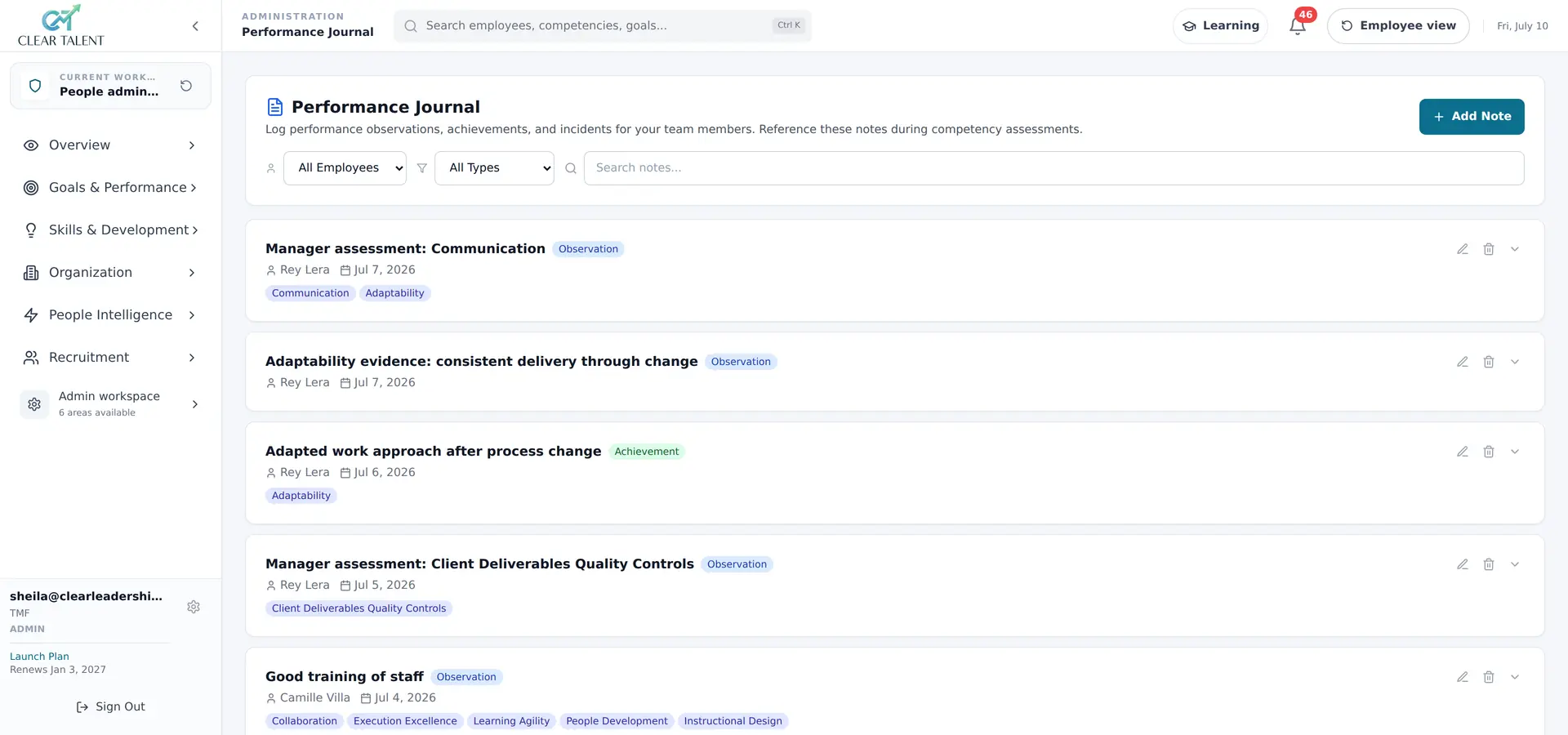
CLEAR Talent is built around the written record this framework depends on. Managers schedule 1-on-1s from a schedule that tracks upcoming, completed and cancelled sessions, and the team overview flags anyone without a next session booked. Feedback captured in a 1-on-1 is kept as a development note that can stay private, kudos can be tagged to a competency or value and made public, and managers log observations in a performance journal as they happen. Goal check-ins keep progress current, and goals falling behind are flagged while the quarter is still running.
For distributed teams, the native iOS and Android apps carry check-ins, feedback and one-to-one preparation, with push notifications, and every review stage has automated reminders. There is no Slack or Microsoft Teams app today, so test the reminder and mobile journey with a few managers during the trial. CLEAR Talent has no pulse or engagement surveys either; keep those in a dedicated tool.
At review time, Ava, the platform’s AI assistant, drafts a first review narrative from the goal scores, competency ratings, 360° feedback and check-in notes already recorded, and flags rating patterns that may indicate gender, recency or leniency bias before submission. Ava does not check for proximity bias by work location, so the work-pattern comparison above stays a calibration task. Ava never makes the final rating, and every output is labelled, editable and logged.
See AI performance management software: how Ava drafts reviews from evidence