Competency frameworks
Leadership competencies for managers: a 12-competency model with behavioural indicators
Twelve leadership competencies for people managers, each with behavioural indicators at emerging, proficient and advanced levels, plus a manager self-assessment checklist and a step-by-step way to turn the model into a 360 feedback form.
By the CLEAR Talent team15 min read
Key takeaways
- Leadership competencies describe how a manager gets results through other people. They need their own model, because they do not grow in the same steps as technical expertise.
- Twelve competencies in three groups — leading people, leading the work, and leading across and through change — cover what most people-management roles need.
- Write each level as something you could observe. “Emerging”, “proficient” and “advanced” only mean something when each has a behaviour behind it.
- Use the same indicators for the self-assessment and the 360 form, and ask each rater group only about what it can actually see.
- A gap matters only when it becomes one or two development actions with an owner and a date.
Most people become managers because they were good at something else. The skills that earned the promotion — expertise, speed, getting things right personally — are not the ones the new job is judged on. A manager is judged on what their team does: whether people know what matters, get useful feedback, grow, and keep working well when things change.
That is why leadership competencies deserve their own model rather than a few extra rows in a general framework. This guide sets out a manager competency model of twelve leadership competencies in three groups, with a behavioural indicator for each at three levels — emerging, proficient and advanced. It then gives you a self-assessment checklist a manager can work through in twenty minutes, and shows how to turn the same indicators into a 360 feedback form, so what a manager rates themselves on and what their team rates them on are the same thing.
What leadership competencies are, and why managers need their own model
Leadership competencies are the observable behaviours that let someone get results through other people: setting direction, developing the team, making decisions, holding people to account and keeping the team working through change. A manager competency model is the set of those competencies that applies to people-management roles, with a description of what each looks like at different levels.
Most competency frameworks have three layers: core competencies for everyone, functional competencies for each job family and leadership competencies for people who lead. The first two are usually where the effort goes. The leadership layer often ends up as two or three generic lines — “leads by example”, “develops the team” — that every manager rates themselves highly on and nobody can assess.
A separate model fixes that in two ways. It makes the shift from individual contributor to manager explicit: the person who was the best technician in the team now has to be measured on something else. And it gives managers a development path of their own, instead of a rating that only says whether they are “good at managing”.
A technical competency describes the quality of someone’s own work. A leadership competency describes what happens in other people’s work because of them.
Guide: how to build a competency framework, with a free matrix template
Three levels: emerging, proficient and advanced
A manager model works best with a short scale. Three levels are enough to separate someone new to the role from someone who does it reliably and someone who raises the standard for others — and they are easy for direct reports and peers to apply in a 360.
- Emerging
- Applies the competency in routine situations, usually with prompting or support from their own manager or HR. Typical of a first-time manager, or an experienced one in an unfamiliar area.
- Proficient
- Applies it consistently and without prompting across their own team, including in difficult situations. This is the level most people-management roles should require.
- Advanced
- Applies it in complex, high-stakes or cross-team situations, and builds it in others — coaching other managers or shaping how the organisation does it.
If your organisation already uses a five-level scale, you do not need a second one. Emerging maps roughly to level 2 (developing), proficient to level 3 and advanced to level 4. Keep the indicators below and attach them to your existing levels.
The 12 leadership competencies, with behavioural indicators
The model groups twelve competencies into three clusters of four. Each row gives a one-line definition and one behavioural indicator per level. Read across a row and you should see the same behaviour growing in independence, difficulty and reach.
Competency model
Manager competency model: 12 leadership competencies at three levels
The indicators are examples of what each level looks like, not a complete list. Rewrite them in your organisation’s own language and keep the structure.
| Competency | What it covers | Emerging | Proficient | Advanced |
|---|---|---|---|---|
| Leading people | ||||
| Coaching and developing others | Helping each team member build the skills their role and next step need. | Agrees a development goal with each team member and asks about it in one-to-ones. | Uses real work — stretch assignments, shadowing, feedback on drafts — to develop people, and can say where each person is heading. | Develops people who move into bigger roles, and helps other managers coach their own teams. |
| Feedback and difficult conversations | Giving timely, specific feedback in both directions, including when it is hard to hear. | Gives specific positive feedback regularly, and raises problems when prompted or once they have grown. | Raises concerns early with examples of the behaviour and its effect, and asks for feedback on their own management. | Handles sensitive conversations — underperformance, conflict, conduct — fairly and in a way people can act on, and helps other managers prepare for theirs. |
| Building trust and inclusion | Creating a team where people can speak up, disagree and be treated fairly. | Keeps commitments to the team and treats team members consistently. | Invites dissent in meetings, gives credit by name and checks that quieter voices and remote colleagues are heard. | Notices and corrects unfair patterns — in who gets visible work, praise or promotion — and is trusted with difficult news across teams. |
| Delegation and empowerment | Handing over work and decisions with enough context and authority for others to own them. | Delegates tasks with clear instructions and checks progress closely. | Delegates outcomes rather than tasks, agrees how much freedom each person has and steps back without disappearing. | Builds a team that runs well in their absence, with decisions made at the lowest sensible level. |
| Leading the work | ||||
| Setting direction and goals | Turning organisation priorities into clear team and individual goals. | Passes on organisation goals and agrees individual goals with each team member. | Explains why the team’s goals matter, links each person’s goals to them and revisits them when priorities change. | Shapes the priorities above the team and sets direction that other teams align to. |
| Planning and prioritisation | Deciding what the team works on, in what order, with the capacity it actually has. | Plans the team’s work week to week and flags conflicts in priorities to their manager. | Plans a quarter ahead, says no or “not now” to lower-priority work and protects time for important but non-urgent work. | Balances priorities across several teams and makes the trade-offs visible to senior leaders. |
| Decision-making and judgement | Making sound, timely decisions with incomplete information, and owning them. | Makes routine decisions promptly and escalates the rest with a recommendation. | Makes difficult calls on time, explains the reasoning, and revisits a decision openly when the evidence changes. | Makes high-stakes decisions across teams, and improves how the organisation decides — who decides what, and on what evidence. |
| Managing performance and accountability | Holding people to clear expectations, recognising good work and acting on underperformance. | Runs one-to-ones and reviews on schedule and records goal progress. | Bases ratings on evidence from across the period, deals with underperformance early and fairly, and holds themselves to the standards they set. | Rates consistently with peers in calibration and helps other managers apply the same standard. |
| Leading across and through change | ||||
| Communication | Keeping people informed, listening and adapting the message to the audience. | Passes on information the team needs promptly and accurately. | Explains the reason behind decisions, adapts to different audiences and checks what was understood. | Communicates difficult or uncertain messages clearly across the organisation, and is sought out to do so. |
| Collaboration and influence | Working across teams and getting support for work they do not control. | Works well with neighbouring teams when asked and keeps them informed. | Builds working relationships with other teams before they are needed and resolves cross-team conflicts directly. | Brings together groups with competing interests and gains support for shared priorities without relying on authority. |
| Leading change | Helping the team understand, adopt and sustain changes in how work is done. | Explains changes decided elsewhere and answers the team’s questions about them. | Prepares the team for change, involves them in how it is implemented and follows up on what is not working. | Identifies when change is needed, makes the case for it and leads it across teams. |
| Self-awareness and resilience | Knowing their own strengths, limits and effect on others, and staying effective under pressure. | Asks for feedback on their management and accepts it without defending. | Acts on feedback, knows their own pressure points and keeps workload sustainable for themselves and the team. | Stays steady and fair in a crisis, talks openly about their own development and makes it normal for others to do the same. |
The model and indicators are illustrative, not a benchmark. Select the table to paste it into a spreadsheet, or download it as a CSV below.
Twelve is a ceiling, not a target. A team lead role might require proficient in six of these and emerging in the rest; a head of function might need advanced in setting direction, collaboration and leading change. Deciding which level each management role needs is the competency matrix step in the framework guide, applied to the leadership layer.
Reference: the core competencies list, with behavioural indicators at four levels
How to assess managers against the indicators
Behavioural indicators make leadership assessable, but only if they are used as evidence prompts rather than as a list to tick.
- Ask for an example behind every rating
- A rating of “proficient” in delegation should come with a recent situation: what was handed over, how much freedom the person had and what happened. If nobody can name one, the rating is a guess.
- Rate the level the evidence shows most of the time
- One excellent week does not make someone advanced, and one bad conversation does not make them emerging. Look for the pattern across the period.
- Focus each cycle on four to six competencies
- Assessing all twelve every cycle produces twelve thin ratings. Choose the ones that matter most for the role and the year, and rotate the rest.
- Do not average the clusters
- A manager who is advanced in direction-setting and emerging in feedback does not have a “proficient” leading-the-work score worth anything. Keep the ratings separate; the gap is the useful part.
Manager self-assessment checklist
A self-assessment is the cheapest way to start using the model, and a good preparation for a 360. Each statement below describes the proficient level. Tick the ones you could support with an example from the last three months.
Checklist
Leadership competencies self-assessment
Work through it in about twenty minutes. Be strict: “I would like to” or “I usually mean to” is not a tick.
Leading people
- Each person in my team has a development goal, and we discussed it in the last month
- I gave someone a development opportunity through real work this quarter, not only a course
- I raised a concern with someone early, with a specific example, rather than waiting for the review
- I asked my team for feedback on my management, and changed something as a result
- In meetings, I make sure quieter and remote colleagues are heard, and I give credit by name
- I delegated an outcome, not just a task, and let the person decide how to deliver it
Leading the work
- Every person in my team can explain how their goals connect to the team’s priorities
- I revisited or closed at least one goal when priorities changed this quarter
- I said no or “not now” to work that did not fit our priorities, and explained why
- I made a difficult decision on time and explained my reasoning to the people it affected
- My last ratings were based on evidence from across the period, not the last few weeks
- I dealt with an underperformance issue early rather than letting it build up
Leading across and through change
- I explained the reason behind a recent decision, not only the decision itself
- I checked what my team understood after an important announcement
- I have a working relationship with the managers of the teams we depend on
- I involved my team in how a recent change was implemented, and followed up on what did not work
- I can name my two biggest development areas as a manager, and what I am doing about each
- My own workload, and my team’s, has been sustainable this quarter
Two or fewer ticks in a group suggests that cluster is at the emerging level. Pick one or two competencies from it as development goals, then compare the result with how your team rates you in a 360.
How to turn the model into a 360 feedback form
A 360 built from the same indicators tells a manager how others experience the behaviours they have just rated themselves on. The gaps between the two views are usually the most useful part of the report.
Pick four to six competencies
Use the self-assessment, the role’s required levels and the year’s priorities to choose. A form covering all twelve competencies is too long to answer carefully.
Match each competency to the raters who can see it
Direct reports see coaching, feedback, trust and delegation. Peers and cross-functional colleagues see collaboration, communication and change. The manager’s own manager sees direction, prioritisation, decisions and performance management. Ask each group only about what it can observe.
Rewrite the proficient indicator as a statement
Turn the indicator into a short statement about one behaviour the rater can observe: “Raises concerns early, with specific examples.” If a statement joins two behaviours a rater could see separately, split it into two items or keep only one.
Use a frequency scale with “not observed”
Ask how often the rater sees the behaviour — for example never, sometimes, often, almost always — and always offer “not observed”, so raters do not guess.
Add two or three open-text questions
For example: “What should this manager keep doing?”, “What one thing would make them more effective for you?” and, for direct reports, “What do you need from them that you are not getting?”
Protect anonymity, then turn the report into a plan
Only report a rater group once enough people in it have responded, show group averages rather than individual answers, and finish with one or two development actions agreed with the manager’s own manager.
Template
Manager 360 feedback form: sample items
Six competencies from the model, each written as a rating statement and assigned to the rater groups best placed to answer it.
| Competency | Rating statement | Who rates it |
|---|---|---|
| Leading people | ||
| Coaching and developing others | Uses real work, such as stretch assignments or feedback on drafts, to help me develop. | Direct reports, self |
| Feedback and difficult conversations | Raises concerns with me early, with specific examples I can act on. | Direct reports, self |
| Delegation and empowerment | Gives me ownership of outcomes, not just tasks. | Direct reports, self |
| Leading the work | ||
| Decision-making and judgement | Explains the reasoning behind the difficult decisions they make. | Manager, peers, direct reports, self |
| Leading across and through change | ||
| Collaboration and influence | Resolves disagreements between our teams directly. | Peers, cross-functional colleagues, self |
| Leading change | Involves the people affected in how changes are implemented. | Manager, direct reports, peers, self |
Rate each statement on a frequency scale with a “not observed” option. For the self-assessment, rewrite each statement in the first person.
Guide: 100 example 360 feedback questions, including upward feedback for managers
Five mistakes with leadership competency models
- Describing personality instead of behaviour
- “Charismatic”, “inspiring” and “a natural leader” cannot be observed consistently or developed in a plan. Describe what the person does.
- One model for every level of management
- A team lead and a head of function need the same competencies at different levels. Keep one model and set different required levels, rather than writing a new model for each grade.
- Assessing managers only from above
- A manager’s own manager rarely sees coaching, feedback or delegation happen. Without input from direct reports, the leading-people cluster is mostly guesswork.
- Promoting on technical skill, then assessing leadership
- If people only meet the leadership model after promotion, every new manager starts at emerging. Use the emerging indicators to develop senior individual contributors before they step up.
- Rating without development
- A 360 report with no agreed actions teaches managers that the exercise is a judgement, not support. Every cycle should end with one or two development goals.
How CLEAR Talent supports a manager competency model
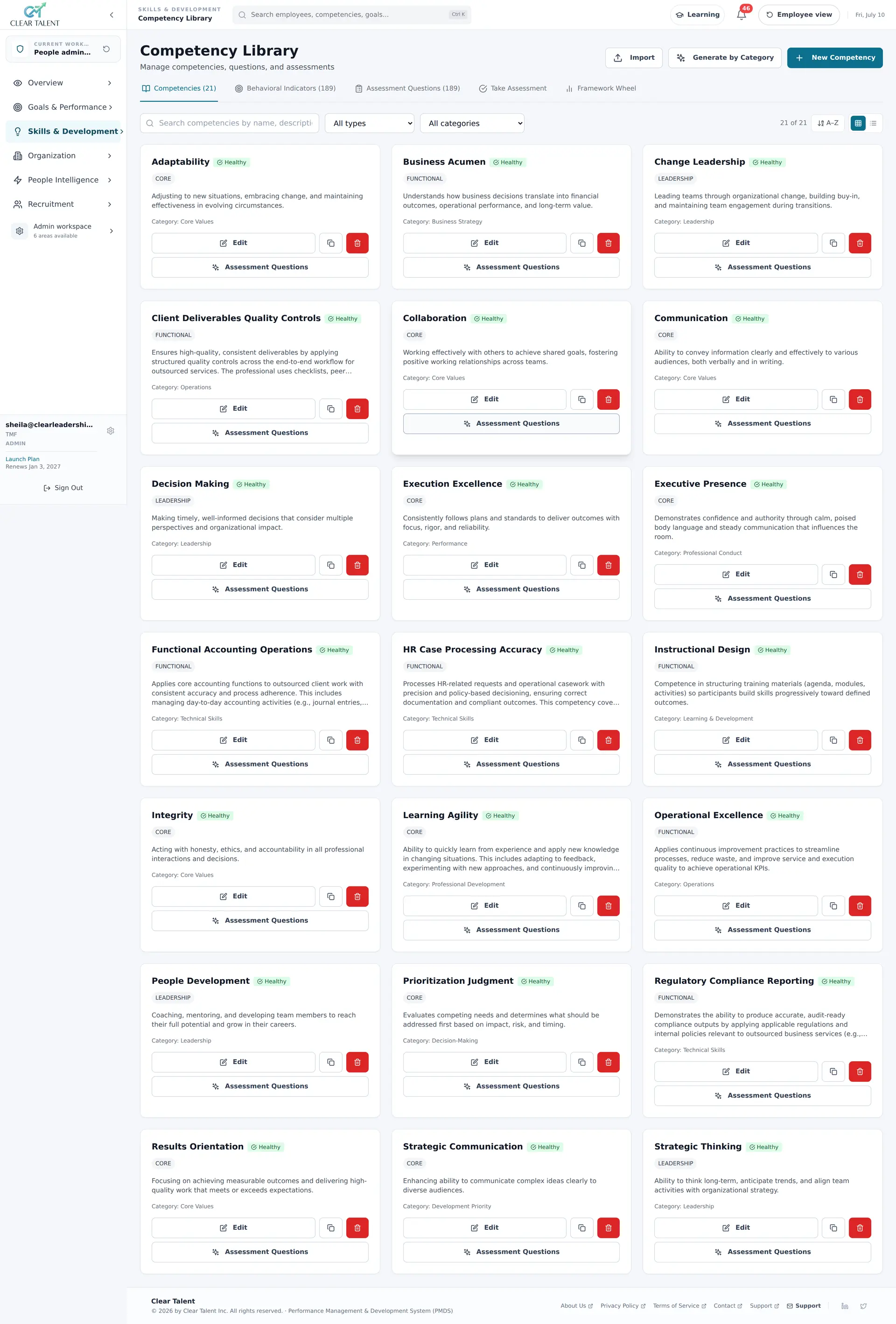
In CLEAR Talent, competencies are defined once in a central library, with behavioural anchors at each proficiency level, and the same library flows into reviews, 360° feedback and development plans. Scales are configurable from three to seven levels, so a three-level leadership scale like the one above can sit alongside a different scale for technical or individual-contributor roles. Each role has its required competencies and a target level for each, editable starter libraries mean you begin from a draft, and ratings can require evidence or leave it optional.
For the 360, the manager, direct reports, peers and cross-functional stakeholders are separate rater groups. Employees nominate raters and managers approve them, and each rater scores a targeted set of competencies from your framework. Responses are anonymised within each rater group, minimum-rater thresholds are enforced and outliers flagged. The report brings together strengths, blind spots and development priorities, and each assessment drafts an individual development plan from the competencies most important for the next role, ranked by the size of the gap. Longitudinal charts then show whether those gaps are closing from one cycle to the next.