Competency frameworks
How to build a competency framework, with a free competency matrix template
A competency framework says what good looks like in each role, in terms two managers would apply the same way. How to build one, the scale that makes it work, and a matrix template you can copy.
By the CLEAR Talent team9 min read
Key takeaways
- A competency framework describes capability, not tasks. If a line could sit in a job advert, it probably belongs in the job description instead.
- Most frameworks need three layers: core competencies for everyone, functional competencies per job family and leadership competencies for people who lead others.
- Write the proficiency scale before the competency list. The scale is what two managers have to apply identically.
- The competency matrix is where the framework becomes usable: each role, each competency, the level required.
- A framework earns its keep when assessment gaps turn into development plans — otherwise it is a document, not a system.
Most organisations already have a competency framework somewhere — usually a slide of values, a spreadsheet one department built for itself and job descriptions that list tasks rather than capability. None of them can answer the questions a framework exists for: what does this role need, where does this person stand against it, and what should they work on next?
This guide covers how to build one that can. It defines the terms, separates the three kinds of competency most frameworks need, walks through a five-step build, shows a five-level proficiency scale and ends with a competency matrix template you can copy or download. The competencies in the example are placeholders — the structure is the part worth keeping.
What a competency framework is — and what it is not
A competency framework is a structured description of the knowledge, skills and behaviours an organisation needs, with each one broken into levels of proficiency. Its job is to make “good” specific enough that two people assessing the same work would reach the same answer.
Three terms get used interchangeably and are worth separating. The competency framework is the whole library: every competency, its definition and its levels. A competency model is the subset that applies to one role or job family. The competency matrix is the grid that maps roles against competencies and records the level each role requires. You build the framework once and read it through the matrix.
A framework is not a job description. A job description lists what someone is responsible for doing; a framework describes the capability they need to do it well. “Prepares the monthly forecast” is a task. “Builds forecasts that hold up to challenge, and explains the assumptions behind them” is a competency at a level — and it applies to more than one role.
A job description says what someone is responsible for. A competency framework says what doing it well looks like.
Core, functional and leadership competencies
Almost every framework ends up with three layers. Keeping them distinct stops the list growing into sixty items nobody can assess.
- Core competencies — everyone
- The handful of behaviours expected of every employee regardless of role: communication, ownership, collaboration, customer focus. They usually express how the organisation wants work to be done. Keep them to four to six; more than that and they stop being core.
- Functional competencies — by job family
- The technical and professional capabilities a particular kind of work needs: financial analysis for finance, stakeholder discovery for product, clinical skills for care roles. They apply to a job family rather than to everyone, and they are where most of the framework’s volume sits.
- Leadership competencies — for people who lead
- Coaching and developing others, decision-making, setting direction. They apply to anyone who leads people or leads through influence, and they deserve their own scale: leadership proficiency does not grow in the same steps as technical expertise.
How to build a competency model in five steps
The order matters more than the effort. Most frameworks that stall were built list-first — forty competencies agreed by committee, then a scale bolted on at the end.
Start from the decisions the framework has to support
Hiring, promotion, development planning, succession, workforce planning — each needs something slightly different. Name the two or three decisions you care about first, because they decide how precise the levels need to be and which roles to start with.
Agree the proficiency scale
Decide the number of levels and write an observable description of each before listing a single competency. Anchor the levels to independence, scope and influence rather than to adjectives like “good” or “advanced”.
Draft the competencies with the people who do the work
Run short workshops with high performers and their managers in each job family. Ask what separates the person everyone goes to from the person still learning. Capture behaviours, not traits, and cap each role’s required set at a number you can realistically assess — often ten to twelve.
Map roles to competencies and set required levels
Build the matrix: for each role, which competencies apply and at what level. This is where the framework becomes practical, and it is also where gaps in the draft show up — a competency no role needs, or a role that needs nothing distinctive.
Pilot in one cycle, then connect it to development
Use the framework in one assessment cycle with one or two teams before rolling it out. Check whether managers rated consistently, rewrite the descriptors they read differently, and make sure every gap below the required level turns into a development action.
A five-level proficiency scale you can adapt
Three to seven levels can all work; five is a common middle ground because it leaves room for progression without levels that read the same. Each level below is anchored to how independently someone works and how far their impact reaches.
- Level 1 — Foundational
- Understands the concepts and can apply them to routine work with guidance and review. Knows when to ask for help.
- Level 2 — Developing
- Applies the competency independently in familiar situations; needs support when the work is new or ambiguous.
- Level 3 — Proficient
- Applies it independently and consistently, including in unfamiliar situations. Others can rely on the result without checking it.
- Level 4 — Advanced
- Handles complex or high-stakes cases, improves how the team applies the competency, and coaches others in it.
- Level 5 — Expert
- Sets the standard across the organisation, is consulted on the hardest problems, and shapes how the competency itself is defined.
If you cannot say what separates level three from level four in observable terms, you do not have five levels. You have five labels.
Each competency then gets its own behavioural anchors at each level — what “proficient” looks like for data analysis is not what it looks like for coaching. The generic scale keeps the steps consistent; the anchors make them assessable.
Competency matrix template
Here is the framework read through the matrix: five roles in one job family, ten competencies across the three layers, and the proficiency level each role requires on the five-level scale above.
Template
Competency matrix: required proficiency by role
Each number is the minimum level the role requires. A dash means the competency is not part of that role’s required set.
| Competency | Associate | Specialist | Senior specialist | Team lead | Head of function |
|---|---|---|---|---|---|
| Core | |||||
| Communication | 2 | 3 | 4 | 4 | 5 |
| Ownership and accountability | 2 | 3 | 4 | 4 | 5 |
| Collaboration | 3 | 3 | 4 | 4 | 4 |
| Customer focus | 2 | 3 | 3 | 4 | 4 |
| Functional | |||||
| Technical expertise in the discipline | 2 | 3 | 4 | 3 | 3 |
| Data analysis | 2 | 3 | 4 | 3 | 3 |
| Planning and delivery | 1 | 2 | 3 | 4 | 4 |
| Leadership | |||||
| Coaching and developing others | — | — | 2 | 4 | 5 |
| Decision-making | 1 | 2 | 3 | 4 | 5 |
| Setting direction | — | — | 2 | 3 | 5 |
The levels are illustrative, not a benchmark — replace the roles, competencies and numbers with your own. Select the table to paste it into a spreadsheet, or download it below.
Two things in the example are deliberate. Technical expertise peaks at senior specialist and dips for the team lead, because a leadership path should not require someone to be the best technician in the team. And the leadership rows start at senior specialist, not at team lead: people should be developing those competencies before the promotion that needs them, not after it.
Add a column per person alongside the required levels and the same grid becomes a skills gap analysis: every cell where the assessed level sits below the required one is a development conversation waiting to happen.
From assessment gaps to development plans
A framework that is only used to rate people will be treated as a rating exercise. The return comes from what happens after the assessment: a gap between the assessed level and the required one should become a specific development action, with an owner and a date, attached to the competency it is meant to close.
Prioritise ruthlessly. Someone with six gaps does not need six development goals; they need the two or three that matter most for their current role or the one they are working towards, ranked by the size of the gap. Reassess on the same scale in the next cycle, and the framework starts to show whether development is working — not just whether it was planned.
Common competency framework mistakes
- Too many competencies
- Forty competencies per role looks thorough and assesses nothing. If managers cannot gather evidence for the full set in a cycle, it will be completed rather than assessed.
- Levels described with adjectives
- “Good”, “strong” and “excellent” mean different things to different managers. Anchor each level in behaviour someone could observe.
- A separate scale in every department
- When each team invents its own scale, a level three in one department cannot be compared with a level three in another. Agree the scale centrally; let job families choose the competencies.
- Built by HR alone
- A framework written without the people who do the work reads like a policy document. The managers who will use it should recognise their own language in it.
- No link to anything that matters
- If ratings do not feed development, promotion or succession decisions, people stop taking them seriously within a cycle or two.
- Nobody owns it after launch
- Roles, tools and priorities change; descriptors quietly do not. Name an owner for each job family’s competencies and review them on a set schedule.
Spreadsheet or software?
A spreadsheet is a perfectly good place to draft a framework and pilot the matrix. It struggles once the framework is live: versions multiply across departments, evidence sits in email, ratings from last year are in a different file, and nobody can see gaps across teams without a week of copying and pasting.
The point to move is usually when the framework has to feed other processes — reviews, 360° feedback, development plans — and when you need to see how capability is changing over time rather than as a single snapshot.
How this maps to CLEAR Talent
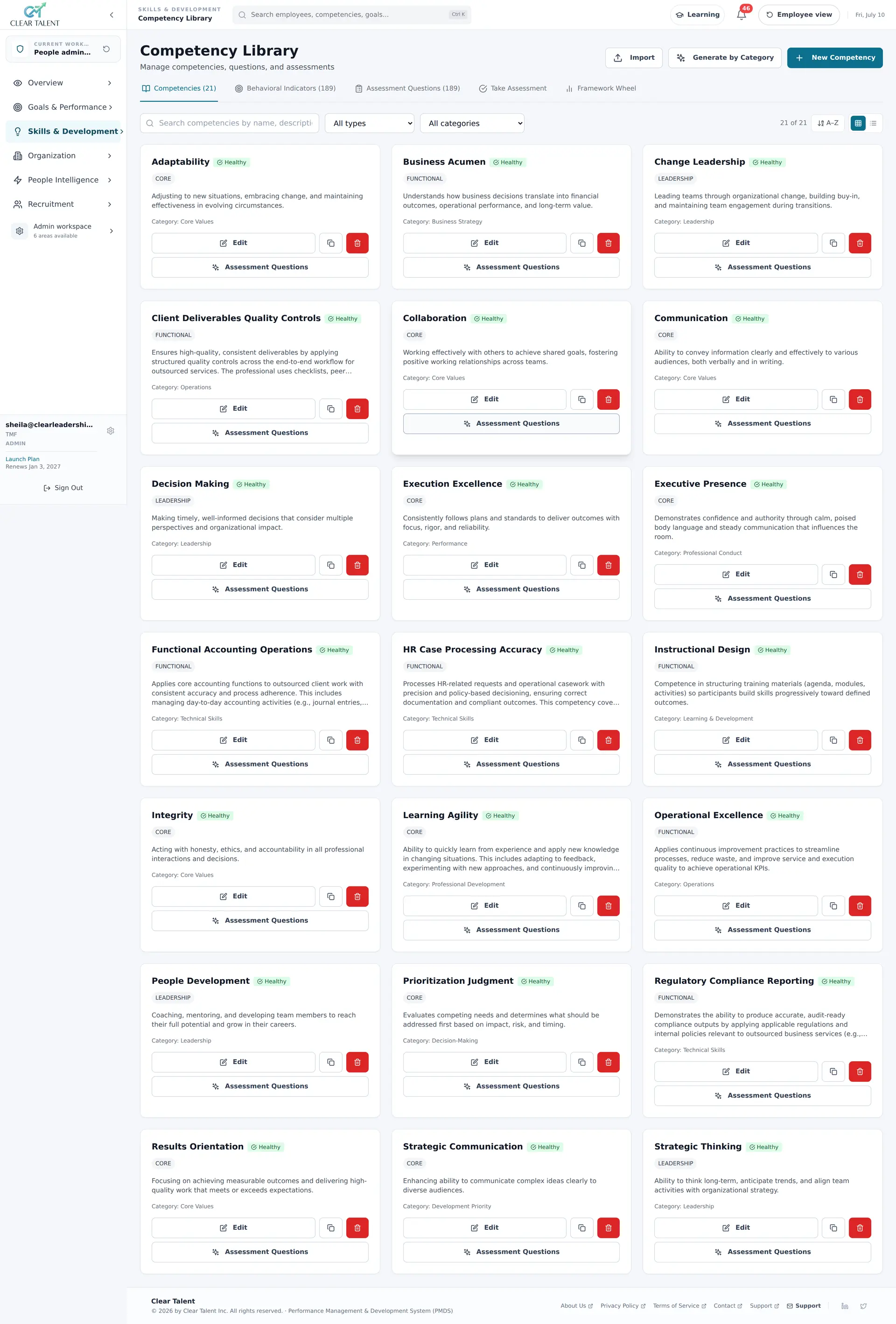
CLEAR Talent’s Competency Assessment Framework follows the structure in this guide. Competencies are defined once in a central library with behavioural anchors at each proficiency level, and the same library flows into reviews, 360° feedback and development plans. Scales are configurable from three to seven levels, and you can use different scales for technical, leadership and individual-contributor roles. Editable starter libraries mean you begin from a draft rather than a blank page.
The matrix becomes role mapping: each role has its required set of competencies and a target level for each. Ratings can require evidence or leave it optional. Dashboards show capability coverage by team, department and competency, longitudinal charts show whether gaps are closing, and each assessment drafts an individual development plan from the competencies that matter most for the next role, ranked by the size of the gap.