Review cycles
Performance review questions: 60 to ask employees, and 15 employees should ask their manager
Sixty performance review questions for managers to ask employees, grouped into six themes, plus fifteen questions employees should ask their manager and advice on running the conversation.
By the CLEAR Talent team9 min read
Key takeaways
- Pick six to ten questions per review, drawn from at least four of the six themes.
- Share the questions in advance so answers draw on evidence, not memory.
- Ask open questions, then follow up with “can you give me an example?”
- Keep wellbeing questions separate from the rating, and make answering optional.
- Employees should bring questions too, especially about expectations and growth.
A review form tells you what to rate. It rarely tells you what to ask. Yet the questions a manager brings decide whether the meeting becomes a real conversation about the work or a reading of a form both people have already seen.
This guide gives you sixty questions to ask employees, grouped into six themes: accomplishments, goals, obstacles, development, manager support and wellbeing. A second set of fifteen is for employees to ask their manager, because a review works best when both people arrive with questions. Treat them as a bank to choose from, not a script.
How to use this question bank
- Choose, do not cover everything
- Sixty questions would fill a day. Choose the handful that fit this person and this point in the year, and leave time to follow up.
- Send them ahead
- Questions shared a week before give the employee time to gather examples. Pair them with the self-evaluation so the two do not overlap.
- Match the question to the cycle
- Mid-year questions look forward and adjust goals. Year-end questions look back and set the next period. Check-ins stay short and practical.
- Listen more than you talk
- The employee should do most of the talking. Your job is to ask, probe for examples and write down what was agreed.
60 performance review questions to ask employees
Ten questions for each theme. The second column suggests when each one works best; “any review” means it suits mid-year, year-end and quarterly conversations alike.
Question bank
Performance review questions for managers, by theme
| Question | Best asked at |
|---|---|
| Accomplishments | |
| What are you most proud of from this period? | Any review |
| Which piece of work had the most impact, and how do you know? | Any review |
| What did you deliver that I might not have seen? | Any review |
| Where did you go beyond what your role asked of you? | Year-end |
| Which result took the most effort, and was it worth it? | Year-end |
| What feedback from colleagues or customers stood out? | Any review |
| What did you start doing this period that worked? | Mid-year |
| Which of your skills did you use most? | Year-end |
| Whose help made the biggest difference to your results? | Any review |
| If you could redo one piece of work, which would it be? | Year-end |
| Goals | |
| Which of your goals are on track, and which are not? | Mid-year |
| Is any goal no longer the right goal? | Mid-year |
| What would make your goals clearer or easier to measure? | Any review |
| How does your work connect to the team’s priorities? | Any review |
| What should your top three priorities be next period? | Year-end |
| What would success look like six months from now? | Year-end |
| Which goal do you feel least confident about, and why? | Mid-year |
| What could you stop doing to make room for what matters most? | Any review |
| Is there a goal you would like to own that you do not today? | Year-end |
| How should we track progress between reviews? | Any review |
| Obstacles | |
| What got in the way of your best work this period? | Any review |
| Which processes or tools slow you down? | Any review |
| Where did you wait on other people or decisions? | Any review |
| What would you change about how the team works together? | Any review |
| When did you feel stuck, and what happened? | Mid-year |
| Which part of your role takes more time than it should? | Any review |
| What information do you need that you are not getting? | Check-in |
| Where have expectations felt unclear or contradictory? | Any review |
| What risk to your goals can you see coming? | Mid-year |
| If you could remove one obstacle tomorrow, which would it be? | Any review |
| Development | |
| Which skill would make the biggest difference to your work next year? | Year-end |
| Where would you like your career to be in two to three years? | Year-end |
| What kind of work would you like more of? | Any review |
| What kind of work would you like less of? | Any review |
| Which competency is your strongest, and which needs most work? | Any review |
| What have you learned this period, and how have you used it? | Any review |
| Is there a project or stretch assignment you would like to take on? | Year-end |
| Who would you like to learn from, inside or outside the team? | Any review |
| What support would help you reach the next level? | Year-end |
| How do you learn best: courses, coaching, practice or shadowing? | Any review |
| Manager support | |
| What do I do that helps you do your best work? | Any review |
| What could I do differently to support you better? | Any review |
| Do you get enough feedback from me, and is it useful? | Any review |
| How often would you like us to meet one-to-one? | Check-in |
| Do you have the autonomy you need to make decisions? | Any review |
| When did you last feel recognised for your work? | Any review |
| Is there anything I do that gets in your way? | Any review |
| How clearly have I explained what is expected of you? | Mid-year |
| What should I know about your work that I do not? | Any review |
| How can I help your work get seen by senior colleagues? | Year-end |
| Wellbeing | |
| How manageable has your workload felt recently? | Check-in |
| What gives you energy at work, and what drains it? | Any review |
| Are you able to switch off outside working hours? | Check-in |
| How well does your current way of working suit you? | Any review |
| Do you feel part of the team? | Check-in |
| Is there anything you would like me to be aware of? | Check-in |
| What one change would make your work more sustainable? | Any review |
| How comfortable do you feel raising concerns? | Any review |
| What would make you more likely to stay here? | Year-end |
| Is there anything we have not covered that you want to discuss? | Any review |
Examples to adapt, not a validated instrument. Rewrite them in your organisation’s language and trim hard.
Free tool: generate behaviour-based review questions by role
15 questions employees should ask their manager
A review is also the employee’s best chance to learn how their work is seen. These questions turn a one-way assessment into a two-way conversation.
Question bank
Questions to ask your manager in a performance review
| Question | What it tells you |
|---|---|
| Expectations | |
| What does excellent performance in my role look like to you? | The real standard |
| Which of my priorities matters most next period? | Where to focus |
| How will my goals be measured, and when? | How success is judged |
| Is there anything you would like me to stop doing? | Hidden friction |
| Feedback | |
| What one change would give my work more impact? | Your next step |
| Where did my work fall short of what you expected? | Gaps to close |
| What is my main strength, and am I using it enough? | How you are seen |
| How would you describe my performance to your own manager? | How you are represented |
| Growth | |
| Which skills should I build to reach the next level? | The development gap |
| What would make me ready for promotion, and how far off is it? | Honest readiness |
| Is there a project you could put me forward for? | Stretch opportunities |
| Who in the organisation should I learn from? | People worth meeting |
| Team and organisation | |
| What are the team’s biggest priorities for the coming year? | Context for goals |
| What changes ahead could affect my role? | What is coming |
| How can I make your job easier? | Working well together |
How to run the review conversation
Prepare from evidence
Read the self-evaluation, goal progress and your notes from the period before choosing questions.
Open with accomplishments
Starting with what went well makes harder questions easier to hear and answer honestly.
Probe every answer once
Ask for an example or a result. One follow-up is usually where the useful detail is.
Close with development and support
End on what happens next: one or two development actions and what you will do to help.
Write down what was agreed
Summarise the actions within a day, and revisit them at the next one-to-one rather than the next review.
The best review questions are the ones you already asked in one-to-ones. The review should confirm, not surprise.
See continuous performance management with 1-on-1s and check-ins
Four mistakes that waste good questions
- Asking leading questions
- “You would agree the launch went well?” invites agreement, not reflection. Ask “how did the launch go?” instead.
- Answering for the employee
- Silence after a question is thinking time. Filling it with your own view ends the conversation.
- Mixing wellbeing into the rating
- If an honest answer about workload could lower a score, people stop giving one. Keep the two apart.
- Asking and never acting
- Questions about support and obstacles create an expectation. Follow up, or say plainly what you cannot change.
How to use these questions in CLEAR Talent review cycles
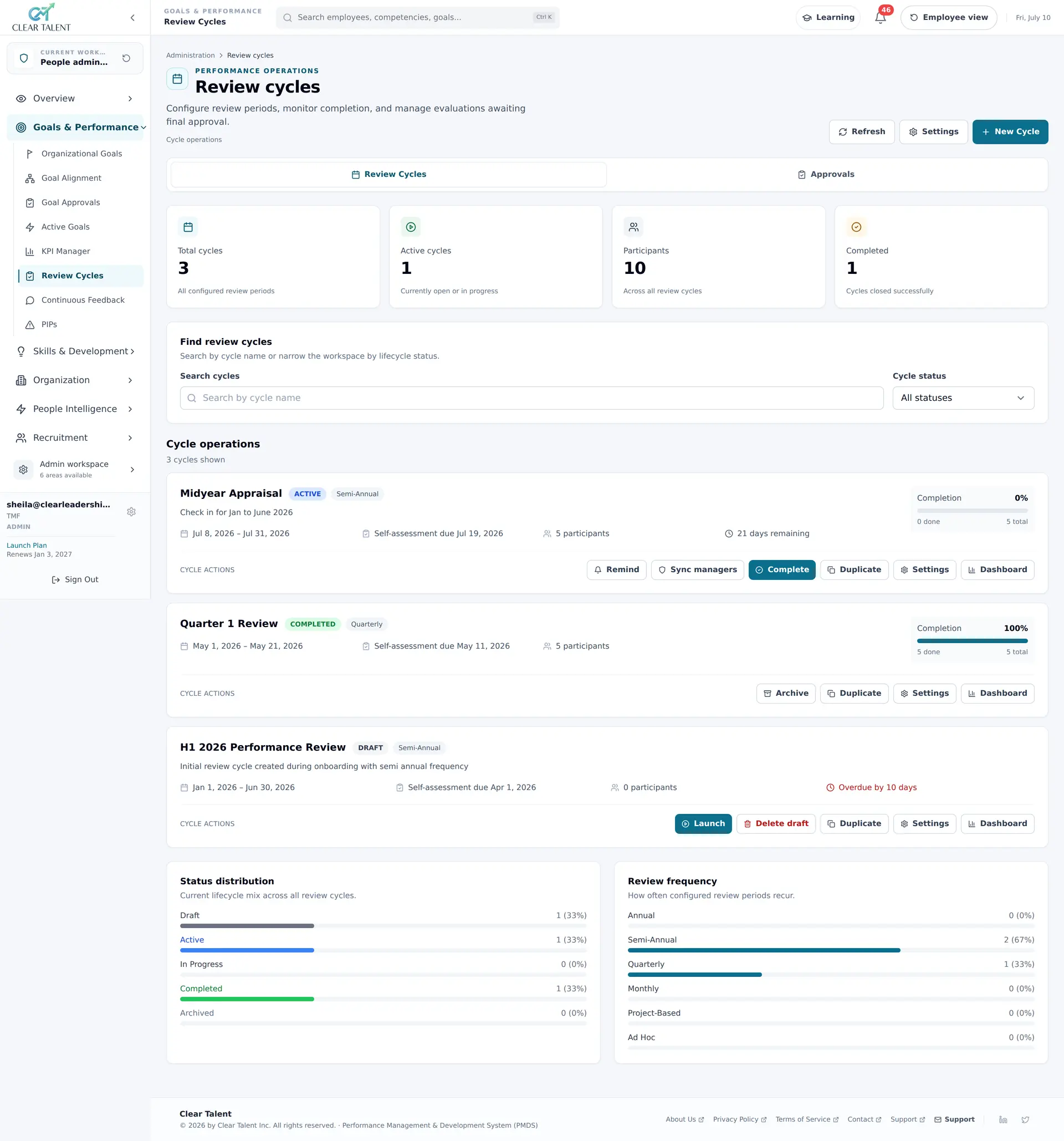
In CLEAR Talent, each review cycle, whether mid-year, year-end or quarterly, has its own configurable template, so the questions you choose for that point in the year can go into it. The cycle runs from self-review through 360° feedback and manager review to calibration and a final rating, with stages that open and close on the dates you set and automated reminders along the way. Once the manager releases the review, the employee sees every rating and narrative section.
Between reviews, managers schedule 1-on-1s, and the team overview gives each person a combined summary and suggested next steps. Answers worth keeping can be recorded as development notes, which can stay private, or in the performance journal, tagged to competencies. When the review opens, Ava can draft a first narrative from goal scores, competency ratings, 360° feedback and check-in notes, which the manager accepts, amends or rejects. CLEAR Talent has no survey product, so the wellbeing questions stay a conversation.