Competency assessment
Nurse and clinical competency assessment: checklist, framework and template
A licence proves someone was qualified to start. Ongoing competency assessment answers a narrower question: can this person do this, to this standard, on this unit, now?
By the CLEAR Talent team13 min read
Key takeaways
- Competency assessment is not credentialling. A licence says someone was qualified to be hired; a competency record says what you have seen them do since.
- If you cannot describe what separates one level from the next in observable behaviour, you have labels rather than levels.
- The annual date is the floor. Role change, new equipment, extended absence and post-incident review all trigger reassessment on their own schedule.
- Evidence recorded as the work happens beats evidence reconstructed before a deadline — and it is the only kind that covers a full year.
- Every sign-off needs an attributable assessor, a date and the evidence behind it. That is what an auditor asks for, in that order.
Clinical competency programmes rarely fail because nobody cared. They fail because the scale meant different things on different wards, because the evidence was assembled the week before sign-off, or because the annual date was the only date anyone watched. By the time an accreditation visit asks to see a record, the gap is not in the practice — it is in the paperwork that was supposed to describe it.
This guide covers the three parts that do most of the work: the competency levels, the validation cycle around them, and the evidence that makes a rating defensible. It ends with a checklist you can work through and a record template you can copy. The clinical standards themselves are yours — what follows is the process discipline around them.
What a competency assessment actually proves
Credentialling and competency assessment answer different questions, and conflating them is the most common structural mistake in a clinical HR programme. Credentialling and primary source verification establish that someone holds a valid registration, the qualifications they claim and the privileges granted to them. It is a question about entitlement, and it is answered at the point of hire and at renewal.
Ongoing competency assessment asks something narrower and more current: can this person perform this activity, to this standard, in this setting, now? The registration does not change when a ward adopts a new infusion pump. The competency does.
There is a third distinction worth naming, because it changes who assesses and when. Initial competency is established before someone practises unsupervised — during orientation, preceptorship or after a change of scope. Ongoing competency asks whether the standard has held since. The same competency can appear in both, assessed by different people against the same descriptors.
A licence tells you what someone was allowed to learn to do. A competency record tells you what you have seen them do.
Competency levels: write the scale before you write the list
Most frameworks are built list-first — forty competencies agreed by committee, then a scale bolted on at the end. Invert it. The scale is what two assessors on two units have to apply identically, and it is where the programme is won or lost.
- Three to five levels is usually enough
- More levels only help if you can describe the difference between adjacent ones in observable behaviour. Write the descriptor before you commit to the level: if level three and level four read the same to a charge nurse, one of them is decorative.
- Anchor levels to supervision, not to adjectives
- For clinical work, supervision is the most observable anchor available: performs with direct supervision, performs with supervision available, performs independently, performs independently and teaches others. “Proficient” and “advanced” are not observable — two assessors will read them differently and both will be sure they are right.
- Set the required level per role, not per competency
- A competency without a target level is a list item. The same aseptic technique competency can require independent practice from a theatre practitioner and supervised practice from someone newly rotated in. One library, different required levels.
- Keep the progression separate from the pass mark
- The novice-to-expert progression familiar from nursing education is a development conversation. Validation is a decision: is this person at the level their role requires today? A clinician can be working towards the next level and be fully validated at their current one. Blur the two and every development note starts to read like a performance concern.
- Write the scale once and reuse it
- A scale invented per department guarantees that two units mean different things by the same word, and it makes every cross-site comparison meaningless. Agree it centrally, then let units decide which competencies apply and at what level.
If you cannot say what separates level three from level four, you do not have four levels. You have four labels.
The annual validation cycle — and the triggers that do not wait for it
An annual cycle gives the programme a rhythm and a deadline. It does not, on its own, keep a record current. Treat the annual date as the floor and the triggers below as the rest of the schedule.
Fix the population and the required set
Before the window opens, confirm who is in scope, which competencies each role requires at which level, and who is eligible to assess each one. Bank, agency and rotational staff need deciding explicitly rather than discovering at sign-off that nobody owns them.
Open the window with dates for every stage
Self-assessment, assessor review, moderation and final sign-off each need their own deadline. A single “due by” date at the end means the whole cycle lands in the last fortnight, which is exactly when the evidence gets thin.
Review the evidence before the assessment conversation
The assessor should arrive having read what was recorded during the year. An assessment meeting that opens with reading has already spent its time, and it pushes the assessor towards the most recent thing they remember.
Assess, moderate, then sign off
Keep the self-rating, the assessor rating and the final rating as separate values. Moderation that overwrites what a clinician originally recorded destroys the most useful signal in the record: where self-perception and observed practice differ, and by how much.
Close the period and read the gaps
Once the window closes, the outstanding question is not who is complete. It is which competencies are held below the required level, in which units, and what is being done about each. That is the output the programme exists to produce.
Then handle the triggers that do not respect the calendar: someone new to the role or the unit, a new device, procedure or protocol, a return from extended absence, a change of scope, a conditional outcome from the previous assessment, and any finding from an incident review that names a capability. Each of these calls for reassessment when it happens, not at the next annual date.
A programme that only reassesses annually is, on average, six months out of date — and it is out of date in exactly the situations where being current matters most.
Evidence tracking: what counts, and when to record it
A rating with no evidence behind it is a position, not an assessment. Surveyors and internal auditors rarely ask whether your staff are competent; they ask to see the evidence — dated, attributable and reviewed by someone qualified to judge it.
- Direct observation of practice
- The strongest evidence for most clinical competencies, and the hardest to schedule. Record what was observed, on what date, by whom — not simply that an observation took place.
- Return demonstration or simulation
- Appropriate where direct observation is impractical or the procedure is high-risk and low-frequency. Note the setting, because a simulated demonstration and an observed live procedure are not interchangeable evidence.
- Case or record review
- Retrospective review of documentation and decisions. Useful for competencies that show up in judgement rather than in a visible technique.
- Reflective account and discussion
- The clinician’s own account of a situation, what they did and what followed. Weak on its own, valuable alongside an observation — it is what shows whether the practice was reasoned or habitual.
- Peer and skip-level input
- For rotational staff, night shifts and cross-site working, the person who observed the work is often not the line manager on the org chart. Allow the assessment to come from whoever was actually there, subject to eligibility rules you have written down.
- Self-assessment
- An input, never the decision. Its value is the comparison with the assessor’s view; treated as the rating itself, it turns validation into a form-filling exercise.
The question at sign-off is not “is this person competent?” It is “what did we see, when, and who judged it?”
The recording discipline matters more than the method. Structure each entry as the situation, the action taken and the result; date it; tag it to the competency it evidences; attach the supporting file where one exists. Entries written this way stay useful a year later, when the person reading them was not there.
Above all, record as you go. Evidence assembled in the week before sign-off describes the last fortnight and calls it a year — and the reviewer who eventually reads it can tell.
The clinical competency assessment checklist
Work through this before and during a validation cycle. It assumes nothing about your clinical standards — it covers the process around them, which is the part that usually fails first.
Checklist
Competency validation cycle checklist
Five stages, from the decisions taken before the window opens to the actions that follow it closing.
Before the cycle opens
- The population in scope is named, including bank, agency and rotational staff.
- Every role has a required competency set with a target level for each competency.
- Assessor eligibility is written down per competency, not assumed from the org chart.
- The scale and its level descriptors are agreed centrally and circulated in advance.
- Deadlines exist for self-assessment, assessor review, moderation and final sign-off.
- The trigger list for out-of-cycle reassessment is published alongside the annual dates.
For each competency
- The descriptor for each level is observable, not an adjective.
- The departments, units or sites it applies to are recorded.
- The permitted assessment methods are stated, with any that are not acceptable on their own.
- It is clear whether evidence is required or optional, and what kind.
- The reassessment interval is set, and any trigger that shortens it is named.
- An owner is named for keeping it current when a protocol or device changes.
For each clinician
- Their required set reflects the role and unit they are actually working in.
- Initial competency is recorded separately from ongoing validation.
- Evidence entries are dated across the period, not clustered at the end.
- Self-assessment is complete and has not been overwritten by anyone else.
- Any competency assessed below the required level has a development action attached.
- Anything left conditional at the last assessment has been revisited.
At sign-off
- The assessor is eligible for that competency and says so on the record.
- Self-rating, assessor rating and final rating are held as separate values.
- Any difference between self and assessor rating has a comment explaining it.
- The sign-off carries a name and a date, not a shared account or a tick.
- The next review date and the reason for it are recorded at the same time.
After the period closes
- Gaps are reported by unit and competency, not only by completion rate.
- Development actions have an owner and a review date.
- The period is closed so ratings cannot be quietly amended afterwards.
- An evidence pack can be produced for one clinician or a whole department on request.
- Competencies that produced the same gap across several units are reviewed as a training or process question, not an individual one.
Print this page or copy the list into your own validation template. Where your accreditation programme is more specific than this, its requirements win.
A competency record template
These are the fields that make a single record defensible a year later. Anything missing here is a question somebody will eventually have to answer from memory.
- Competency name and version
- Protocols change. A record that does not say which version of the competency was assessed cannot be read against the standard that applied at the time.
- Scope and required roles
- The departments, units or sites the competency applies to, and the roles required to hold it — each with its target level.
- Level descriptors
- The full set of levels with their observable descriptions, stored with the record rather than in a separate document that may have moved on.
- Assessment method used
- Observation, return demonstration, case review, discussion or a combination — and the setting, so a simulation is never mistaken for live practice.
- Evidence references
- The dated entries the rating rests on, each with the situation, action and result, plus any attached files.
- Self-rating, assessor rating and final rating
- Three separate values with their own comments. Collapsing them into one field is what makes a moderated rating impossible to explain afterwards.
- Assessor identity and eligibility
- Who assessed, and on what basis they were qualified to. “The manager” is a role, not an attribution.
- Assessment date and sign-off timestamp
- When the assessment happened and when it was signed. These are often different dates, and the gap between them is occasionally the interesting part.
- Outcome and any conditions
- Validated, validated with conditions, or not yet validated — with the conditions written as actions rather than as a note.
- Next review date and its trigger
- The date, and whether it comes from the annual cycle or from something specific: a new device, a change of scope, a conditional outcome.
Whether these fields live in a spreadsheet, a paper folder or a platform matters less than whether they are all present. What a platform changes is how much of it survives a year of staff turnover.
How this maps to CLEAR Talent’s competency management
CLEAR Talent was built around the same three parts — the levels, the cycle and the evidence. Here is how each maps, and where the boundary of the product sits.
- Levels: one library, behavioural anchors, required levels per role
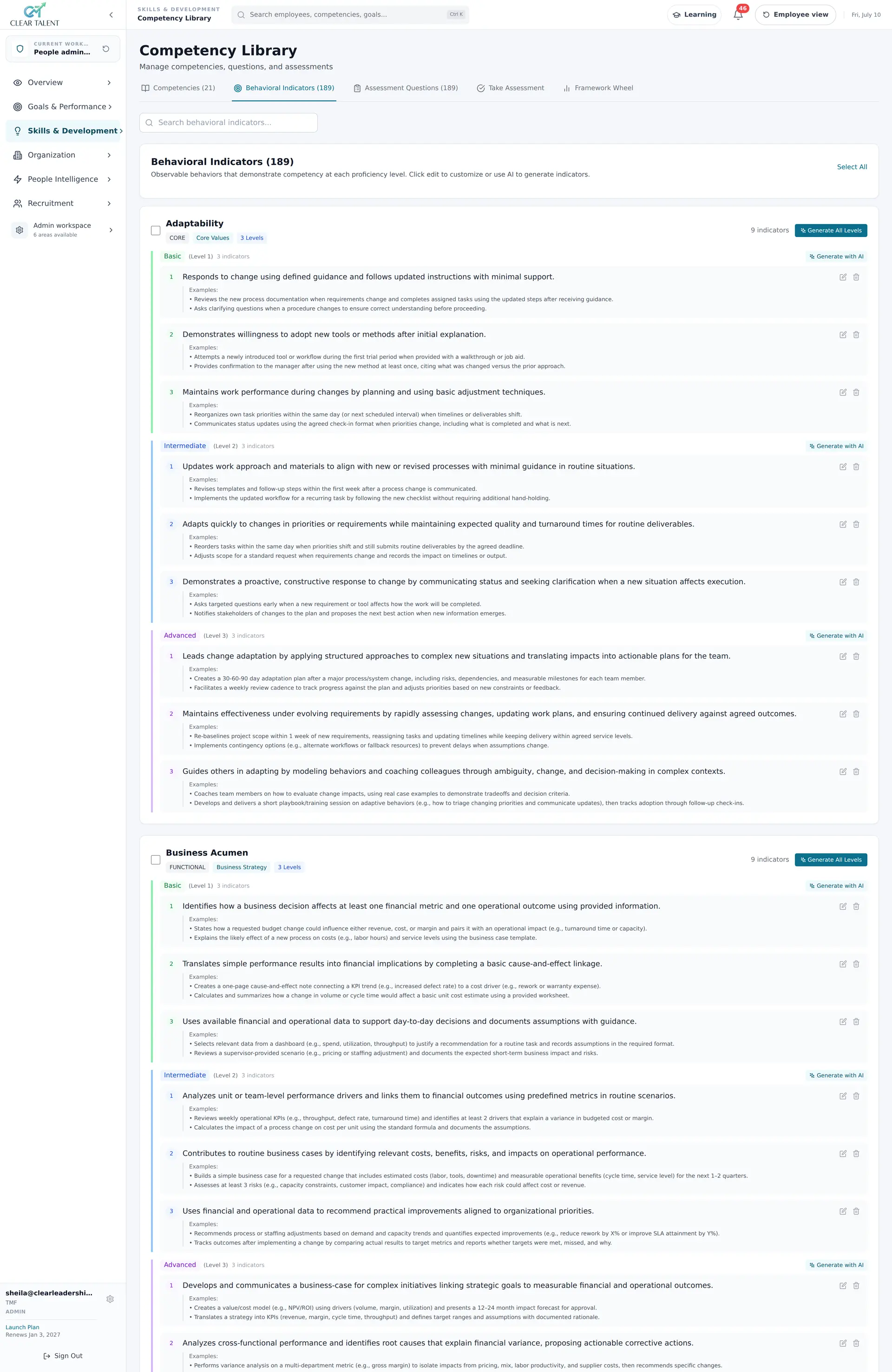
- Competencies are defined once in a central library, with three to seven configurable proficiency levels per scale, behavioural descriptions at each level, the departments the competency belongs to and the roles that must hold it with their target level. Starter libraries for nursing, allied health and physician roles ship fully editable, so you begin from a draft rather than a blank page.
- Cycles: assessment periods with a deadline per stage
- Each assessment period carries its own dates for self-assessment, assessor review, calibration and final rating, with automated reminders on whatever is outstanding. You set the cadence your accreditation programme requires; when a period closes, so does the window to amend it.
- Evidence: recorded as the work happens
- Staff record evidence as they go — the situation, the action taken and the result, dated by month and tagged, with supporting files attached. The annual reassessment then reviews a year of entries. Self-rating, assessor rating and final rating are held separately with their own comments, so a preceptor can moderate without overwriting what the clinician recorded, and peer or skip-level assessment lets the person who observed the work be the one who rates it.
- The record afterwards
- Every submission, approval and status change is written to the audit log with the person responsible, the values before and after, and the timestamp. Evidence packs come out as a PDF for one clinician in one period or a whole department, or as spreadsheets for competency history and team analytics. Documents are served through signed links that expire after 24 hours.
- Gaps become development, not just a rating
- Where a competency sits below the required level, the gap feeds an individual development plan rather than only a dashboard, and longitudinal charts show whether it closed.
The boundary is worth stating plainly: CLEAR Talent is not a credentialling or primary source verification system, and it does not certify your compliance with any accreditation programme. It covers what happens after someone is credentialled — the ongoing assessment, the evidence behind each rating and the record of who signed it off — and runs alongside whatever you use to verify licences and privileges.
Five ways competency validation goes wrong
- The list became the programme
- Sixty competencies per role looks thorough and assesses nothing. If the required set cannot be evidenced properly in the time available, it will be completed rather than assessed — and completion is the metric that hides the problem.
- One assessor for everyone
- A single charge nurse signing off a whole unit is a bottleneck and a single point of judgement. Rotational and night staff end up rated by someone who has not seen them work.
- Evidence written to a deadline
- Where recording only happens in the fortnight before sign-off, the record describes recent memory. It will not answer a question about a specific procedure in a specific month, which is exactly what gets asked.
- Validation with no consequence
- A gap identified and then filed teaches everyone that the cycle is an administrative step. Each gap below the required level needs an action, an owner and a date, or the next cycle will report the same gap.
- A library nobody owns
- Protocols, devices and pathways change; competency descriptors quietly do not. Name an owner per competency and review the library on its own schedule, separately from the assessment cycle it feeds.