Review cycles
Performance appraisal methods: 10 approaches compared, from MBO and BARS to 360 feedback and forced ranking
How ten common performance appraisal methods work, what each is good and bad at, when to use it and a worked example, with a decision table for choosing the right combination.
By the CLEAR Talent team13 min read
Key takeaways
- Methods fall into four families: results-based, behaviour-based, comparative and narrative or multi-source. Each answers a different question about performance.
- Most effective cycles combine a results method such as MBO with a behaviour method such as BARS, and add 360 feedback or self-assessment for perspective.
- Comparative methods, including forced ranking, differentiate people quickly but say little about what to improve, and they break down in small teams.
- Evidence gathered through the period, such as critical incidents, protects every other method from recency bias.
- Choose methods by the decision the rating feeds: pay and promotion need defensible criteria; development needs specific, actionable detail.
Ask ten HR teams how they appraise performance and you will hear ten different answers, often using the same words to mean different things. One organisation’s “MBO” is another’s OKRs; one team’s “ranking” is a calibration discussion, another’s is a quota. Before you redesign a review cycle, it helps to know what each method actually is, what it measures and where it breaks.
This guide covers ten performance appraisal methods in turn. For each one you get how it works, its strengths and weaknesses, when to use it and a short example about a hypothetical role. It closes with a decision table and a note on combining methods, because almost no organisation runs only one, and the useful question is which mix suits your roles and the decisions your ratings feed.
The four families of appraisal methods
Every appraisal method answers one of four questions. Results-based methods ask what the person achieved against agreed objectives. Behaviour-based methods ask how they worked, judged against defined standards. Comparative methods ask how they performed relative to colleagues. Narrative and multi-source methods ask what the people who saw the work observed, in their own words.
None of these questions is the right one on its own. A salesperson who hit every target by alienating the team, and an engineer who is a model colleague but shipped nothing, both look fine under one family and poor under another. That is why the methods below are best read as components to combine rather than as rival systems.
Guide: performance appraisal vs performance review vs performance management
1. Management by objectives (MBO)
In management by objectives, the manager and employee agree a small set of objectives at the start of the period, each with a measure and a deadline, and the appraisal assesses how far each was achieved. The objectives should link to team and organisation goals, so the appraisal doubles as a check on alignment. OKRs are a close relative, usually with more ambitious targets and a shorter cycle.
- Strengths
- Clear expectations agreed in advance, a direct link to business priorities and a rating grounded in outcomes rather than impressions.
- Weaknesses
- It rewards what is measurable and can ignore how results were reached. Objectives set badly, or left unchanged when priorities shift, turn the appraisal into an argument about the targets.
- When to use it
- Roles with outcomes the person can genuinely influence, such as sales, project delivery or operations, and organisations that already cascade goals.
- Example
- A customer success lead agrees three objectives for the half-year: renew a defined set of accounts, cut onboarding time for new customers and publish a self-service help centre. At review, each objective is scored on how far it was met, with the evidence attached.
2. Graphic rating scale
The graphic rating scale is the most familiar method: a list of factors, such as quality of work, reliability or communication, each rated on a numbered scale, typically from one to five. It is quick to complete and easy to total, which is why so many review forms still use it.
- Strengths
- Simple, fast and consistent in format across the whole organisation, and it produces numbers that can be compared and reported.
- Weaknesses
- Without written definitions for each level, two managers read “4 — good” differently. It is prone to central tendency, leniency and halo effects.
- When to use it
- Large populations in similar roles, as long as every level carries a definition and the factors are relevant to the job.
- Example
- A warehouse team is rated on accuracy, safety, teamwork and attendance from one to five. Each level is defined, so a 3 on accuracy means “meets the picking accuracy standard for the role” rather than “average”.
3. Behaviourally anchored rating scales (BARS)
BARS keeps the numbered scale but ties each level of each competency to specific examples of behaviour. Instead of choosing a number from an impression, the rater matches what they observed to a written description. Anchors are usually built from real examples collected from experienced managers, then tested by having two raters score the same cases.
- Strengths
- More consistent ratings, feedback the employee can act on and a record a manager can explain, because each rating points to a description of behaviour.
- Weaknesses
- Building and maintaining anchors takes real effort, often by job family, and they go stale when roles change.
- When to use it
- Competencies that drive pay, promotion or development decisions, and any process that goes through calibration. Start with the few competencies that matter most.
- Example
- For stakeholder management, level 2 reads “keeps stakeholders informed when asked”, while level 4 reads “anticipates stakeholder concerns and agrees trade-offs before deadlines are at risk”. The manager rates against those sentences, not against a feeling.
4. 360-degree feedback
360-degree feedback gathers ratings and comments from several perspectives: the manager, peers, direct reports and sometimes cross-functional colleagues, alongside the employee’s own view. Responses from peers and reports are normally anonymised by group, with a minimum number of raters before results are shown, so people can be candid.
- Strengths
- It captures behaviour the manager never sees, especially collaboration and leadership, and it balances one person’s view with several.
- Weaknesses
- It takes raters’ time, depends on good questions and can feel unsafe if anonymity is weak. Tying it directly to pay can make raters cautious or tactical.
- When to use it
- Leadership and people-manager roles, cross-functional work and development planning. Many organisations use it to inform the rating rather than to set it.
- Example
- A new team lead receives feedback from their manager, four peers and six direct reports on communication, delegation and developing others. The aggregated report shows strong peer scores but a gap on delegation, which becomes the focus of the development plan.
5. Forced ranking and forced distribution
Forced ranking orders employees from best to worst; forced distribution, its more common form, fixes what share of people may fall into each rating band, such as a set percentage at the top and the bottom. Both are rules applied on top of a scale rather than scales in their own right, and they are sometimes called stack ranking or a bell curve.
- Strengths
- It forces differentiation and stops ratings drifting upwards until everyone is above average.
- Weaknesses
- It penalises genuinely strong teams, means little for a team of six, discourages people from helping colleagues they are ranked against and encourages managers to inflate opening ratings.
- When to use it
- Rarely as a quota. A distribution is most useful as a diagnostic in calibration, to decide which ratings to discuss first.
- Example
- In calibration, HR shows that one department has placed most of its people in the top band while others look very different. The room discusses whether the standard is being read differently, rather than moving people until the numbers fit.
6. Critical incident method
In the critical incident method, the manager records specific examples of notably effective or ineffective behaviour as they happen: what the situation was, what the person did and what resulted. At appraisal time, the record of incidents becomes the evidence for the rating and the conversation.
- Strengths
- Concrete, dated evidence from across the whole period, which is the best defence against recency bias and makes feedback specific.
- Weaknesses
- It depends on managers keeping notes consistently, and a record of only the dramatic moments can miss steady, reliable work.
- When to use it
- Alongside almost any other method, and especially where ratings feed pay or a performance improvement plan and need to be explained.
- Example
- A nurse manager notes in March that a staff nurse spotted a medication labelling error and escalated it correctly, and in July that handover notes were incomplete on two shifts. Both entries are cited at the year-end review.
7. Checklist and weighted checklist
The checklist method gives the rater a list of yes-or-no statements about behaviour, such as “completes work to agreed deadlines” or “shares knowledge with colleagues”. In the weighted version, each statement carries a value, often hidden from the rater, and the score is the sum of the ticked items.
- Strengths
- Easy for raters, quick to complete and focused on observable behaviour rather than personality.
- Weaknesses
- Yes-or-no answers lose degree, the list needs tailoring by role and hidden weights can feel opaque to employees.
- When to use it
- Probation reviews, compliance-heavy roles and onboarding milestones, where the question is whether a standard is being met.
- Example
- At the end of a three-month probation, a contact centre agent’s manager works through twelve statements covering procedures, call handling and systems use, and any unticked item becomes an agreed action.
8. Ranking and paired comparison
Simple ranking orders a group from strongest to weakest on overall performance. Paired comparison makes the judgement more structured: each person is compared with every other person in the group, one pair at a time, and their rank is the number of comparisons they win.
- Strengths
- Quick for small groups and useful when a relative decision really is required, such as allocating a limited number of places.
- Weaknesses
- It says nothing about whether anyone meets the standard, the number of pairs grows quickly with group size and it gives the employee no feedback on what to improve.
- When to use it
- Specific relative decisions with a small group, such as shortlisting for a development programme, and never as the only appraisal method.
- Example
- A head of engineering compares five senior engineers in pairs on readiness to lead a new team. The comparison narrows the shortlist; the decision itself still rests on each person’s evidence.
9. Essay or narrative appraisal
In the essay method, the manager writes a free-text account of the employee’s performance over the period: strengths, areas to develop, achievements and support needed. Many review forms include a narrative section even when the rating comes from another method.
- Strengths
- Rich, specific detail and room to explain context that a number cannot carry.
- Weaknesses
- Quality depends on the manager’s writing and effort, essays are hard to compare across teams and vague praise is easy to write.
- When to use it
- As the explanation beneath a rating, and in small organisations where comparability matters less than a useful conversation.
- Example
- A marketing manager writes four paragraphs on a content specialist’s year, citing the campaigns delivered, the feedback from the sales team and one skill to build next year, with an example for each point.
10. Self-assessment
In a self-assessment, the employee rates and describes their own performance against the same objectives and competencies the manager will use, usually before the manager completes their part. The gap between the two views is often the most useful part of the conversation.
- Strengths
- It gives the employee a voice, surfaces achievements the manager missed and turns the review into a discussion rather than a verdict.
- Weaknesses
- Some people overrate and others underrate themselves, so a self-rating should inform the manager’s judgement, not replace it.
- When to use it
- In almost every review cycle, as the first step, with guidance on what good evidence looks like.
- Example
- Before the year-end review, a finance analyst rates themselves against their goals and competencies and lists three pieces of evidence for each, including a reporting process they automated that their manager had not known about.
Which appraisal method should you use? A decision table
Use the table to match each method to the decision it supports. Most organisations will pick one from the results family, one from the behaviour family and one source of wider perspective.
Decision table
Performance appraisal methods compared
| Method | Best for | Effort to run | Main risk |
|---|---|---|---|
| Results-based | |||
| Management by objectives | Roles with measurable outcomes; aligning work to strategy | Medium | Ignores how results were achieved |
| Behaviour-based | |||
| Graphic rating scale | Large populations in similar roles | Low | Inconsistent ratings without level definitions |
| BARS | Calibrated ratings that feed pay or promotion | High to build, low to use | Anchors going out of date |
| Checklist | Probation and compliance standards | Low | Loses degree; needs tailoring by role |
| Critical incident | Evidence for any rating; fair PIP records | Ongoing, light | Inconsistent note-taking |
| Comparative | |||
| Forced ranking or distribution | Diagnosing rating drift in calibration | Low | Unfair to strong teams; harms collaboration |
| Ranking and paired comparison | Small-group relative decisions | Medium | No feedback; no link to the standard |
| Narrative and multi-source | |||
| 360-degree feedback | Leadership roles and development planning | High | Weak anonymity or poor questions |
| Essay or narrative | Explaining a rating in context | Medium | Vague and hard to compare |
| Self-assessment | Two-way conversations; surfacing missed work | Low | Over- or under-rating |
Effort and risk are general guides, not measurements. Test your chosen combination with a few managers before a cycle opens.
How to combine appraisal methods
A common, workable combination for a mid-sized organisation looks like this. Adjust the weighting to the role.
Start with self-assessment
The employee rates and evidences their own goals and competencies first, so the manager reads their view before forming one.
Score results through objectives
Use MBO, OKRs or weighted KPIs for what was achieved, with evidence attached to each result.
Rate behaviour against anchored competencies
Use BARS for the competencies that matter most, and back each rating with critical incidents gathered through the period.
Add 360 feedback where it helps
Include it for managers and cross-functional roles, aggregated and anonymised, as evidence rather than as a score on its own.
Write the narrative, then calibrate
The manager explains the overall rating in writing, and calibration uses the distribution as a diagnostic before anything is final.
The method decides what evidence you collect. The definitions decide whether two managers reach the same rating from it.
Where CLEAR Talent fits
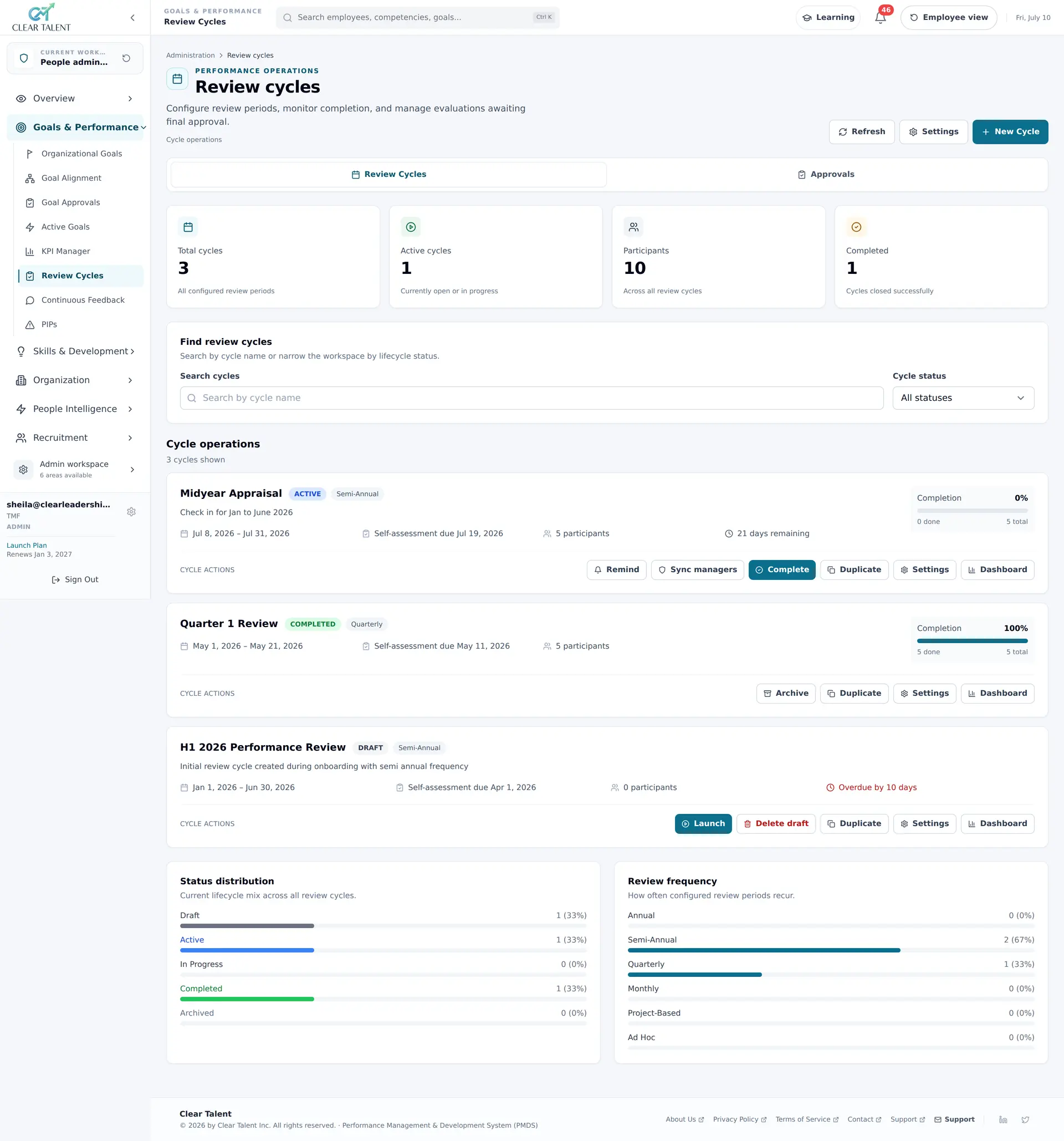
CLEAR Talent supports the combination above rather than a single method. Each review cycle runs through self-review, 360° input and manager review to calibration and a final rating, on review templates and rating scales you configure. SMART goals, OKRs and weighted KPIs sit on one platform, and each competency in the library carries behavioural anchors, proficiency levels and evidence requirements, with scales from three to seven levels. Goal achievement, competency ratings and 360° feedback combine into one composite rating, with each part still visible beneath it.
360° feedback is anonymised within each rater group, with minimum-rater thresholds enforced. The performance journal lets managers record observations through the year, tagged to competencies, so the evidence is there when the review opens. At calibration, heatmaps and outlier flags show where managers read the scale differently, forced-distribution simulations are an optional guardrail rather than a requirement, and every rating change is written to the audit trail.