Product update
How to read a competency rating: dates, ties and what to develop first
A competency rating is a summary of a judgement made on a particular day. What to check before you act on one — and what the latest release changes for managers and employees.
By the CLEAR Talent team10 min read
Key takeaways
- Read the date before the rating. An assessment describes the person on the day it was made, not today.
- A tied rating is information, not a rounding problem — it tells you the scale could not separate two things, and somebody still has to choose.
- A development plan with six priorities has none. Rank the gaps and act on the two or three that matter most for the role.
- Proficiency in the current role and readiness for the next one are different questions and deserve different evidence.
A competency rating looks like a fact. A level, a label, perhaps a colour — and a manager with twenty minutes before a one-to-one reads it as one. But a rating is a summary of a judgement that somebody made on a particular day, against the evidence they had at the time. Most of what goes wrong with competency data goes wrong in the gap between the summary and the judgement behind it.
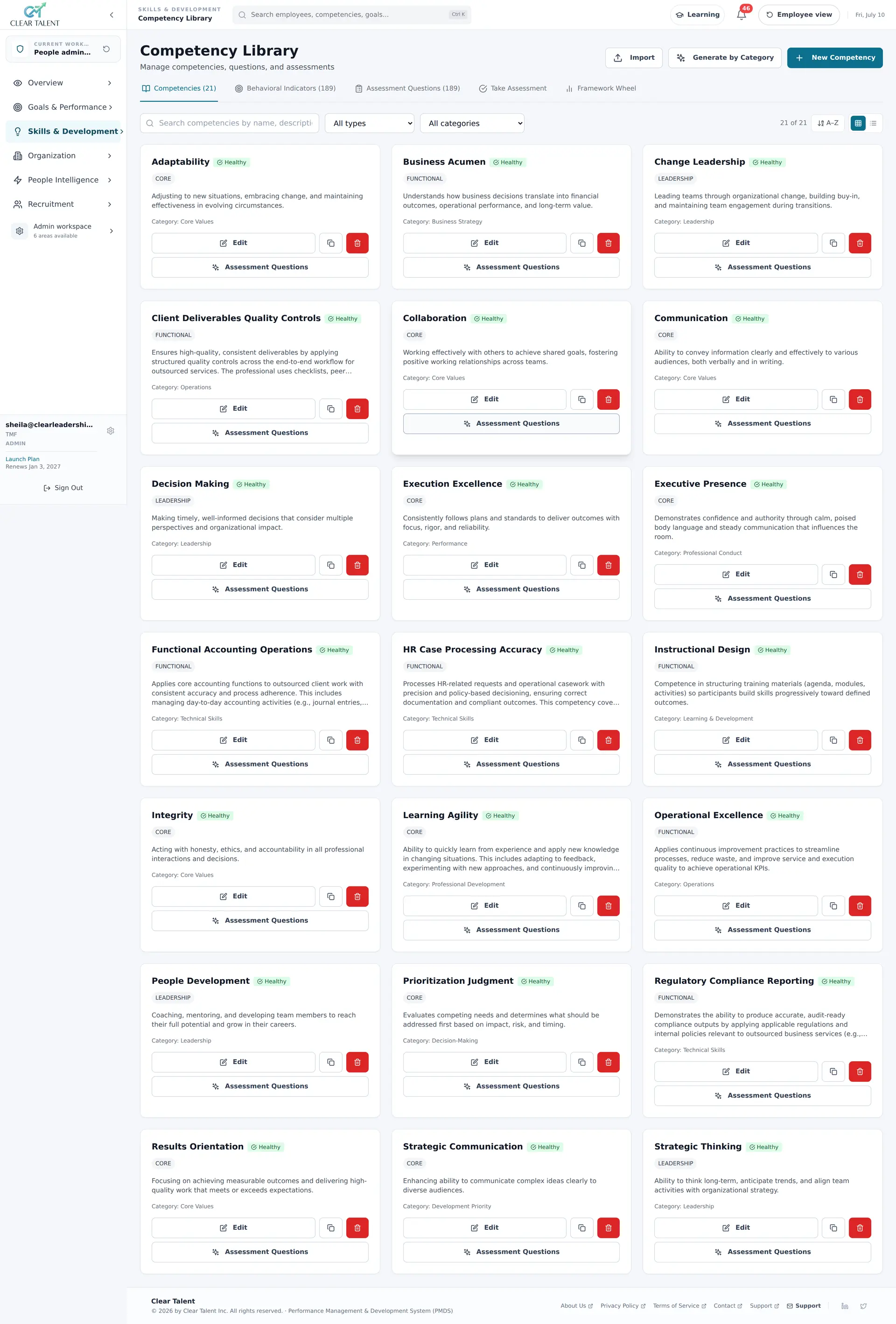
The latest CLEAR Talent release is mostly about that gap. The competency cards managers work from have been refined, along with the assessment dates on them; tied ratings are explained more clearly; development actions are prioritised for the manager; and the manager and employee views of competencies have both been reworked. The same release redesigns the succession intelligence workspace and tightens access to it. All of it is live. This article covers what changed and, more usefully, the questions those changes are there to help you ask.
A rating is a summary, not the record
Open any competency profile and the first thing you see is the conclusion: this person is at level three for stakeholder management, level four for planning. What you do not see, unless the screen is built to show it, is everything that conclusion rests on — who made the assessment, when, against which role’s expectations, and with what evidence in front of them.
That matters because ratings travel. A level recorded in a spring review turns up in an autumn talent review, in a development conversation, and in a succession discussion about a role the person was never assessed against. Each time it is read as though it were current and as though it answered the question now being asked. Often it is neither.
The habit worth building, for managers and for HR, is to treat the rating as the start of the reading rather than the end of it. Three questions do most of the work: when was this assessed, how does it compare with the ratings next to it, and what should happen because of it.
Ask when it was assessed
Capability moves. Someone who was new to a responsibility at their last assessment may have had six months of practice since; someone rated strongly on a skill may not have used it since their role changed. A rating with no visible date invites the reader to assume it is recent, and the assumption is usually generous.
Dates also explain disagreements that otherwise look like inconsistency. Two competencies on the same profile may have been assessed in different periods, by different people, under different expectations. Set side by side without their dates they read as one coherent picture. With their dates they read as what they are: observations taken at different times.
This is what the refined manager competency cards address. The release reworks the cards a manager sees for their team and the assessment dates on them, so the question of when a judgement was made is answered where the judgement is shown rather than somewhere a manager has to go and look.
An undated rating is read as a current one. Put the date next to the level and the reader does the rest.
In practice, the date tells you what to do next. A recent assessment is something to act on. An old one is something to refresh before you act — and noticing the difference takes seconds when the date is in front of you.
What a tied rating is telling you
Rating scales are short on purpose. Five levels are easier to describe, easier to agree on and easier to apply consistently than fifteen. The cost of a short scale is that ties are common: several competencies land on the same level, or two views of the same competency come out equal.
A tie is easy to misread in either direction. Some readers treat it as agreement and stop asking questions. Others treat the order in which tied items happen to be listed as a ranking, and conclude that the first one is the stronger or the more urgent. Neither is what the data says. A tie says only that the scale could not tell the two apart.
That is useful to know, because it marks the place where a person has to decide. If three competencies sit at the same level and only one can be the focus this quarter, the scale will not choose for you; the role, the team’s priorities and the employee’s own aims will.
The release clarifies how tied ratings are presented on competency cards, and includes fixes that make the cards themselves more stable. The intent is simply that a tie should look like a tie, so that nobody reads an order into it that the assessment never contained.
Decide what to develop first
Most competency assessments produce more gaps than anyone can work on. That is not a failing of the person; it is what happens when a role is described honestly and someone is measured against all of it. The failure comes afterwards, when every gap becomes a development goal and the plan has six priorities, which is to say none.
Prioritising is a judgement about the role, not arithmetic on the ratings. The largest gap is not always the one that matters most: a small shortfall in something the role depends on every day outranks a large one in something it touches twice a year. And a gap that reflects no opportunity to practise calls for an assignment, not a course.
- Importance to the role
- Start with the competencies the role, or the next role, leans on hardest. A gap there costs more and closes faster, because the work itself provides the practice.
- Size of the gap
- The distance between the current level and the level the role requires. Useful for ordering gaps of similar importance, misleading as the only criterion.
- How current the evidence is
- A gap recorded a long time ago may already have closed. Check the assessment date before building a plan on it.
In CLEAR Talent, a competency assessment already drafts an individual development plan around the competencies most important for the next role, ranked by current gap. This release applies the same thinking on the manager’s side: competency development actions are now prioritised for the manager, so the view answers “what should I do first?” as well as “what could be done?”.
The prioritised list is a starting point for a conversation. The manager and the employee still decide what goes into the plan, and an employee who wants to grow in a different direction from the one the data suggests has told you something no rating can.
Manager and employee: two views of one record
A competency record has two regular readers who need different things from it. The manager is looking across a team: who is where, what is out of date, what needs doing next. The employee is looking at themselves: what is expected, how they were assessed, and what they are supposed to do about it.
When both read the same screen, one of them is badly served — usually the employee, who is shown a management summary of themselves. This release refines the competency experience on both sides, the manager’s and the employee’s, instead of treating one as a cut-down copy of the other.
It also includes a correction to the self-review workflow. Self-review is where most cycles begin, and it works only if what the employee records is kept as their account. A self-rating is a valuable input and a good way to open the conversation; it becomes comparable data when a manager or assessor rates against the same descriptors and the two views are held apart and compared, not blended into one number.
Readiness is a different question from proficiency
A competency rating answers “how well does this person do this, in the role they hold?” Readiness answers “how close is this person to what a different role requires?” The inputs overlap and the questions do not. Someone can be fully proficient in their current job and still sit two capabilities short of the next one.
Because readiness is derived from competency data, it inherits every weakness of that data. An undated rating produces an undated readiness judgement. A stale one produces a confident statement about a person as they were. That is why the points above matter more in a succession discussion than in a review: the evidence is being used to predict, not to describe.
Three changes in this release sit on that boundary. Competency readiness has been corrected. The succession intelligence workspace has been redesigned, and access to it has been hardened. And candidate discovery in succession has had fixes that stabilise eligibility and handoff.
The access change deserves a sentence of its own. Succession data is among the most sensitive material an HR platform holds: who is being considered, for what, and how ready they are judged to be. Who can open that workspace is a policy question as much as a technical one, and it is worth confirming that the people with access today are the people your policy says should have it.
Proficiency describes the role someone holds. Readiness predicts a role they do not hold yet. Do not let one stand in for the other.
Product update: comparing succession candidates side by side
What to check before your next review conversation
None of this needs a project. It needs ten minutes with the record before the conversation rather than during it.
Read the assessment dates
For each competency you intend to discuss, note when it was last assessed. Where the date is old or the role has changed since, treat the rating as a question to reopen, not a finding to present.
Look for ties and decide what breaks them
Where several competencies sit at the same level, decide in advance which matters most for the role. Say why in the conversation, so the employee hears a reason and not just a ranking.
Pick two or three development actions
Start from the prioritised actions, then check them against what the employee wants and what work is actually available to practise on. Give each one an owner and a date.
Compare the self-review with your own assessment
The differences are the agenda. Where the two views diverge, ask what evidence each of you was looking at before discussing who is right.
Keep readiness separate
If the conversation turns to a future role, say which role, and be clear that readiness for it is a separate judgement from this period’s ratings.
Confirm who can see succession data
Before the next talent review, check that access to the succession workspace matches your policy on who may see candidate and readiness information.
A better card does not make the judgement for anyone. What it does is put the date, the tie and the next action in front of the person making it — which removes the most common reason a sound assessment leads to a poor decision: it was read too quickly, by someone who could not see what it was resting on.