Talent Management Software That Connects Performance, Skills and Succession
Most organisations already run reviews, keep a competency framework, write development plans and hold a succession list. The trouble is that each one lives in its own document, built from its own evidence. CLEAR Talent puts them on one platform and one competency framework, so the rating from a review is the same data that drafts a development plan and informs who is ready for a critical role.
- Reviews, skills, IDPs & succession
- Connected
- Languages supported
- 16
- Ava drafts, people decide
- Human-led
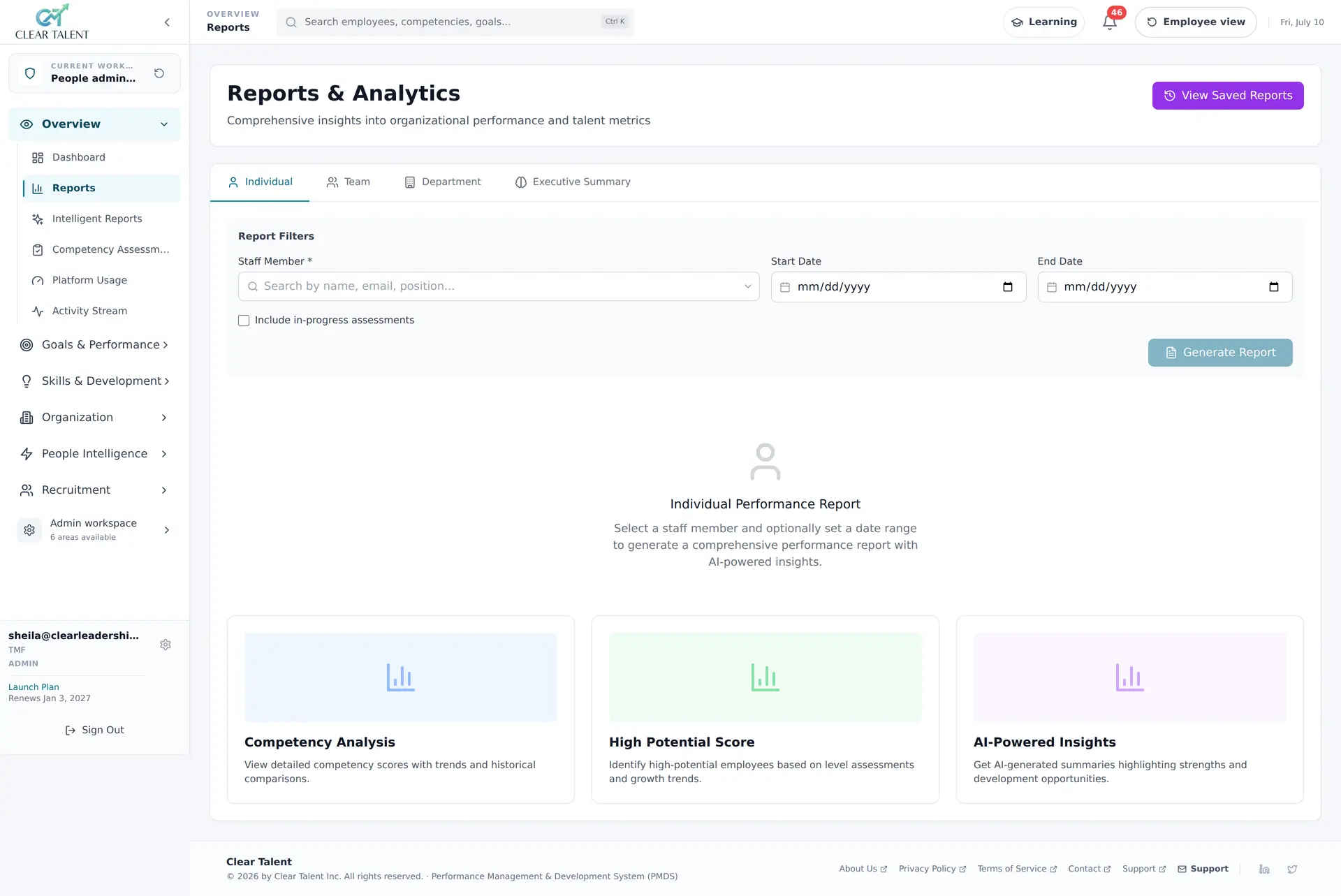
Talent management, from the first goal to the next role
Talent management is usually drawn as a lifecycle that starts with a job advert and ends with an exit interview. CLEAR Talent covers the part of that lifecycle where most of the judgement happens: what someone is asked to deliver, how well they deliver it, which capabilities they still need, and whether they could step into a bigger role.
It does not cover recruitment or applicant tracking, and it does not run payroll, time off or the core employee record. Those stay in the systems you already have. If buying hiring and performance from one supplier matters more to you than depth in assessment and development, a broader HR suite may be the better fit, and it is worth knowing that before a demo rather than after one.
Four talent processes, one competency framework underneath
Each of these has its own page with the detail. What matters here is that they read from, and write to, the same record.
Performance
Goals that cascade from organisation objectives, KPIs, continuous check-ins, anonymised 360° feedback and review cycles with calibration, combined into one rating a manager can explain.
Competencies
One library of competencies with behavioural anchors and three to seven proficiency levels, role-specific target levels, and ratings that can be set to require evidence.
Development
Individual development plans drafted from the competencies that matter most for the role, ranked by the size of the gap, with owners, due dates and monthly check-in prompts.
Succession and the 9-box
Readiness ratings for critical roles, a 9-box grid with configurable axes and an audit log of every move, and dashboards that flag roles with fewer than two successors.
How one set of evidence moves through the talent cycle
The value of a connected platform is not that four screens share a login. It is that nobody has to re-key, re-interpret or re-argue the same evidence at each step.
- 1
Define what each role needs
Each role gets the competencies it requires and the target level for each, described as observable behaviour. That definition is reused by every step that follows.
- 2
Assess and review against it
Self-review, manager review and 360° feedback rate the same competencies on the same scale, alongside goal and KPI scores. Calibration compares ratings across managers before they go final.
- 3
Turn the gaps into a plan
The assessment drafts a development plan around the largest gaps that matter most. The employee and manager edit it together, and the next assessment re-scores the same competencies, so you can see whether a gap closed.
- 4
Decide who is ready for what
Readiness for a critical role is read from the same competency ratings, performance trend and 360° input — "ready now", "ready in 1–2 years", "ready in 3+ years" — each with the specific gaps that stand in the way.
What changes when the talent processes share a record
When reviews, development and succession run in separate places, every talent conversation starts with an argument about whose numbers are right. The succession list was compiled from last year’s ratings, the development plan was written before the latest 360°, and the competency framework in the policy document is not quite the one managers rate against.
Running them on one framework removes that argument. A talent review opens with the same ratings, evidence and development history the manager saw in the review, a high-potential conversation can point at the competencies behind it, and a successor’s development plan is aimed at the gaps that stand between them and the role, not at a generic leadership course.
Ava does the drafting across the cycle; people make the calls
Ava, the AI assistant inside CLEAR Talent, takes on the work that slows every talent process down: she drafts review narratives from goal scores, competency ratings, 360° feedback and check-in notes, consolidates 360° input into strengths, development areas and a suggested focus, and prompts a manager before submission when a rating pattern may indicate gender, recency or leniency bias.
None of that is a decision. Every Ava output is labelled, editable and logged, the manager accepts, amends or rejects it, and Ava can be switched off per review cycle, team or module. Your employees’ data is never used to train models for other customers.
Where to start, and what each plan includes
A talent platform rarely goes live in one step, and it does not need to. Starting with the competency framework and one review cycle gives every later process something to read from; development plans follow from the first assessments, and succession builds on the ratings and plans that already exist. The rollout itself is scoped with each organisation before work begins.
Not every module sits on every plan. Talent & Succession Planning is one of the modules the quoted Enterprise plan adds, so check which plan covers the talent processes you intend to run before you scope the rollout, and raise anything unclear in the demo.
Built to sit beside your HRIS, with the controls people data needs
There is no prebuilt connector to a named HRIS. Organisation structure, goals and ratings come in through CSV and Excel bulk import or the API, and records export to CSV, Excel or PDF on every plan.
Role-based access decides who sees which reviews, plans and succession data; sign-ins, exports and rating changes are audit-logged; and subject access request exports and right-to-be-forgotten workflows support your GDPR programme. The platform is hosted on Google Cloud Platform.
Related solutions
- Performance management softwareGoals, 360° reviews, competency assessment and development plans in one connected platform.
- Competency management softwareA reusable competency library with behavioural anchors, proficiency levels and skills-gap dashboards.
- Employee development and IDP softwareTurn competency gaps into individual development plans that managers track at every check-in.
- Succession planning softwareIdentify and develop successors for critical roles with 9-box grids, readiness ratings and IDPs.
Frequently asked questions
Can't find what you're looking for? Talk to a specialist →
What is talent management software?
Does CLEAR Talent include recruitment or payroll?
How is talent management software different from performance management software?
Is every talent management capability on every plan?
How does Ava fit into talent management?
How does our existing people data get into CLEAR Talent?
See talent management software in action.
Book a live demo with a CLEAR Talent specialist. No generic slide deck—just the platform and a conversation focused on your scenario.