Employee engagement & pulse survey software: where CLEAR Talent fits
A straight answer first: CLEAR Talent does not run engagement or pulse surveys. It is the performance and development platform that sits beside your survey tool — 1-on-1s, goal check-ins, structured feedback and a performance journal — so that what a survey tells you about a team turns into conversations, goals and evidence for individual people. This page covers how the two connect, how to keep survey anonymity and GDPR in order, and question sets you can use on both sides.
- Scheduled, summarised, followed up
- 1-on-1s
- Minimum-rater rules on 360° feedback
- Thresholds
- Access-request exports and erasure
- DSAR
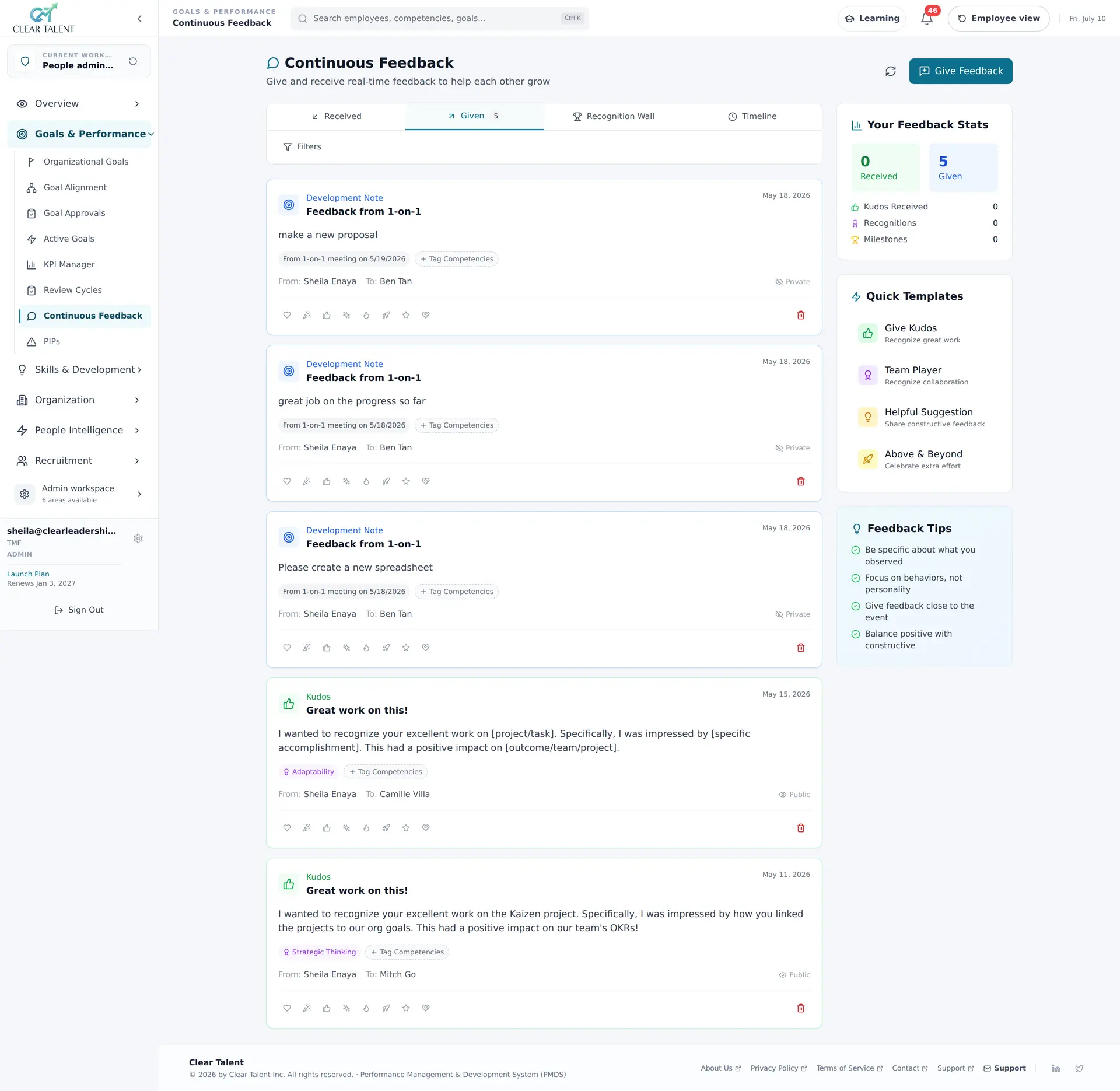
CLEAR Talent is not a survey tool — and what it is instead
If an engagement or pulse survey is a required part of this purchase, CLEAR Talent does not cover it and you will need a dedicated survey tool. We would rather you knew that on the first page you read than in the third demo. Several platforms combine surveys with performance management, and our comparison pages name them and say where each one fits.
What CLEAR Talent does cover is the part a survey cannot: the record for each person. One-on-ones, check-ins against goals, development notes, kudos, a performance journal and anonymised 360° feedback build that record through the year, and it is what the formal review is assessed from. Most organisations that run surveys still need that record; the two tools answer different questions.
What a pulse survey measures, and what it cannot
Engagement and pulse surveys ask how people feel about the organisation. Feedback and check-ins ask how one person is doing and what happens next. Mixing them up is how surveys end up being read as performance data, which they were never designed to be.
A survey reports on groups
Results are read for a team, a department or the whole organisation, and only once enough people have answered to keep individuals anonymous. A good survey tells you where to look; it does not tell you about any one person.
A check-in records an individual
A 1-on-1, a goal check-in or a development note is about one named person, agreed with them and kept on their record. It is evidence for their review, which is exactly why it can never be anonymous.
Feedback sits in between
360° feedback is about one person but collected from several raters, so it is anonymised within each rater group. That is the closest CLEAR Talent comes to survey-style input, and it is structured against the competencies in the role profile rather than gathered as open text.
How pulse survey results feed performance and goal data
There is no connector between a survey tool and CLEAR Talent, and survey responses are not imported into it. The link is what managers do with the results. This is the sequence that keeps it useful without breaking anyone’s anonymity.
- 1
Read the results at the level the survey reports
Take the team or department result as it comes out of your survey tool. Do not try to work out who said what, and do not carry individual comments into anyone’s performance record.
- 2
Take the theme into the next 1-on-1s
If workload or clarity of priorities scored low, the manager raises it as a team finding in the next round of 1-on-1s. Each person’s 1-on-1 in CLEAR Talent carries a summary of previous sessions and suggested next steps, so the follow-up is still there next month.
- 3
Record what was agreed, privately if it needs to be
Actions agreed with an individual are captured as a development note linked to that 1-on-1, which can be kept private. Recognition for someone who helped fix the problem can go on record as kudos, tagged to the competency it shows.
- 4
Turn team actions into goals with check-ins
Where the fix is a piece of work — clearer handovers, a reworked rota, a delivery process — it becomes a goal linked to the organisation objective it serves. Check-ins keep it current, and goals falling behind are flagged from pace and check-in signals while the quarter is still running.
- 5
Compare at team level, never person by person
Before the next survey, export goal and review data as CSV or Excel and set it beside the new results for the same teams or departments. Join the two only at a group size your survey tool would itself report, or the comparison can identify people.
Feedback and check-ins: what CLEAR Talent actually ships
1-on-1s that remember the last one
Managers schedule 1-on-1s from their own schedule, which tracks upcoming, completed and cancelled sessions, and the team overview flags anyone who still needs a next one booked.
Goal check-ins
Check-ins against each goal keep progress current, with at-risk flags from pace and check-in signals and goals linked to the organisation objectives above them.
Development notes and kudos
Coaching is recorded as development notes that can be kept private; kudos recognise good work, can be tagged to a competency or value and can be made public.
A performance journal
Managers log observations, achievements and incidents as they happen, each tagged to the competencies it evidences, and refer to it when the person is next assessed.
Anonymised 360° feedback
Rater groups across managers, peers, direct reports and stakeholders, anonymised within each group, with minimum-rater thresholds and input structured against role competencies.
On the web and on mobile
Check-ins and feedback work in native iOS and Android apps as well as the browser, with push notifications and stage reminders so the rhythm does not depend on someone chasing.
Anonymity people actually believe
People answer a pulse survey honestly only if they are sure they cannot be identified. Whichever survey tool you use, settle these rules before the first survey goes out rather than after a small team’s results land on a manager’s desk.
Set a minimum group size before results are shown
Agree the smallest group the tool will report on, and hold back any team, department or filter below it. Put the number in the launch communication so employees know it exists.
Watch combinations of filters
A department that clears the threshold can fall below it once it is sliced by location, tenure or grade. Apply the minimum to every cut of the data, not only to the top-level teams.
Treat free-text answers with care
Writing style, a named project or a specific incident can identify someone even in a large group. Decide who reads raw comments, and whether managers see themes rather than verbatim text.
Keep survey results out of individual records
Survey answers should never be used as evidence about one person. In CLEAR Talent the performance record is built from 1-on-1s, check-ins, the journal and 360° feedback — and 360° raters are anonymised within their group, minimum-rater thresholds apply and managers see only aggregated group data.
GDPR for survey data and for the performance record
Survey responses that can be linked back to a person — directly, through an employee identifier the vendor holds, or by combining filters — are personal data under the GDPR, and pseudonymised data still counts. Only genuinely anonymous, aggregated results fall outside it. Before launch, ask your survey vendor for its data processing agreement, where responses are held, how long they are kept, and who on their side and yours can see identifiable data. This is general information, not legal advice; your data protection officer or counsel should confirm what applies to you.
On the performance side, CLEAR Talent supports data subject access request exports and right-to-be-forgotten workflows, so a DSAR or an erasure request can be handled from the platform. Access is role-based across administrator, manager and employee roles, and sign-ins, exports, rating changes and consent records are audit-logged against the user responsible. CLEAR Talent runs on Google Cloud Platform; if you need data held in a particular region, regional requirements are agreed for each deployment, and a DPA is available on request.
Questions to use in your survey and in the follow-up
Illustrative starting points to adapt, not a validated survey instrument. The first set belongs in your survey tool; the other three are for the conversations and check-ins that follow, which is where CLEAR Talent comes in.
A five-question pulse survey (in your survey tool)
Rate 1–5: “I understand how my work this month connects to my team’s goals.” “My workload over the last two weeks has been manageable.” “I have had a useful conversation about my development in the last month.” “I would feel comfortable raising a concern with my manager.” Open: “What one change would make next month easier?”
Following up a team result in a 1-on-1
“The team said priorities feel unclear — does that match your experience?” “Which piece of your work is most affected?” “What would you change first?” “What do you need from me to make that happen?” “How will we know in a month whether it has improved?”
A monthly check-in
“What went well since we last spoke?” “Where are you on each of your goals, and is any of them at risk?” “What is blocking you?” “What feedback have you had, or would you like?” “What is one thing to focus on before our next 1-on-1?”
Checking an action goal at quarter end
“Did the change we agreed get made?” “What evidence do we have that it helped?” “Is the goal still the right one, or should it be revised or closed?” “Who should be recognised for the work?”
Related solutions
- Continuous performance management1-on-1s, goal check-ins, feedback and a performance journal that carry into the year-end review.
- 360-degree feedback softwareAnonymised peer, manager and direct-report feedback, structured against the competencies that matter for each role.
- OKR and goal-setting softwareCascade organisation objectives to every individual goal, with enforced parent-goal linkage and at-risk flags.
- Employee development and IDP softwareTurn competency gaps into individual development plans that managers track at every check-in.
Guides, walkthroughs and more
Frequently asked questions
Can't find what you're looking for? Talk to a specialist →
Does CLEAR Talent include employee engagement or pulse surveys?
Can survey results be imported into CLEAR Talent?
What anonymity threshold should a pulse survey use?
Are pulse survey responses personal data under the GDPR?
What is the difference between a pulse survey and a check-in?
See employee engagement & pulse survey software in action.
Book a live demo with a CLEAR Talent specialist. No generic slide deck—just the platform and a conversation focused on your scenario.