Retail
Rolling out performance management to a store network
In a store network the rollout and the adoption problem are the same problem. What you configure matters less than whether it can be completed on a phone between tasks.
By the CLEAR Talent team5 min read
The organisation in this example
- Setting
- A multi-site retailer with stores, distribution and head office
- Constraint
- Colleagues with no desk, no company laptop and no forty spare minutes
- Owner
- HR working with regional operations
- Starting point
- A process that completes in head office and almost nowhere else
Decisions that shape the rollout
- Which positions get their own role profile, and which share one
- What a colleague can realistically complete on a phone in a short break
- What an area manager sees compared with head office
- Which languages the network actually needs on day one
Store rollouts tend to fail on logistics rather than on design. The framework is sound, the training is delivered, and then completion rates come back concentrated in the places with desks — leaving a performance record that is most thorough for the colleagues who needed it least.
That makes a store rollout different from an office one in one specific way: the binding constraint is not what the process should contain, it is what a colleague can finish on their own phone in the gaps a shift actually leaves. Almost every other decision follows from taking that seriously early.
Adoption is the rollout
In most sectors adoption is a change-management workstream running alongside the implementation. In retail it is the implementation. A framework that is beautifully specified and completed by a fraction of the estate has not been rolled out; it has been announced.
CLEAR Talent puts the same process on a phone: native iOS and Android apps with biometric sign-in, push notifications when something needs attention, and offline support for stockrooms and sites where the signal drops. That is the baseline the rest of the design has to respect.
A framework only head office completes has not been rolled out. It has been announced.
Decide these before the first import
How many role profiles you genuinely need
Sales assistant, supervisor, store manager, distribution and head office each get their own required competencies and target levels, built from reusable templates. The temptation is to create a profile per job title; the useful version creates one per genuinely different standard.
What fits in a short break
Decide the scope of what a colleague completes themselves versus what the manager brings to the conversation. Configurable review templates and rating scales mean a store-level assessment does not have to carry the same weight of fields as a head-office one.
Who sees what
Access is role-based, so area and regional managers work within their own reporting line while head office gets organisation-level reporting. Agreeing this early avoids the awkward version where a regional manager finds out what they cannot see during their first review week.
Which languages, from the start
CLEAR Talent supports 16 languages, and AI-generated feedback, summaries and recommendations are delivered in the language each employee prefers. Deciding the day-one set is cheaper than retrofitting it after a region has already formed an opinion of the tool.
What gets built
- A central competency library
- Define each competency once, with behavioural indicators at every proficiency level, then reuse it across every store, region and role. Ava can draft role-specific frameworks from your role and organisation context for your team to edit and approve.
- Role profiles per position
- Required competencies and target levels per role, so the same position is assessed against the same behavioural indicators and the same expectations in every store.
- The estate, modelled properly
- Locations, departments and reporting lines are first-class concepts, with multi-entity support for groups running more than one trading brand.
- Goals that reach the shop floor
- Strategic Linked Goals cascades an organisational objective down through region, store and individual, with a KPI library holding reusable, role-aware templates, configurable weightings, performance bands and guardrails.
Start in one region, and not at peak
Quarterly and annual cycles run side by side, which matters when the year has a peak. Use that: run the first cycle in one region through a quieter trading period, where a store manager has the attention to tell you what is wrong with the form rather than simply not completing it.
Do the bulk import before the cycle rather than during it. Bulk import and staff transfers are designed to keep the structure current through seasonal hiring and internal moves, but a first cycle running against a half-loaded org chart produces feedback about the org chart instead of about the process.
The output you want from a first region is not a completion percentage. It is a short list of the fields store managers skipped, which tells you what to cut before the estate sees it.
Running it across the estate
- The whole network, and one store
- Reports run at individual, team and organisation level, with AI-generated summaries that turn ratings, evidence and feedback into a narrative. One click exports to PDF or Excel.
- Recognition that does not wait for a cycle
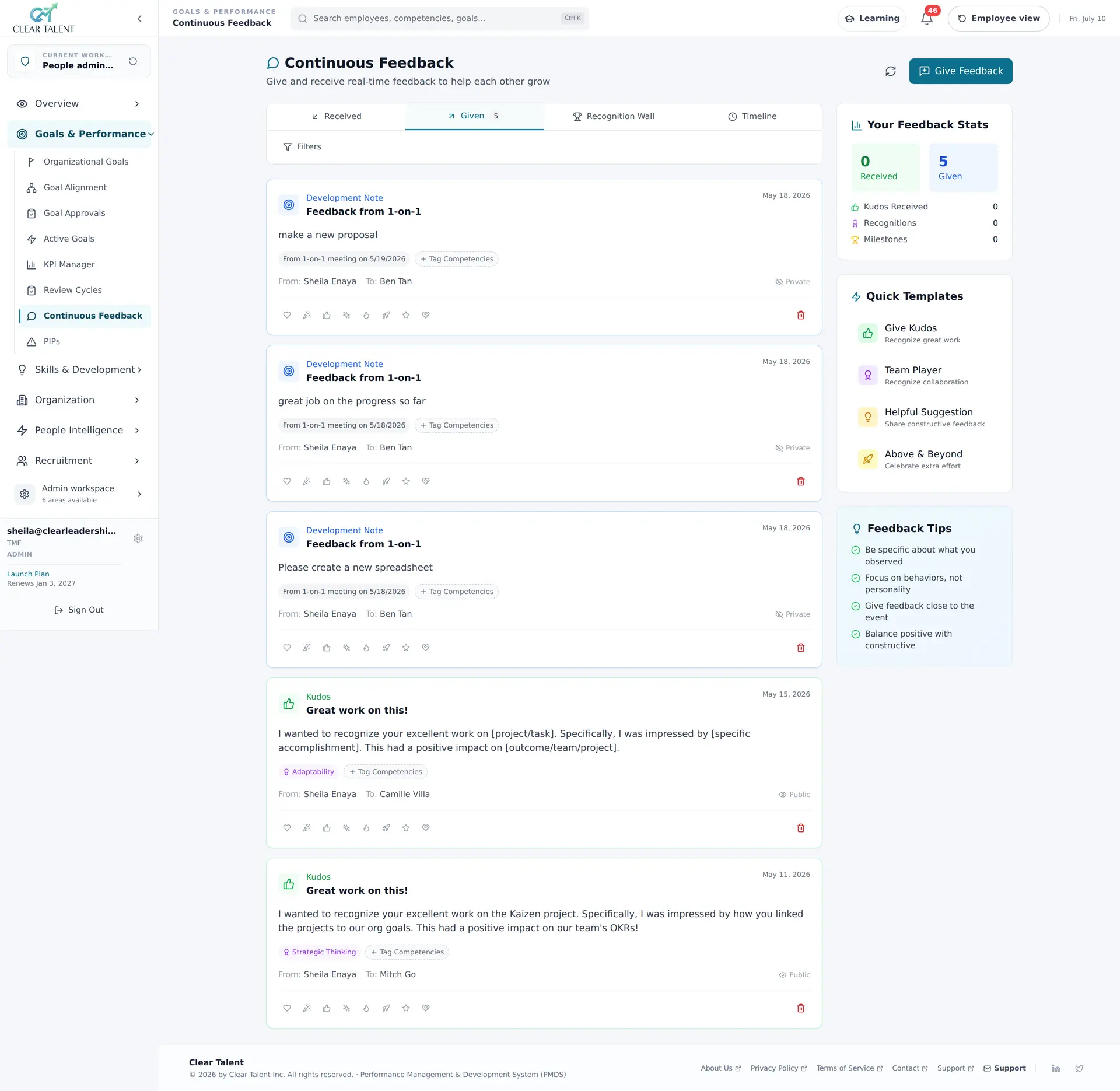
- Structured peer and manager feedback and recognition can be given in the moment and mapped to competencies, which suits a workforce where the review is infrequent but the observable behaviour is constant.
- Early-warning signals
- Ava surfaces attrition and performance risk signals, so a regional manager knows which store to visit next rather than working from the last set of numbers.
- A structure that survives seasonal churn
- Bulk import and staff transfers keep the organisation current as people join, move and leave, and role profiles make expectations explicit from the first shift rather than at the first review.