Product update
Competency assessment reports: completion, distribution and manager trends
Before a competency report says anything about your people, it says something about your process: who was assessed, and by whom. How to read completion and manager trends — and what the latest release changes.
By the CLEAR Talent team9 min read
Key takeaways
- Read completion before results. A report drawn from a half-finished cycle describes the people who finished first.
- Who is missing matters more than how many. Gaps that cluster in one team or one manager’s line skew the whole picture.
- A manager trend is a question for calibration, not a verdict on the manager or their team.
- Small teams produce noisy trends. Look for patterns that persist across competencies and cycles before acting on one.
A competency assessment report is usually read for what it says about people: where the strengths are, where the gaps are, which teams need support. But every result in it was produced by a process — somebody was assessed, by a particular manager, before a particular deadline — and the report says just as much about that process. Read the people findings without reading the process first and it is easy to present a conclusion the data cannot carry.
The latest CLEAR Talent release refines the competency assessment report around three things: completion, distribution and manager trends. All of it is live. This article covers what changed and, more usefully, the order in which to read those three things so that a report supports a decision rather than quietly distorting one.
Read completion before you read results
The first question to ask of any competency report is not “what does it show?” but “who is in it?”. Assessment cycles run through stages — self-assessment, assessor review, calibration, final rating — and at any point before the cycle closes, some people will have finished and some will not. A report run mid-cycle is a report on whoever was quickest.
That matters because the people who finish first are rarely a random sample. Teams with settled managers and clear expectations tend to complete early. Teams that are stretched, newly formed or between managers tend to complete late — and they are often the teams where the capability picture is most uncertain. An early report can make the organisation look stronger, or more uniform, than it is.
So read the completion figure, and then read beneath it. A high overall figure can hide one department that has barely started. And a rating that has been started but not finalised is not the same as one that has been through assessor review and calibration; know which stage the results you are about to quote have reached.
An incomplete cycle does not produce a smaller version of the true picture. It produces a different picture, drawn by the people who finished first.
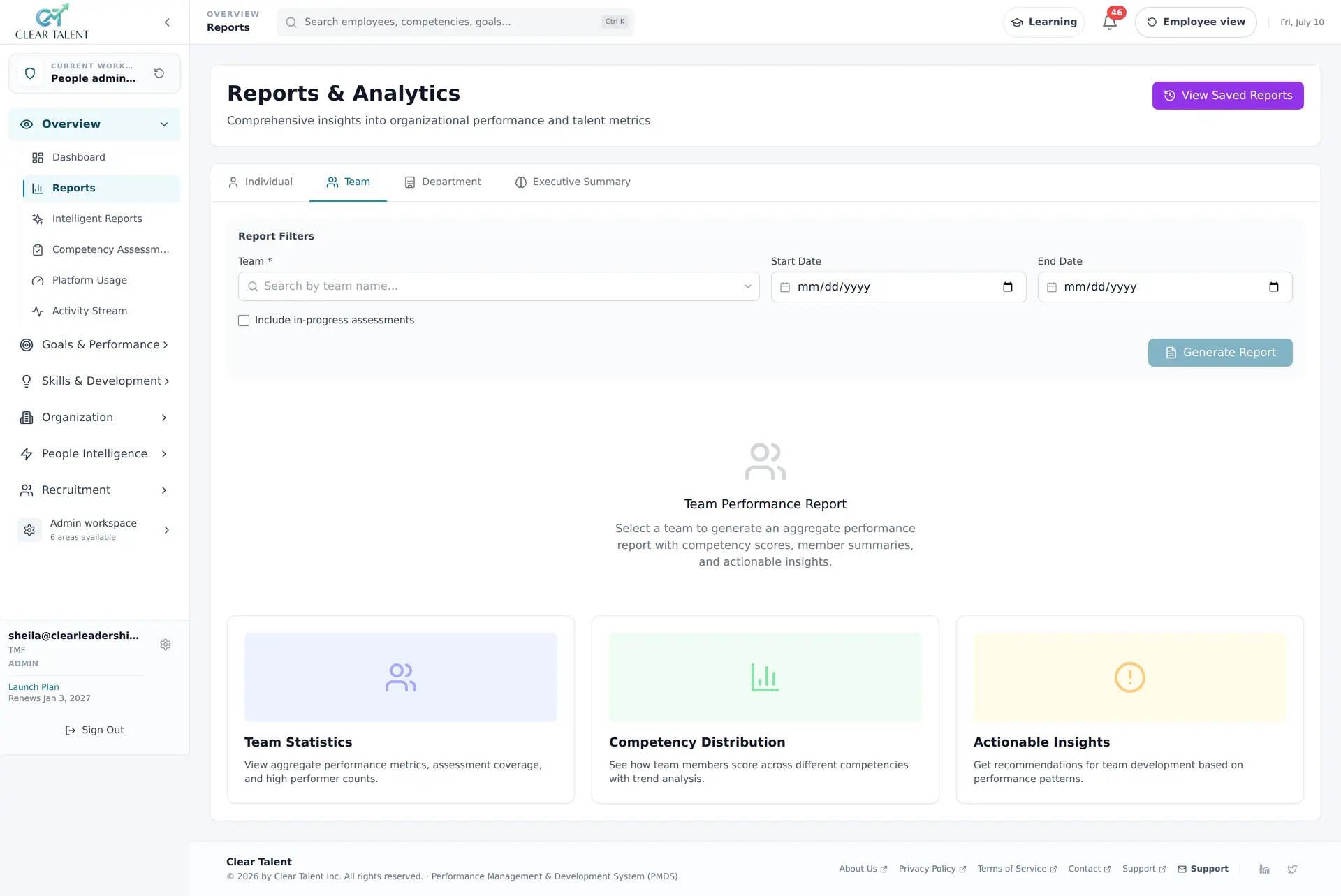
CLEAR Talent already shows assessment coverage alongside results on the team report — how many people have actually been assessed — and sends automated reminders on whatever is outstanding in a stage. Completion is the condition for reading everything else; treat it as the first line of the report, not a footnote.
Then read the distribution, not the average
Once you know who is in the report, look at how their results are spread across the levels. An average level per competency is easy to present and hides almost everything: a team where everyone is solidly competent and a team split between strong and struggling performers can share the same number and need entirely different responses.
Read the shape against the role. A cluster at the top of the scale for a competency that is new to most of the team is worth questioning. So is a wide spread for something everyone does every day — and that second pattern is often less about the team than about how differently its assessors used the scale, which is where manager trends come in.
What a manager trend can and cannot tell you
Most competency ratings are given by a line manager or assessor, and every rater brings habits to the scale. Grouping results by who gave them makes those habits visible. Three are worth knowing by name.
- Leniency
- One manager’s ratings sit consistently above those of peers managing similar roles. Sometimes the team really is stronger; sometimes the manager avoids difficult conversations by rating generously.
- Severity
- The mirror image: a manager whose ratings run consistently low, often someone who reserves the upper levels for an ideal nobody meets. Their team’s development plans fill up with gaps that may not exist.
- Central tendency
- Nearly everything at the middle level. It feels safe and fair, and it removes the information the assessment was meant to produce — nobody stands out in either direction, so nobody gets the right support.
A trend is not proof of any of these. A manager whose team genuinely is more experienced should rate higher; one who has just inherited a struggling team may rate lower for good reason. Small teams make this harder, because a handful of ratings can move a manager’s pattern a long way. Treat a trend that appears on one competency in one cycle as a prompt to look, and a trend that persists across competencies and cycles as a question that needs an answer.
The point of seeing manager trends is not to grade managers. It is to make sure that two people with the same capability, in the same role, get the same rating regardless of who assessed them — which is the promise a competency framework makes to every employee measured against it.
A worked example: two managers, one role
This is an illustrative scenario, not a CLEAR Talent customer case study.
Imagine an organisation with two teams doing the same customer-facing work under two managers. Midway through the cycle, the report shows the first team well ahead on “resolving complex queries” and the second well behind. The obvious reading is a training need in the second team.
Reading in order changes that. Completion shows the second team is only partly assessed: its manager joined recently and has finished the people they know best. The distribution shows the first team almost entirely at the top two levels, including several people new to the role. And the manager trend shows the first manager rating above the organisation on nearly every competency, not just this one.
None of this proves the first team is weaker than it looks or the second stronger. It does show the comparison is not yet fair enough to fund a training programme on. The sensible next steps are to finish the second team’s assessments, then bring both managers to calibration with examples of what they each count as the top level for that competency.
Taking a manager trend into calibration
Calibration is where a manager trend becomes a conversation rather than a suspicion. A few habits keep that conversation useful.
Compare like with like
Set a manager’s ratings against peers rating the same roles against the same competencies. A trend across different roles may simply reflect different target levels.
Bring evidence, not adjectives
Ask each manager for the examples behind a top or bottom rating. Disagreements about evidence get resolved; disagreements about whether someone is “strong” go in circles.
Agree what each level looks like
Most rater habits come from different readings of the level descriptors. Agree a shared example for the levels in dispute, then revisit the ratings against it.
Change ratings, not just the average
If calibration concludes a manager rated leniently, adjust the individual ratings the evidence does not support. Shifting a team’s numbers to match a target distribution fixes the chart and not the record.
Look again next cycle
Note the trends discussed and check whether they persist. A pattern that disappears after one calibration conversation was a calibration problem; one that returns needs a different response.
In CLEAR Talent, calibration already works from what is in the platform — competency ratings with their evidence, goal scores and structured 360° input — with heatmaps and outlier flags that surface inconsistent ratings across managers before they go final.
What has changed in CLEAR Talent
The main change in this release is the one this article is built around: the competency assessment report has been refined around completion, distribution and manager trends. Those are the three things this article suggests reading, in that order, before quoting a competency result: who was assessed, how the results are spread and whether the person rating made a difference.
The release also includes a security maintenance change. A third-party dependency, proxy-addr, has been pinned to version 2.0.8 to clear a finding that a dependency audit rated critical. It changes nothing about how the product looks or works; it is the kind of routine upkeep that keeps the platform’s dependencies on versions the audit is satisfied with.
Finally, the code behind the rating scale, the report and Multi-Rater interpretation has been reformatted. That is a tidy-up with no change to how any of those features behave, mentioned here only so the release notes are complete.
What to check before you present a competency assessment report
Ten minutes with the report, in this order, before it goes in front of leaders.
Check completion, overall and by team
Note the overall figure, then look for teams or managers well below it. If the cycle is still open, say so on the first slide.
Check which stage the results have reached
Be clear whether you are quoting self-assessments, assessor ratings or calibrated final ratings. They are different documents.
Read the distribution for each competency you will highlight
Look at the spread across levels, not only the average, and question any shape that does not fit the role.
Look at manager trends before comparing teams
If two teams differ, check whether their managers rate differently across the board. If they do, the comparison belongs in calibration first.
Make sure the export says what it is
State the period, population and stage on anything that leaves the platform, so a mid-cycle snapshot is not read as the final position.
None of this makes the decision for anyone. It makes sure that when leaders read a competency result, they are reading something about their people — and not, without knowing it, something about who finished first or who happened to be rating.